
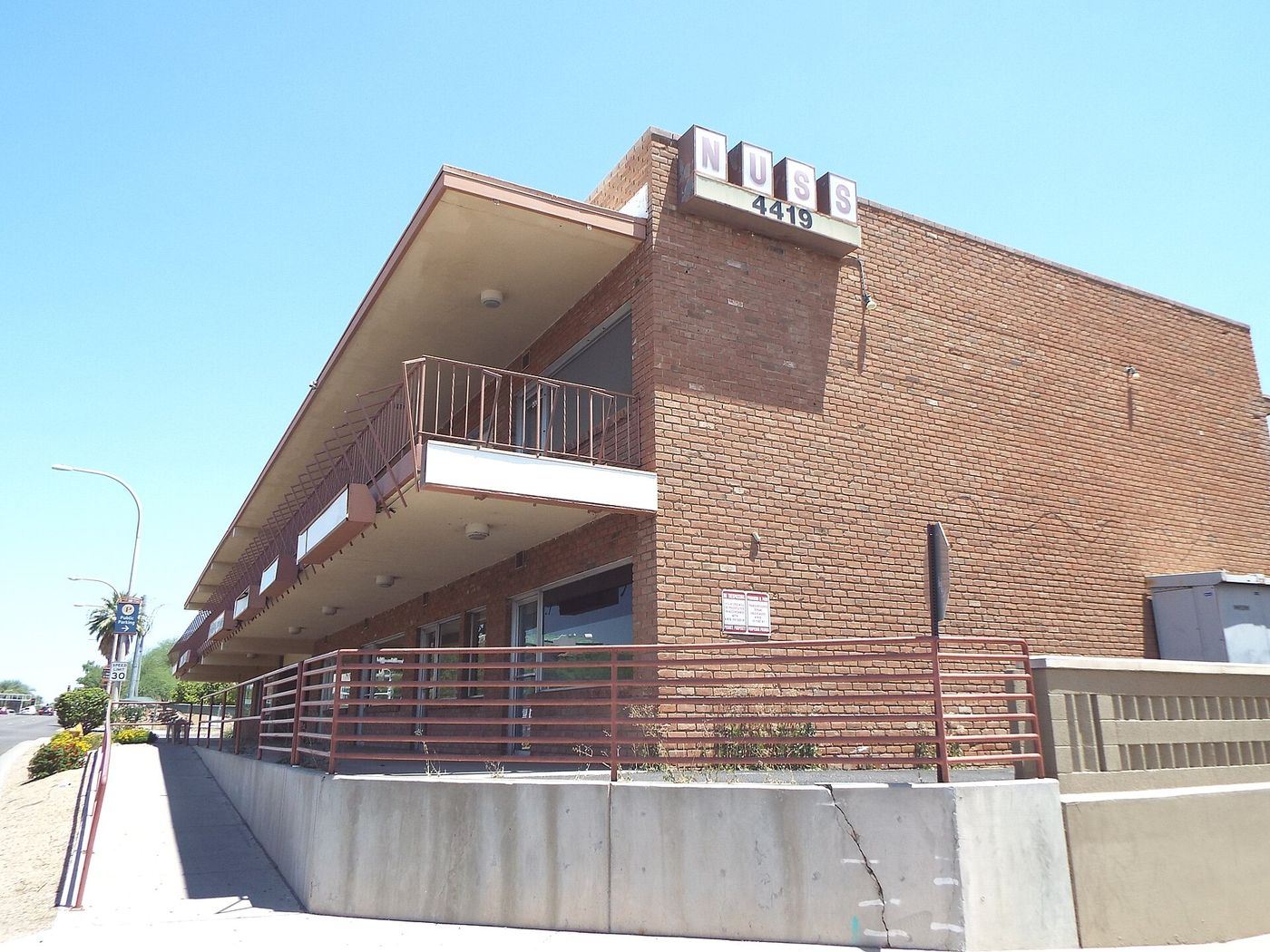
At a glance: The 1960s were Scottsdale’s supernova. Population grew nearly seven-fold; the town became a charter city, stopped new billboards, opened a hospital, a mall, an airport and an architectural landmark of a Civic Center; annexed enormous tracts including McCormick Ranch; and somehow — through citizen planning forums — kept a coherent identity while adding a new neighbor roughly every 80 minutes for ten years.
Growth you could watch happen
Air conditioning, Motorola wages, spring sunshine, and the postwar migration machine all converged, and the numbers went vertical: 10,026 people in 1960; 54,504 at a special census in 1965; 67,841 by 1970. Farmland flipped to subdivisions block by block — citrus one spring, model homes the next. The 1970 Census would rank Scottsdale among the fastest-growing municipalities in the country.

Growth this fast is usually ugly. Scottsdale’s remarkable trick — the thing planners still study — was pairing it with unusually aggressive aesthetic self-government.
1961–62: charter, billboard ban, and taste as policy
Voters approved a home-rule city charter on October 31, 1961 (the governor signed it November 16), giving Scottsdale control of its own destiny just as the boom crested. In September 1962, five months after taking office, the first charter council stopped new billboards: the town had decided its product was the view — desert, mountains, and a stage-set western downtown — and it was not going to rent out that product’s frame. The billboards already standing were allowed to stay, and getting rid of them took a sixteen-year sign fight that the city lost in court in 1978 and won anyway, one redevelopment at a time. The 1962 rule and the Design Review Board of 1965 were the start of Scottsdale’s design-review culture: the same instinct later produced strict sign codes, dark-sky lighting rules, and the desert-preservation politics of the 1990s.
The same year brought City Hospital of Scottsdale on Osborn Road, soon run by the Southern Baptist convention and today HonorHealth Osborn — the boomtown finally had its own beds — and by 1964 sewers had at last reached the southern neighborhoods.
Planning by town meeting
In November 1964 the city invented its most Scottsdale institution: the Scottsdale Town Enrichment Program (STEP), committees of residents who drafted the lists that became policy. The first round reported on January 20, 1965 with a $14.6 million capital program; later rounds, from 1969 into the 1980s, took up height limits, freeways, the greenbelt concept and redevelopment. The first adopted general plan followed in July 1967, seven years after the council rejected a county-drafted one, and voters rewrote the charter that November (see November 7, 1967). When people ask why a city that grew this fast didn’t dissolve into sprawl-anywhere, STEP is a large part of the answer: the residents kept writing the spec.
1965–1968: Gonzales gives the boomtown a heart
In 1965 the city hired Arizona architect Bennie Gonzales to design its government quarter. Voters turned down the first bond that year and approved $2.4 million in 1966, the city bought and cleared the houses of the old barrio on the site (see The Barrio Under the Civic Center), and in 1968 his City Hall and Civic Center Library opened — white, sculptural, adobe-soft modernism organized around shaded courtyards and lawns. It was public architecture that looked like nowhere else in America and exactly like Scottsdale wanted to feel: western, modern, and unhurried. The Civic Center Mall became the town’s living room (and stayed so — renovated and re-opened for events in the 2020s), and the Scottsdale Historical Society, founded by old-timers in 1968, set up to make sure the boom didn’t erase the memory of the farm town.
The annexation race and the 1967 trifecta
Phoenix and Scottsdale spent the decade racing to annex the county land between and around them, and 1967 was Scottsdale’s championship year: the city annexed McCormick Ranch (setting up the great master-planned community of the 1970s), opened Scottsdale Municipal Airport on the old Thunderbird II field (the industrial airpark around it got its first tenant in 1968), and adopted the general plan to govern what came next. The 1960s politics chapter tells how the city governed all of it. The northern land grabs of this era — pushing city limits toward the McDowells — are why modern Scottsdale is 31 miles long.
Commerce kept score too: Los Arcos Mall opened in 1969 at Scottsdale and McDowell with Sears and The Broadway, giving the southern neighborhoods an enclosed, air-conditioned downtown of their own. (Its whole life cycle — regional hub, decline, demolition, rebirth as SkySong in 2008 — is a one-parcel history of American retail.)
What the boom didn’t fix
Growth left two bills unpaid. Old Town’s merchants watched retail energy drain toward the malls — a problem the arts districts would have to solve. And every monsoon, the Indian Bend Wash flooded straight through the new neighborhoods, because the city had built a boomtown across a riverbed. The Army Corps’ answer was a concrete channel; Scottsdale’s counter-proposal — grass — became the epic story of the 1970s.