

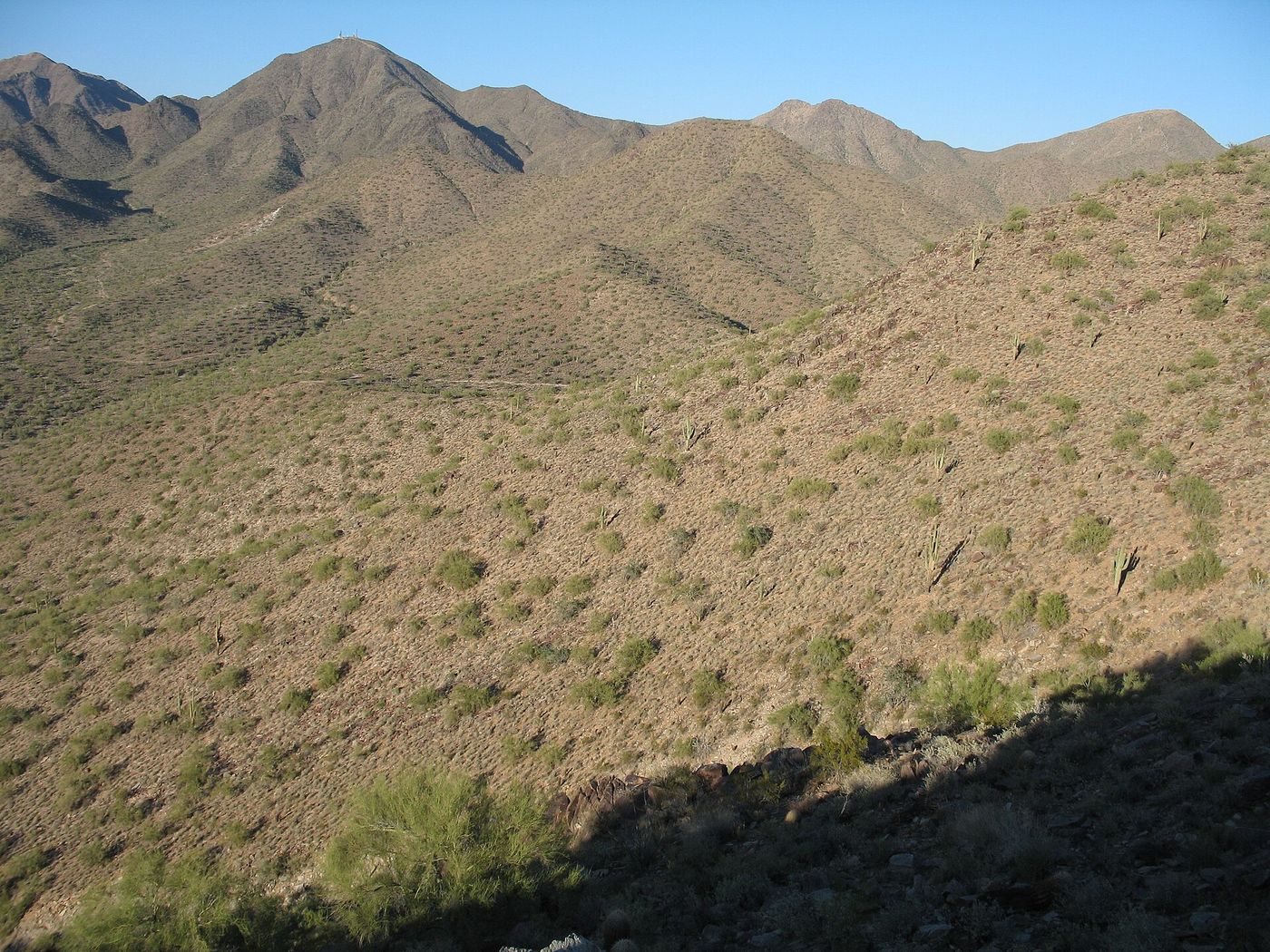
At a glance: Every fast-growing western city eventually watches development march up its signature mountains. Scottsdale is the rare one that stopped it — not with zoning that a future council could undo, but with cash. In 1994 the council created the McDowell Sonoran Preserve and in 1995 voters funded it, beginning what Mayor Sam Campana called “this country’s most ambitious municipal open space program,” even while the city itself grew by 70,000 people. It was also a decade of referendums, in which voters overturned council rezonings, rejected a transit tax and killed a $650 million plan to rebuild downtown around canals.
The rooftops reach the bajada
By 1990 Scottsdale stretched 185 square miles and the growth machine was working through the northern foothills annexed under Drinkwater. Graded pads appeared higher on the McDowells each season. The range wasn’t parkland or forest — it was a checkerboard of private holdings and Arizona State Trust land, which by law had to be sold or leased for the benefit of schools, generally to the highest bidder. Absent intervention, the mountains’ fate was luxury lots with a view of each other.
On November 17, 1990, thirteen residents (hikers, scientists, a homeowners’ association delegate and a city staffer among them) met at the Mustang Library, and in January 1991 two of them, Jane Rau and Karen Bertiger, signed the papers incorporating the McDowell Sonoran Land Trust, with a preposterous mission: persuade a tax-averse boomtown to buy a mountain range at retail. In 1993 the council created a fifteen-member McDowell Mountain Task Force, chaired by the car dealer Virginia Korte, which asked the city to take the lead, find a fair way to pay and set up a standing commission.
1994–1995: the council, then the voters
It turned out the town wasn’t tax-averse about this. In January 1994 the council created a McDowell Sonoran Preserve Commission, and on October 3 it dedicated the first 2,860 acres of city-owned land to the McDowell Sonoran Preserve. On May 23, 1995 voters approved a dedicated 0.2% sales tax to buy land for it, 12,873 to 7,204. The yes campaign, Save Our McDowells, reframed the mountains as infrastructure, the scenery underwriting every resort rate and home price, and pointed out that visitors would pay much of the tax. It was not unopposed: a committee called Citizens Against Constant Tax Increases, chaired by former councilman Ross Dean, warned that the tax “could raise over $1 billion,” and four other former council members called it “a blank check.” The 1990s politics chapter tells both campaigns. (A second tax, 0.15% in 2004, would extend the buying power; a 2018 initiative, Prop 420, later locked the Preserve against development by requiring a public vote for any change.)
The purchases were real market transactions, not condemnations — ranch parcels, failed subdivisions, and at state auctions, trust sections bid away from developers. The first purchases closed in 1996, a few hundred acres at the Gateway near Bell Road; the first big block, 4,603 acres at DC Ranch, came in July 1998. Voters authorized bonds against the tax in 1996 and $200 million more in 1999, and in 1998 wrote into the charter that Preserve land could not be sold without a public vote. Acre by acre through the 2000s the Preserve grew past 10,000, then 20,000, ultimately beyond 30,000 acres, about one-third of the entire city, managed with an army of volunteer stewards descended from the original Trust. It remains the largest urban preserve in the country.
Meanwhile, the boom rolled on
Preservation didn’t slow the growth machine — it steered it. The 1990s added 70,000+ residents (202,705 by 2000), concentrated along the coming Loop 101 corridor and the Airpark, now maturing into a white-collar jobs engine of thousands of businesses.
Retail power tilted decisively north. Scottsdale Fashion Square’s 1990s growth (Neiman Marcus in 1992, the purchase of Camelview Plaza in 1996, a 1998 Nordstrom wing across Camelback Road, and eventually the Southwest’s densest concentration of luxury brands) made it the region’s dominant mall, while 1969-vintage Los Arcos in the south emptied toward demolition. In 1999 voters twice approved a public financing district for a Phoenix Coyotes arena there, and the plan died anyway when the team left for Glendale in 2001 (the Los Arcos arena page tells it); the site became SkySong. Downtown, the city declared a redevelopment area in 1996, leased Nordstrom’s new garage and backed Fred Unger’s Canals of Scottsdale, a plan to rebuild the empty Galleria and 27 acres along the Arizona Canal around waterways and museums. On September 7, 1999 voters rejected it, 17,823 to 15,411 (see the Canals of Scottsdale). Downtown, mercifully, had its arts economy: galleries, ArtWalk, and in 1999 the striking new Scottsdale Museum of Contemporary Art in a converted cinema.
Some of the decade’s newer institutions didn’t last. The free Fleischer Museum showed California Impressionism in an Airpark office building from 1990 to 2002; the Heard opened Heard Museum North at El Pedregal in 1996; the National Festival of the West filled Rawhide every March from 1991; a bison museum sat in a strip mall at Scottsdale and Shea; and in 1996 north Scottsdale got its own multiplex at Sonora Village.
The decade also collected trophies, among them one of the U.S. Conference of Mayors’ City Livability Awards (1993), and a changing of the guard: Sam Kathryn Campana won a two-round race against former Chamber president Diana Smith to succeed the retiring Herb Drinkwater in 1996, the first new mayor in sixteen years.
A decade of referendums
The politics of the decade ran through the ballot box. Neighbors petitioned council decisions onto the ballot and, in 1996, overturned two rezonings near the Pima Road corridor; the council answered with a rule, upheld by voters in 1998, that petition circulators live in Scottsdale. Voters rejected a half-cent transit tax in 1997, in every district. Across Pima Road, the Salt River Pima-Maricopa Indian Community fought Governor Fife Symington for the same casino compact sixteen other tribes had, winning a statewide vote in 1996 and a Supreme Court order in 1997 (see the Salt River gaming compact). The 1990s politics chapter has the votes and both sides’ words.
Why the 1990s matter most
Ask a planner which Scottsdale decade mattered most and you’ll usually get this one. The 1950s invented the brand and the 1970s proved the city could out-design a flood, but the 1990s decided, permanently, what Scottsdale would not become: a city that built to its horizon. Everything since — the trail economy, the tourism pitch, the 2018 Prop 420 fight, the premium on every north Scottsdale rooftop — rests on the purchase the voters started here. The 2000s would test the rest of the formula with a skyscraping boom and the hardest crash since 1920.