Skip to content
Visiting or new to Scottsdale? Start here
Scottsdale.tips
Merchants & Business Statehood & the Farm Town Active from 1921 Founder of Saba's

E.M. Saba: The Syrian-Born Merchant Whose 1921 Main Street Store Became Saba's Western Wear

E.M. Saba was a Syrian-born merchant who opened a dry-goods department store on Scottsdale's Main Street in 1921, in the middle of the cotton crash. His family dressed the farmers, then the dudes, then the whole Western-themed town, and Saba's Western Wear still trades from Old Town more than a century later.

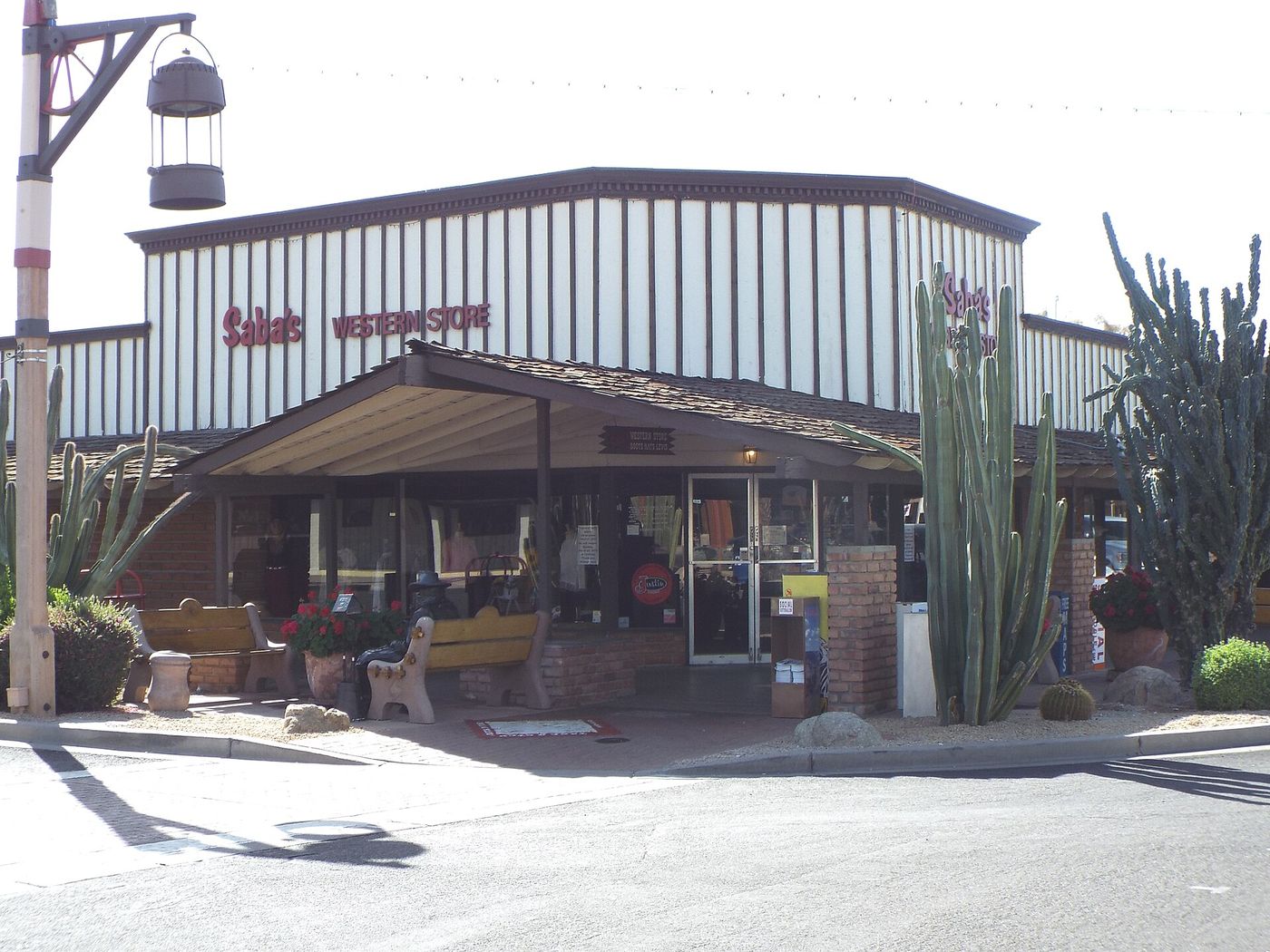
Saba's Department Store, opened in 1921 on Scottsdale's Main Street
Saba's Department Store (1921). E.M. Saba's dry-goods store anchored Scottsdale's first real Main Street, and the family name still trades downtown. Photo: Marine 69-71, CC BY-SA 4.0, via Wikimedia Commons.

The 30-second version

  • Syrian-born merchant E.M. Saba opened his department store on Main Street in 1921, the same year the Farmer's State Bank opened as the town's first bank.
  • He opened it in the middle of the 1920–21 cotton crash, the worst agricultural bust in the Valley's short memory.
  • Saba's anchored Scottsdale's first real merchant row, with E.O. Brown's general store, Cavalliere's forge and Johnny Rose's pool hall.
  • The family dressed farmers first, then dude-ranch and resort guests, and leaned fully into Western wear when the town branded itself in the 1950s.
  • Saba's Western Wear grew into a Valley-wide name and keeps its flagship in Old Town, making it the oldest retail name still trading downtown.

Lived

Active from 1921

Scottsdale years

1921–present

Known for

Opening the 1921 Main Street department store that grew into Saba's Western Wear

Decade chapters

1920s, 1930s, 1940s, 1950s, 1960s, 1970s, 1980s, 1990s, 2000s, 2010s, 2020s

Their name & work today

  • Saba's Western Wear, Old Town flagship

Why he matters

In 1921 the cotton market had just collapsed, the Valley’s farm economy was reeling, and a Syrian-born merchant named E.M. Saba chose that moment to open a department store on Scottsdale’s dusty Main Street. It was a bet that the town would still need clothes when the boom was over. It was a good bet. His store anchored the farm town’s first real Main Street, and the family name has traded downtown ever since.

Saba matters because his business is the clearest line between the working town and the themed one. The store sold dry goods to farmers. Then, when the dude ranches and resorts arrived, it sold the same kind of clothes to guests who wanted to look like farmers. By the time Scottsdale called itself “The West’s Most Western Town” in the 1950s, Saba’s had been selling the working West as a wardrobe for a generation.

He is also a reminder that early Scottsdale was not only Anglo farm families. The town’s first Main Street had a Syrian-born merchant at its center, an Italian blacksmith down the block and, by the end of the decade, a Chinese-American storekeeper as well.

Where to find his mark today

Saba’s Western Wear. The Old Town flagship is still in the Western storefront blocks near Main and Brown. Get fitted for boots; that is the family trade.

The 1921 neighbors. The Rusty Spur Saloon pours in the 1921 bank building that opened the same year as Saba’s store, and Cavalliere’s forge is around the corner on Brown.

The Main Street he anchored

Between 1920 and 1925 Scottsdale acquired the toolkit of an actual town, and the 1920s chapter lists it: Saba’s and the Farmer’s State Bank in 1921, the Scottsdale Bulletin in 1922, a new high school, E.O. Brown’s store and Cavalliere’s shop. Of the businesses on that list, only two still trade: Saba’s and the forge. The bank closed in 1933.

A note on the record. Some tellings of the 1920s say the Sabas “were still selling western wear downtown into the 2000s,” which reads as if the store had gone. It has not: the Saba’s Western Wear flagship is still open in Old Town, and that is the version to trust. Walk the Old Town on foot route and you will pass the blocks he helped build.

The full story

The local record on E.M. Saba himself is short. He was a Syrian-born merchant, he picked Scottsdale’s Main Street for a dry-goods department store, and he opened it in 1921. It does not keep his full name, his birth or death year, or when he arrived in Arizona, and it is better to leave them blank than to guess.

What the record does keep is the timing, and the timing is the story. The Pima cotton boom that had turned Scottsdale’s fields white since 1917 blew up in 1920 and 1921, and the whole Valley’s farm economy went with it. In the middle of that, Saba opened a store and the Farmer’s State Bank opened as the town’s first bank. Two institutions were wagering the town would still need credit and clothing. The bank lasted until the Depression. Saba’s is still here.

Through the 1920s a merchant row filled in around him: E.O. Brown’s general store, Cavalliere’s blacksmith shop, Johnny Rose’s pool hall. The store dressed the farmers first. Then, late in the decade and into the 1930s, the dude ranches and winter resorts arrived, and the same store began dressing guests who had come to ride. That pivot, from dry goods to Western wear, is the whole business in one sentence.

The family carried it through every downtown cycle that followed. When Scottsdale branded itself in the 1950s, Saba’s was already a generation deep in the look the town was adopting. Later the name grew into a chain of Western stores across the Valley, while the flagship stayed in the few blocks the founder chose. A century on, Saba’s is a peer of Cavalliere’s forge and the Rusty Spur’s bank building rather than of the gift shops beside it: one of the handful of downtown names that were here before the story they now sell.

Where to find E.M. Saba on this site

The places they founded, built, saved or gave their name to — each with its own guide.

E.M. Saba by the numbers

1921, Main Street

Store opened

Syria

Born in

Dry goods

Trade then

Western wear

Trade now

A life in Scottsdale: the timeline

  1. 1921

    A year after the cotton market collapses, E.M. Saba opens his dry-goods department store on Main Street; the Farmer's State Bank opens the same year.

  2. 1920s

    A merchant row grows up around Saba's: E.O. Brown's general store, Cavalliere's blacksmith shop, Johnny Rose's pool hall and, from 1922, the Scottsdale Bulletin.

  3. 1930s

    The dude ranches and winter resorts arrive, and the store that dressed the farmers starts dressing the guests who want to look like them.

  4. 1950s

    Scottsdale brands itself 'The West's Most Western Town,' and the family business, already a generation deep, leans fully into Western wear.

  5. Late 20th century

    Saba's grows into a chain of Western stores across the Valley while keeping its flagship in Old Town.

  6. Today

    Saba's Western Wear still trades from the Western storefront blocks downtown, more than a century after the first store opened.

Questions people actually ask

Who founded Saba's in Scottsdale?

E.M. Saba, a Syrian-born merchant, who opened a dry-goods department store on Scottsdale's Main Street in 1921. His family's business grew into Saba's Western Wear.

Is Saba's Western Wear still open?

Yes. The Old Town flagship sits in the Western storefront blocks around Main Street and Brown Avenue, and the company runs other stores around the Phoenix area. It has traded downtown continuously since 1921.

Is Saba's the oldest store in Scottsdale?

It is the oldest retail name still trading downtown, going back to 1921. Cavalliere's Blacksmith Shop on Brown Avenue is older as a business, dating to 1910, but it is a working trade shop rather than a store.

Vernacular & LexiconThe West's Most Western TownPima cottonBrown Avenue

Facts checked: September 22, 2026 • Curated by the Scottsdale.tips editors • Dates follow the Scottsdale Historical Society and city records where sources disagree; corrections are welcome.