Why they matter
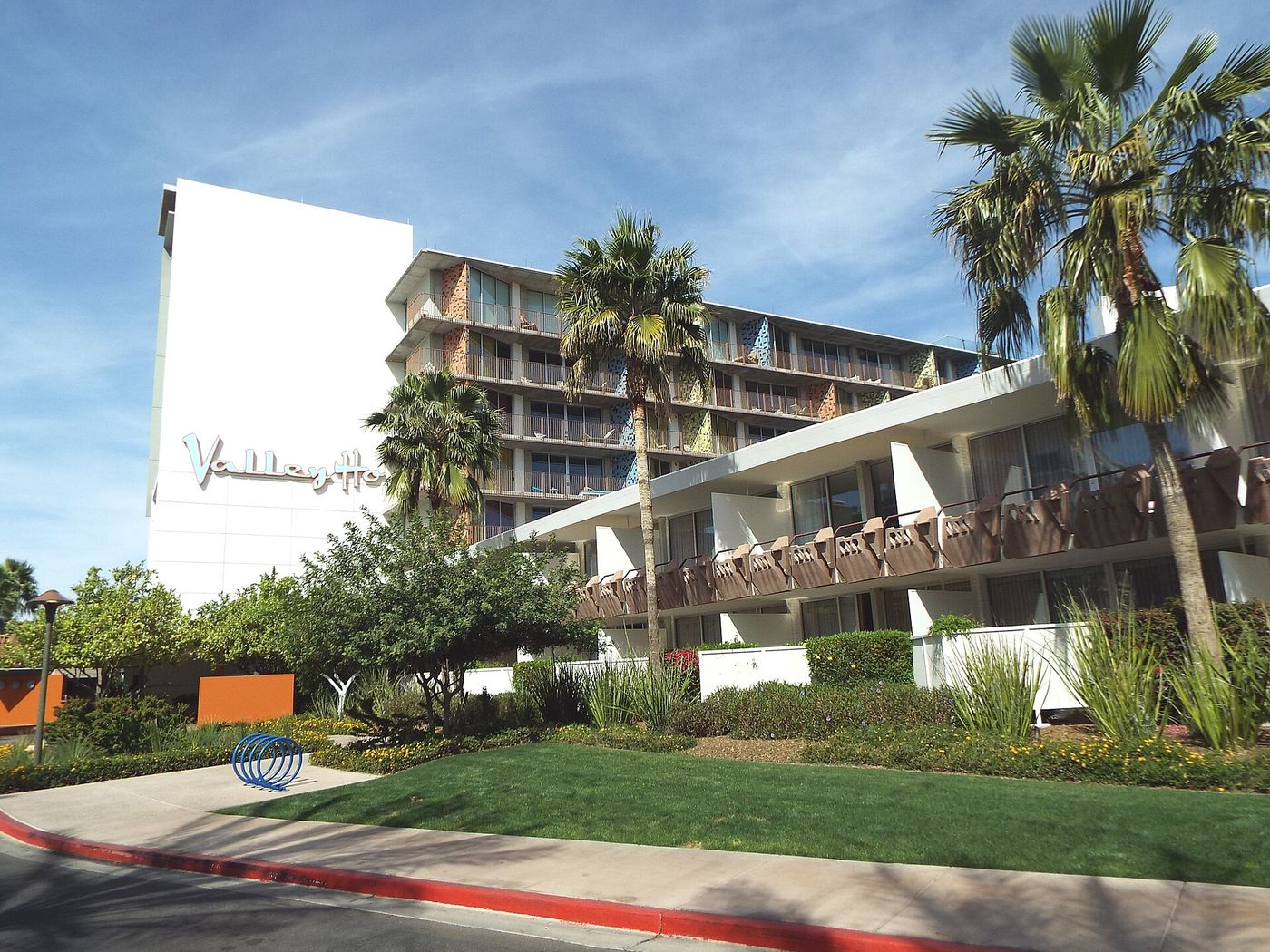
In 1956 downtown Scottsdale had spent five years dressing itself up as a Western town, with false fronts and hitching posts and a rodeo parade. Robert and Evelyn Foehl opened something that looked like none of it: a long, low modernist hotel of glass and concrete a few blocks from Main Street. The Hotel Valley Ho gave the resort town a modern wing and a nightlife to go with it.
The records on the Foehls themselves are thin. What survives is the hotel, and that is the point. Almost everything else from Scottsdale’s Hollywood winter era is gone. The Foehls’ building is still open, on its original corner, doing its original job.
Where to find their mark today
Hotel Valley Ho. The hotel itself, restored in 2005 to the way architect Edward L. Varney drew it: breezeblock screens, terrazzo floors, pastel panels.
The opening night. The day page for December 20, 1956 covers the opening and the guest book that followed.
The party. December 28, 1957 is the day Natalie Wood and Robert Wagner brought their wedding reception to the Foehls’ hotel.
The town they opened into
The Valley Ho arrived in the same boom season as the Safari Hotel up the road, and together they changed what Scottsdale sold. The prewar resorts sold quiet desert winters to wealthy easterners. The Foehls’ Valley Ho and Ernie Uhlmann’s Safari sold scene: air-conditioned rooms, cocktails and the chance of seeing a movie star at the next table. Hollywood found the Valley Ho through the productions shooting Westerns in the desert, and it stayed.
The Safari came down in 1999. The Valley Ho survived the Ramada years and was saved in 2005, the defining win of the city’s midcentury preservation movement, told on the December 1, 2005 day page. For the decade around it, read the 1950s.
The hotel as the town’s meeting room
The Foehls’ hotel was a civic address as well as a celebrity one. On April 6, 1961, nine young businessmen met there to organize the club that became the Scottsdale Charros, hosts of the spring training the Orioles had brought to town in March 1956, and the Howdy Dudettes, the town’s costumed greeters, were photographed there in the 1960s. The guest book filled in the other column: Bing Crosby, then Zsa Zsa Gabor, and in December 1957 the Wood and Wagner reception, which the December 28, 1957 day page calls an advertisement the town’s boosters could not have bought. The same year Motorola opened its Government Electronics Division plant at Granite Reef and McDowell, designed by Varney’s firm, so the Foehls’ architect was shaping the town’s industry and its nightlife at once.
The class of 1956 and 1957 around them gave Scottsdale its glamour infrastructure: the Safari Hotel up Scottsdale Road, with its French Quarter club and Paul Shank’s Gracious Dining, then Mountain Shadows in 1959 and the Executive House Arizonian, now The Scott, in 1961. The Foehls’ building is the only one of the first two still standing.
The full story
Robert Foehl was the Hotel Valley Ho’s original owner-operator, and he ran it with his wife Evelyn as downtown’s clubhouse. The hotel opened on December 20, 1956, in a Scottsdale of barely five years’ incorporation, and its design came from Edward L. Varney, an architect trained under Frank Lloyd Wright who gave the Foehls horizontal lines, cantilevered concrete and desert light instead of adobe.
The combination worked. Tourists could shop the Western storefronts by day and drink somewhere sleek by night. Winter after winter the film crowd made the Valley Ho its address. Bing Crosby signed the guest book; Janet Leigh and Tony Curtis came through; and on December 28, 1957, Natalie Wood and Robert Wagner, married that day in a small Scottsdale church, filled the hotel with their reception. In 1962 Trader Vic’s opened a few blocks away, at Fifth Avenue and Craftsman Court, and gave the neighborhood a tiki-hour pulse.
The Foehl era did not last forever. Ramada bought the hotel in 1973 and ran it as the Ramada Valley Ho for nearly three decades, dropping ceilings, carpeting the terrazzo and painting over the pastels. Westroc bought it in 2002, restored it for about $80 million and reopened it on December 20, 2005. Varney’s unbuilt tower finally rose in 2008, or in December 2006 by the hotel’s own history. The Foehls’ part of the story is the beginning: a husband-and-wife operation that put a modern hotel in a cowboy town and made it the place Hollywood came to hide.
Before and after them
The one detail of their earlier career in the record is that they had run the dining room at the Camelback Inn, the 1936 resort on Mummy Mountain; the Varney profile gives it. They commissioned Varney’s tower concept in the 1950s and never built it, and they sold the hotel to Ramada in 1973, seventeen winters after they opened it. What they did afterward, and their birth and death years, are not in the sources the site draws on, and this profile does not supply them.
Where the sources disagree
A few small facts around their hotel have been told differently. The hotel stands at 6850 East Main Street; an older summary that put it on Indian School Road was wrong. The original Trader Vic’s, 1962 to 1990, was not next door but on the southwest corner of Fifth Avenue and Craftsman Court, a few blocks away; only the franchise revival of 2006 to 2011 operated inside the Valley Ho. And the Safari, the Valley Ho’s rival of the same season, opened on November 6, 1956 by one listing and November 16 by the Safari guide. The opening date of the Foehls’ hotel, December 20, is the hotel’s own and is not in dispute.