
At a glance: Scottsdale’s 1930s are a study in contrasts. The bank failed and the farms limped, yet the guest ranches were full, an immigrant congregation built the town’s most beautiful building with its own hands, and Frank Lloyd Wright decided the McDowell foothills were where architecture’s future should spend the winter. The Depression, oddly, made Scottsdale more itself.
Hard times, full guest ranches
The Depression hit Arizona’s farms and copper towns like a hammer, and Scottsdale took its share: the Farmer’s State Bank closed in 1933, commodity prices scraped bottom, and cash all but vanished from the farm economy. What saved the town was the industry it had stumbled into during the 1920s — selling winter to rich people, who, it turned out, were the one customer segment the Depression barely touched.
Through the 1930s the roster of guest operations grew steadily: the Jokake Inn expanded, the Camelback Inn opened in 1936 on the slopes of Mummy Mountain — in the unincorporated desert between Scottsdale and Phoenix that is now Paradise Valley — and became an instant institution, and dude ranches around the town discovered that easterners would pay handsomely to ride along. “Lungers, dudes, and artists,” the old line went — health seekers, guest-ranch tourists, and painters — were the three imports keeping Main Street’s lights on.
1933: the Mission built by hand
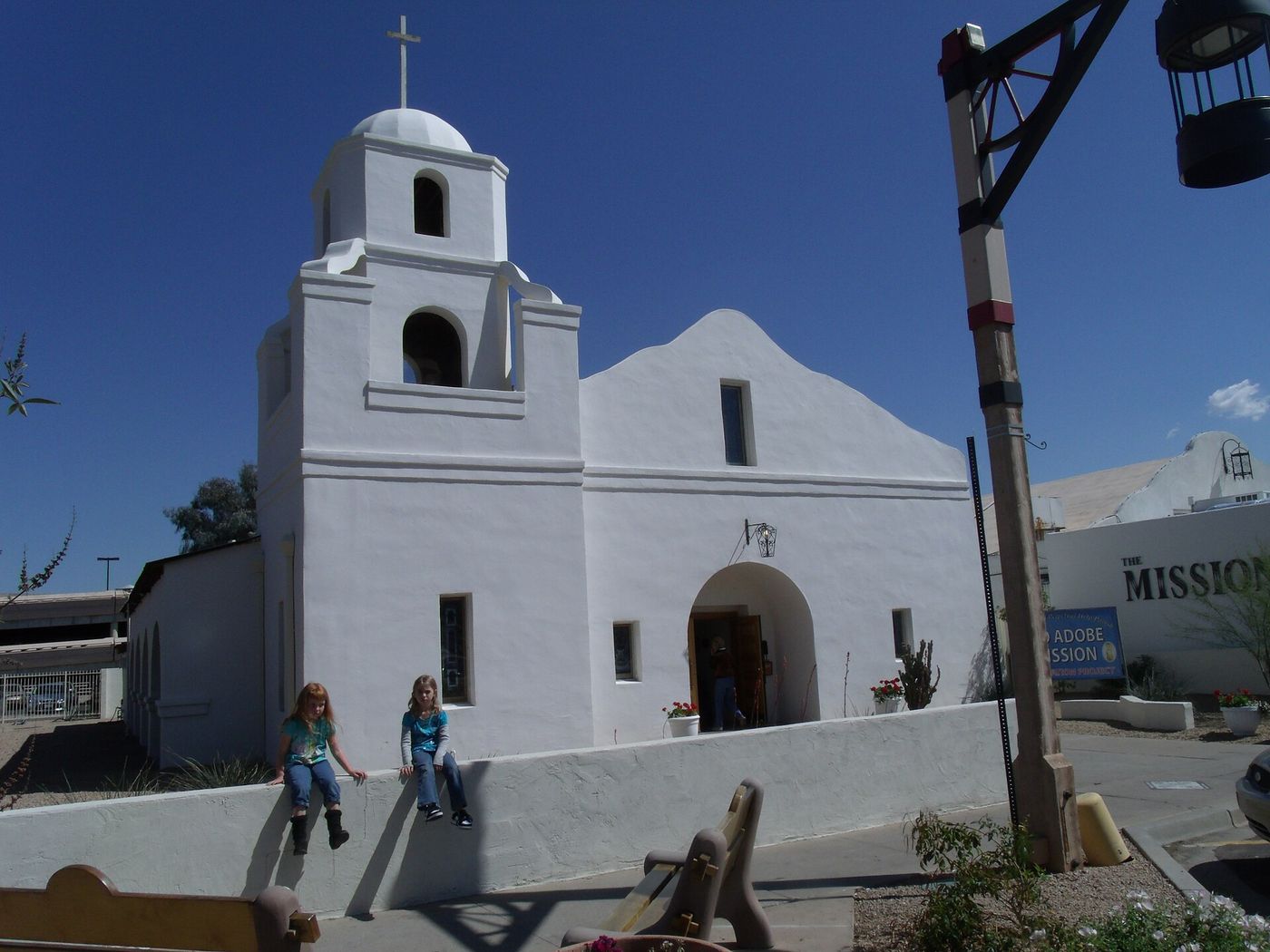
The Depression’s worst year produced Scottsdale’s most moving building. The town’s Mexican-American families — many rooted here since the cotton boom — had long worshipped without a proper church. In 1933, with money nonexistent, they built one themselves: parishioners molded and sun-dried thousands of adobe bricks on site, and raised Our Lady of Perpetual Help, the “Old Adobe Mission,” at First Street and Brown Avenue.
The white mission with its stepped facade served the congregation for decades (as a mission from 1933 and as the parish church from 1949 until a larger church was built), survived years of neglect, and was lovingly restored in the 2000s. It stands today as Old Town’s oldest church and the clearest physical monument to the families whose labor built the town twice — once in the cotton fields, once in adobe.
1937: Wright picks the desert
Frank Lloyd Wright, rebuilding his career at 70, had been wintering in Arizona since consulting on the Arizona Biltmore. In 1937 he bought several hundred acres of raw desert (sources put the first purchase at 320 to 600 acres) at the foot of the McDowell Mountains — miles beyond town, no water, no power — and with his Taliesin Fellowship apprentices began building a winter camp of desert masonry, canvas, and redwood: Taliesin West.
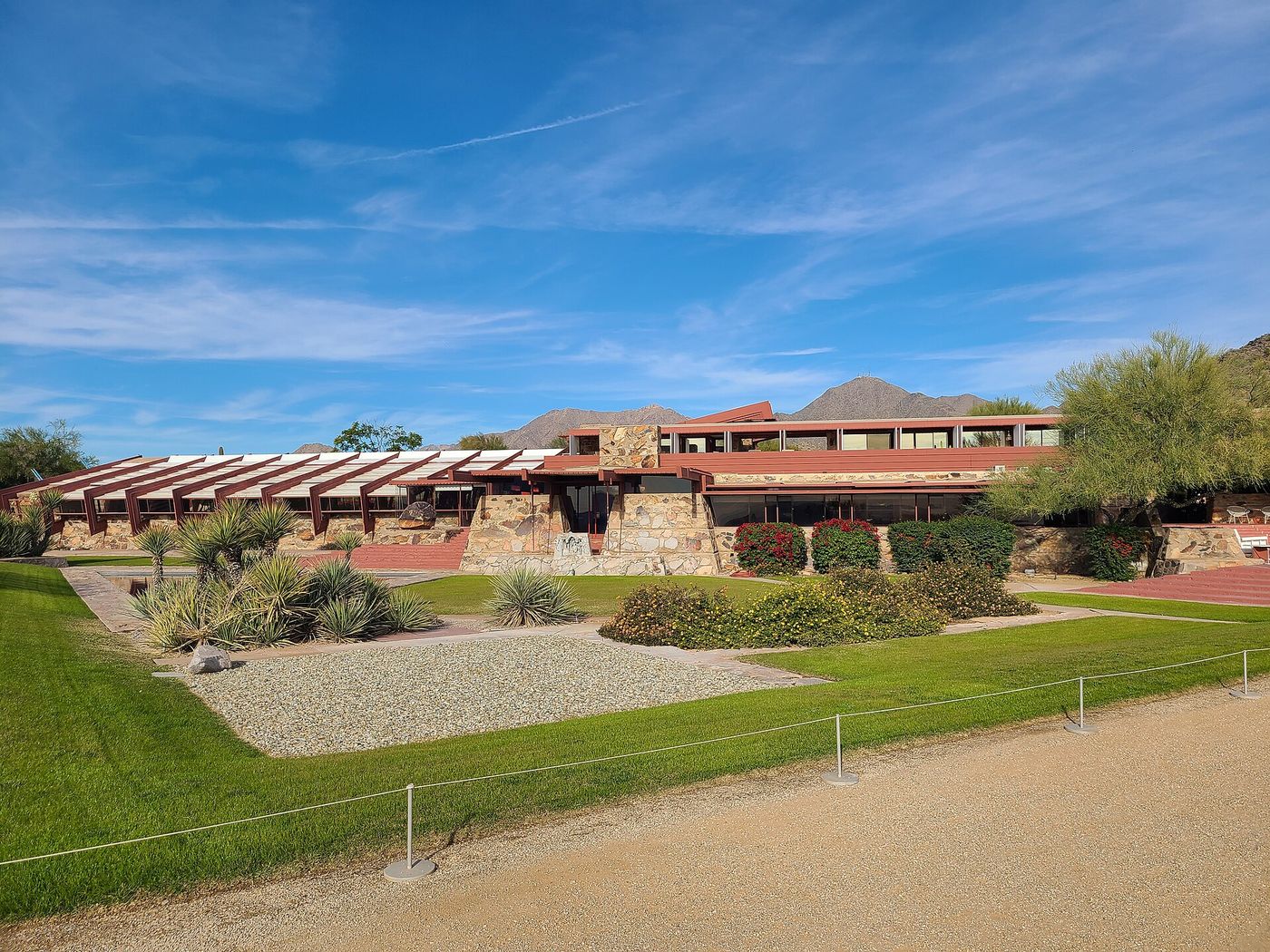
Wright’s arrival mattered far beyond architecture tourism. Taliesin West seeded Scottsdale with designers, craftsmen, and an idea — that buildings here should answer to the desert — which echoed through the town’s midcentury look, from Bennie Gonzales’ civic buildings to resort architecture. Today Taliesin West is a UNESCO World Heritage Site and one of the most visited landmarks in the city.
That same January, in one of the decade’s strangest footnotes, four inches of snow fell on the saguaros — January 20, 1937, a date old-timers retold for fifty years.
The town at decade’s end
By 1940 Scottsdale was still small — a couple of thousand people, still unincorporated, still centered on the same few blocks — but its economic DNA was now set: agriculture underneath, hospitality and art on top. What nobody could see coming was the war, which would drop an airfield, thousands of trainee pilots, and a POW camp on the town’s doorstep almost overnight. That’s the 1940s.