
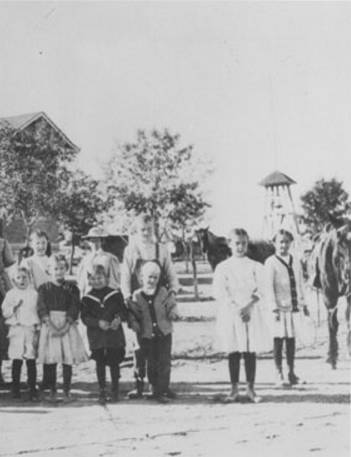
At a glance: The 1900s nearly ended Scottsdale before it began. A years-long drought drained the canals and drove families out — until the valley’s farmers bet their own land on a federal dam. By decade’s end the gamble was visibly working: a brick schoolhouse stood on Main Street, a resort was booking eastern millionaires, and the 1910 census would count 267 people in the surrounding precinct outside the reservation.
The drought that almost won
The Salt River is a moody partner. Starting in the late 1890s and running into the early 1900s, the watershed delivered a brutal sequence of dry years, and without any storage upstream, the canals simply carried what the river gave — which some summers was almost nothing. Fields browned, stock was sold off, and a number of Scottsdale’s recruited families gave up and left. The settlement that had just gotten its name was shrinking.
The drought made one thing obvious to everyone from Tempe to Peoria: the valley would never be more than a gamble until the river was dammed and its floods stored. What no local bank could finance, a new federal law suddenly could.
1902–1903: the farmers bet the farm
The National Reclamation Act of 1902 offered federal construction money for western irrigation works — repaid by the farmers whose land the water served. In 1903, Salt River Valley landowners organized the Salt River Valley Water Users’ Association (the Salt River Project, still the utility today) and pledged their own acreage as collateral. Scottsdale’s settlers signed alongside everyone else; it is hard to overstate the nerve of mortgaging a drought-stricken farm to pay for a dam none of them would live to see paid off.
Construction of Theodore Roosevelt Dam began in 1906 in a canyon 80 miles upstream. Stone by stone through the rest of the decade, the tallest masonry dam in the world rose between the walls — and with every course, Scottsdale’s future got a little less hypothetical. The dam would be dedicated by Roosevelt himself in 1911.
That same year, 1903, the settlement’s founder took a last public post. Governor Alexander Brodie had appointed Winfield Scott a regent of the University of Arizona in 1902, and on August 5, 1903 the regents elected him their chancellor, the board’s presiding officer, a chair he held until January 1905. (The Historical Society’s timeline calls him chancellor of the Tempe Normal School, the future Arizona State University; his 1978 biographer, working from the regents’ minutes, places him on the University’s board and on the normal school’s Board of Visitors.) The old chaplain spent the decade preaching, farming, and boosting — and would not quite live to see the dam finished.
Lungers, tents, and sleeping porches
While the farmers fought the drought, a different migration arrived by rail: the health seekers. Turn-of-the-century medicine had one reliable prescription for tuberculosis — dry air and sunshine — and Arizona advertised both. Scottsdale, dry in every sense of the word, drew its share of “lungers,” who lived in tent cottages and screened sleeping porches scattered among the farms.
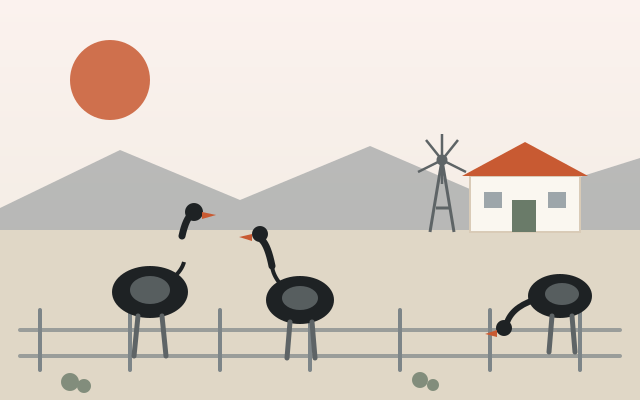
The farms themselves diversified into anything the desert would tolerate — alfalfa, barley, dates, and most memorably ostriches. Plumes for women’s hats commanded absurd prices, and the Salt River Valley became one of the ostrich capitals of America, with birds pastured around Scottsdale. (Fashion would kill the plume market dead in the 1910s; the automobile’s open cockpit and changing hat styles did in a decade what coyotes never could.)
1909: the year everything upgraded
The decade’s optimism cashed out in a single remarkable year:
- The Little Red Schoolhouse. District 48 replaced the 1896 wooden school with a handsome brick schoolhouse, voted as a $5,000 bond in May and built on a $4,526 contract. It would go on to serve as town hall, library, and justice court, and since 1991 it has housed the Scottsdale Historical Museum — the single most important surviving building in Old Town.
- E.O. Brown takes the store. Rancher-merchant E.O. Brown took over Davis’s general store; the Brown family would anchor Scottsdale commerce (and give Brown Avenue its name) for decades.
- The Ingleside Club opens. Just west of the settlement, promoter W.J. Murphy and his son Ralph readied the Ingleside Club, later the Ingleside Inn, to open to patrons on December 1, a refined winter resort that would add a golf course. Wealthy easterners came for the season, and Scottsdale discovered the industry that would one day define it: selling warm winters to cold people.
The founder’s last decade
Winfield Scott died on October 19, 1910, the year the census counted 267 people in the Scottsville precinct outside the Salt River reservation, the figure usually given for the town that carried his name — and just months before Roosevelt Dam’s dedication guaranteed that town a future. He had lived exactly long enough to see the bet pay off. The 1910s would bring statehood, the dam’s completion, and a world war that briefly made this little farm town the center of the cotton universe.