Why they matter
Scottsdale markets its past and tears down most of the evidence. Two of the few old buildings still doing their original work in Old Town were made by the same community, out of the dirt they stand on. The Corral family, who came north from Cananea, Sonora, in the cotton boom, built one of them outright and helped build the other.
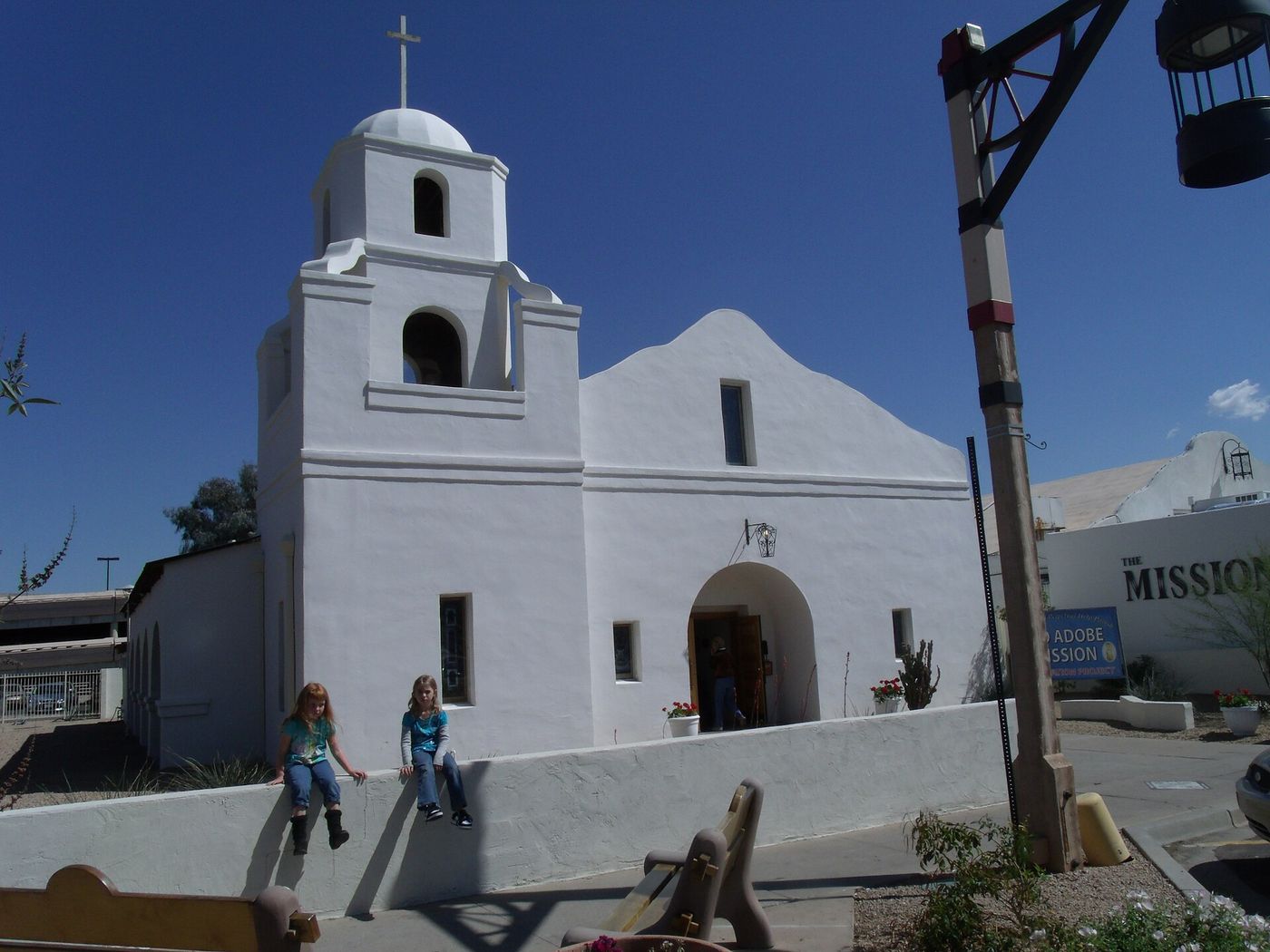
The first is the Old Adobe Mission, the white church at Brown Avenue and First Street that Scottsdale’s Mexican-American families raised through the Depression, roughly 14,000 fifty-pound bricks at a time, and finished in 1933. The second is Los Olivos, the adobe hall the Corrals built by hand in 1928 for the weddings and dances of immigrant families. It became a restaurant around 1947, and the family still runs it. Very few Arizona restaurants have stayed with one family that long.
This profile is collective on purpose. The Mexican-American founders of Old Town mostly get a sentence in the town’s history. The mission’s own story names several of them, and they belong on the same page.
Where to find their mark today
The Old Adobe Mission. Free, open most days from October through May, and still consecrated. Go inside, sit down and look at how thick the walls are.
Los Olivos Mexican Patio. On 2nd Street, with its sculpted folk-art facade. Eat on the patio and order the flat Sonoran enchiladas.
Bernabé Herrera’s windows. The mission’s stained glass, which by Salt River Stories’ account retells the Miracle of the Roses story, was restored in 2003. The same story is acted out each December in the Miracle of the Roses pageant.
The mission builders, by name
Doña Dolores Rivera de Ochoa kept the church-building fund in the late 1920s. The fundraising was organized by the community’s women, and it survived the 1929 crash by slowing down rather than stopping.
Bernabé Herrera was a local tinsmith who made the mission’s stained glass, windows that retell the Miracle of the Roses story, according to Salt River Stories. It is the detail visitors remember.
Grandvell Shumaker drew the blueprints. Robert T. Evans, the Jokake Inn builder who had studied adobe construction in Sonora and New Mexico, supplied the design, equipment and tools. See his profile at Robert T. Evans.
Everyone else was labor, and the labor was the congregation: the Corrals and other Mexican-American families, working alongside Yaqui neighbors, mixing, casting, curing, hauling and laying brick on evenings and weekends for about six years.
The full story
The cotton boom that began in 1917 was hungry for labor, and Valley growers recruited Mexican and Mexican-American families directly from Sonora and Chihuahua to pick, gin, ditch and haul. The Corrals came from Cananea, Sonora: Tomás and Cecilia Corral arrived in September 1919, by the family’s count, which is the date it used for its 2019 centennial (some local histories file them under 1917). As the 1910s chapter puts it, they were paid less and housed worse than Anglo workers and settled in a barrio of adobe homes south and east of the townsite. The growers thought they were importing temporary labor. When cotton crashed in 1920–21, families like the Corrals and Coronados stayed, opened businesses, and became permanent builders of the town.
In 1928 the Corrals built, by hand, an adobe hall where immigrant families could gather for weddings, dances and community life. Around the same time, the community’s Catholics set out to build a church of their own, with Doña Dolores Rivera de Ochoa keeping the money. Then the Depression hit, and the project slowed. Donated material came from Catholic communities in Scottsdale, Tempe and as far away as Chicago. Robert T. Evans supplied plans, equipment and tools, and Grandvell Shumaker drew the blueprints. The walls went up in adobe because adobe was nearly free: roughly 14,000 bricks at about fifty pounds each, made on site by the congregation and Yaqui neighbors. On October 15, 1933 (the parish’s own history says October 14), Mass was celebrated in the finished church, with Bernabé Herrera’s stained glass in the openings. See the 1930s chapter.
The two buildings then went different ways. The Corrals’ hall turned into Los Olivos around 1947, just before Scottsdale incorporated and began calling itself “The West’s Most Western Town,” and it kept a real piece of Mexican-American Scottsdale open for business in the middle of the Western theme. The church became a full parish in 1949, outgrew itself, and in 1956 the congregation moved to a larger church on Miller Road. The mission spent forty-five years as a hall, a rehearsal room and office space while its adobe eroded.
It was saved the way it was built, by volunteers. The building went onto the Scottsdale Historic Register in 2001, a restoration committee formed in 2002, and in 2003 the bell tower was stabilized, the adobe repaired and Herrera’s glass restored; the first Mass since 1956 followed. The mission reached the National Register of Historic Places in September 2018.
Members of the Corral family and other founding families are writing a book about the mission and about what the Mexican community built here. Until it appears, the two buildings tell the story themselves: one church made by hand, and one family restaurant that has not changed hands.