Why he matters
The Jokake Inn is remembered for its beginning, the tea parties Sylvia Evans and Lucy Cuthbert poured in an adobe house in 1926. It spent almost half its life under someone else. Charles Alberding, a Chicago hotel owner, bought it in the early 1950s and kept it open for about twenty-five winters, while Scottsdale incorporated, the Valley Ho and the Safari went up on Scottsdale Road, and the corridor filled with newer, air-conditioned resorts.
Alberding was not a builder or a showman. His chain, Alsonett Hotels, bought older hotels that had seen better days and kept them running. At the Jokake that approach meant the inn aged in place, which is part of why the bell towers were still standing when the land changed hands in the 1980s.
Where to find his mark today
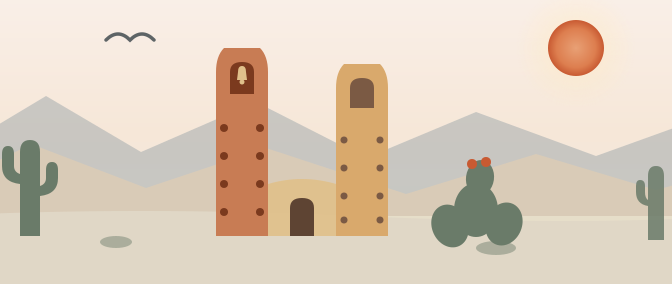
The Jokake Inn. The guide to the lost resort, including the bell towers on the lawn of The Phoenician.
The Jokake Inn Tea Room. The dining-room story, from Sylvia Evans’ first tea parties through the sale to Alberding.
Pinning down the dates
The site’s pages give the purchase as “the early 1950s” (the tea room and Sylvia Evans pages) or simply “the 1950s” (the resort guide). Outside summaries of the inn’s history give 1952. This page uses the early 1950s and notes the specific year. The closing is recorded only as the late 1970s.
Accounts also differ over what Alsonett was. The site calls Alberding a Chicago hotelier, and Florida histories of his hotels describe Alsonett as Chicago-based; one Arizona source calls it a Texas firm, and a former employee recalled its corporate office in Tulsa. The chain spanned many states, and the Chicago description is the one most sources share.
The specific year has support on other pages. The Jokake School for Girls guide and the dude ranch entry both say the inn was sold to Alberding’s Alsonett Hotels in 1952. For the end, the 1979 year page dates the Jokake’s last season to that year, “after 53 winters under the Evanses and Charles Alberding,” while the resort and tearoom guides keep to “the late 1970s.”
The second resort: the Royal Palms
The Jokake was not his only property below Camelback. In 1959 he bought the Royal Palms, the Spanish Revival winter estate New York financier Delos Willard Cooke had finished in 1929 and that had opened as a 15-casita inn in 1948, for about $1 million. It is in Phoenix, about two miles west of Fashion Square, and he ran it for three decades, longer than he ran the Jokake. He turned a citrus grove into a nine-hole golf course, added meeting space, and in 1981 put up a two-story building that brought the room count to 120. Pat Ryan, one of the few women running a resort in that era, managed it for 22 years.
The two resorts make his pattern visible. At the Jokake, an adobe inn he did not modernize aged into a relic and closed; at the Royal Palms, where he added a golf course and a room building, the 1929 house survived at the center of an expanded hotel. Alberding died in 1989, and his family carried on until the mid-1990s, when they sold the golf course to a homebuilder and the hotel to Fred and Jennifer Unger, who restored it and reopened it in 1997.
The full story
Charles Alberding built his chain on a simple bet. After World War II, a former employee later recalled, Alberding bought hotels expecting their value to rise with postwar travel whatever their condition, and he was reluctant to spend much on upkeep. His Alsonett Hotels took over the Soreno in St. Petersburg in 1944 and bought the Vinoy Park there for $700,000 in 1945. The Peabody in Memphis followed in 1953, and the chain also ran the Jayhawk in Topeka. At its peak it held up to 49 hotels in 14 states.
In the early 1950s he added the Jokake Inn. Sylvia Evans had run it since her tearoom days, through her divorce from Robert Evans, and sold it to him around 1952. The inn he bought was a winter resort of the older kind: adobe casitas below Camelback, open November to April on the American Plan, with the 1936 bell tower building as its signature. Under Alberding it kept that character. The Valley around it changed fast. The boomtown era brought refrigerated air, year-round seasons and resorts with pools and nightclubs, and a dressed-for-dinner adobe inn became a well-loved throwback.
The pattern elsewhere in his chain was similar. The Vinoy Park ran seasonally into the 1960s with a dwindling clientele and closed in 1974. The Peabody went bankrupt in 1965 and sold at a foreclosure auction. The Jokake lasted longer than either, operating into the late 1970s before it wound down.
After that, the land mattered more than the buildings. In the mid-1980s Charles Keating assembled the Jokake grounds, the neighboring Paradise Inn and other parcels for The Phoenician, which opened in 1988. Nearly everything was demolished except the bell towers. The site’s Royal Palms guide records that Alberding died in 1989, the year after The Phoenician opened; his birth year is not in the record, and this page will not guess it.
What his ownership left
The towers are the clearest answer. Robert T. Evans designed them in 1936, they were the inn’s signature through Alberding’s quarter century, and they are now the oldest resort architecture in Scottsdale, standing on the Phoenician’s lawn and restored in 2019. The inn’s history from the first tea party is in the Sylvia Evans and Jessie Benton Evans profiles; Jessie, whose Camelback estate had seeded the inn, died in 1954, by which time it had already passed to Alberding. What his ownership meant in the end depends on which resort you look at: the Jokake, left as it was, closed and was cleared, while the Royal Palms, expanded under him, is still operating.