
At a glance: In the 1890s Scottsdale stopped being one family’s farm and became a place. A banker from Chicago platted 40 acres of it, the citrus-flavored name “Orangedale” quietly died, a one-room school went up, and a general store with a post office window made the name official. It all happened against a backdrop of freeze, fire, and the worst drought the settlers had yet seen.
Orangedale gets a better name
Winfield Scott spent the early 1890s straddling two lives — Army chaplain on duty and absentee farmer — until 1893, when the lingering damage from his Gettysburg and Spotsylvania wounds forced his retirement. He and his wife Helen settled onto the ranch full-time, and Scott threw himself into the role he was born for: chief promoter, recruiter, and one-man chamber of commerce for his patch of desert.
The recruit who mattered most was Albert G. Utley, a retired Rhode Island banker who in 1894 bought land adjoining Scott’s and platted a 40-acre townsite — the seed of today’s Old Town. Utley’s paperwork first carried the sunny promotional name Orangedale, but the citrus dream was already freezing to death in the field, and the community had a better asset than orange trees: its famous, tireless chaplain. By the time the plat settled, the town was Scottsdale.
Who actually moved here
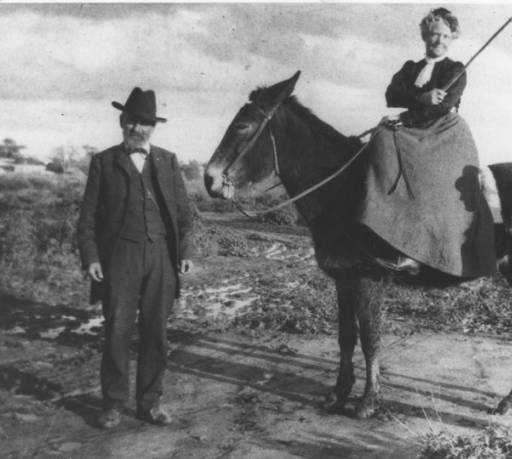
The Scotts’ recruiting pitch — cheap irrigated land, a dry climate, and a dry town — drew a particular kind of settler: sober, churchgoing farm families, many from the Midwest and East. Scott was a temperance man, and early Scottsdale had a reputation as a teetotaling farm colony, in pointed contrast to the saloons of territorial Phoenix. Among the arrivals were families whose names are still on the map — and one industrialist, Frank Titus, whose 1892 ranch house south of the settlement, near today’s Hayden and McDowell Roads, survives as the oldest continuously occupied home in the city.
Health-seekers came too. Territorial Arizona marketed its air to easterners with lung disease, and Scottsdale’s founder was himself proof of concept — a wounded veteran thriving in the desert. The trickle of “lungers” arriving by rail to Phoenix and onward by wagon would become a defining migration in the 1900s.
1895–1896: fire, school, olive trees
The decade’s low point came days before Christmas 1895, when the Scott family home burned to the ground. The response said everything about the young community: neighbors took the founding family in and helped them rebuild.
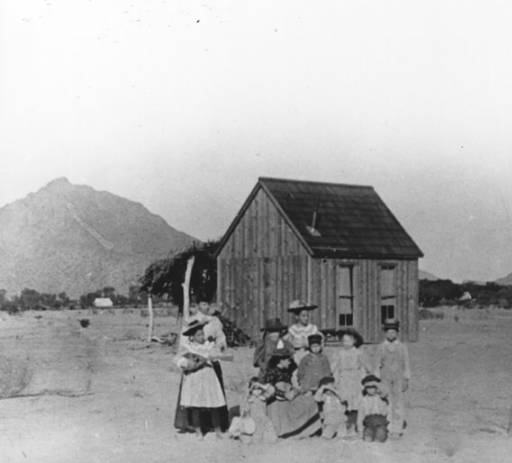
A year later the settlers pooled labor again, this time on purpose. School District No. 48 was organized in 1896 and a one-room wooden schoolhouse went up — schoolroom by weekday, church and meeting hall the rest of the week. That same year the farmers planted olive trees as windbreaks around the surviving groves; some of those olives still line Second Street in Old Town, the oldest living things the settlers left us.
1897: a store, a post office, an address
Scottsdale became findable in 1897, when J.L. Davis opened a general store at the corner of today’s Brown Avenue and Main Street and the post office moved in under the Scottsdale name, with Davis as postmaster. One room now held the town’s entire commercial economy: dry goods, hardware, mail, gossip, and credit between harvests.
The decade closed with the founder in politics — Scott won a seat in the Territorial House of Representatives in 1898 — and the settlement facing its hardest test yet. Drought was tightening across the Salt River watershed, and without storage upstream, canal water was rationed to a trickle. The fight for a reliable water supply would dominate the 1900s and give the whole valley its modern shape.
What survives from the 1890s
- The Old Town street grid is Utley’s 1894 plat, more or less — walk Brown, Main, and First Street and you’re inside the original 40 acres.
- The Titus House (1892) still stands and is listed on the National Register of Historic Places.
- The olive trees of 1896 survive along Second Street near the civic center — planted as windbreaks, kept as monuments.
- The corner of Brown & Main, site of Davis’s store, has hosted continuous commerce since 1897 — a 130-year retail streak.