
At a glance: In 1951 Scottsdale finally became an actual town — half a square mile, 2,000 people, and a cafe owner for mayor. What followed was the most deliberate act of self-invention in Arizona history: a slogan, a rodeo parade, a movie-star hotel, and a Motorola payroll, all inside nine years. By 1960 the population had quintupled and the brand was national.
1951: incorporation, finally
Sixty-three years after Winfield Scott’s land filing, Scottsdale was still legally nothing — an unincorporated crossroads run by the county, the school board, and social pressure. Phoenix’s annexation appetite and the practical needs of a growing town (zoning, sewers, police) forced the issue. On June 25, 1951, the county supervisors approved the residents’ petition to incorporate about half a square mile around the old townsite, and the council they appointed chose Malcolm White — owner of Whitey’s cafe, theater-builder, and the town’s loudest booster — as first mayor.
White and the Chamber had already coined the identity: “The West’s Most Western Town.” It was marketing, and everyone knew it was marketing, and it worked magnificently. Merchants put it into the streetscape on their own, with hitching posts, board sidewalks and false-front western storefronts downtown, and in 1953, the city’s historic context says, the council appointed an Architectural Board to keep the look western. The town had made itself a stage set for the tourist economy.
1953: the town throws itself a parade
The Chamber and the Riding Club had staged a Sunshine Festival parade in November 1951; in 1953 the Junior Chamber of Commerce took it over and gave the brand its liturgy: the Parada del Sol, a horse-drawn parade (a rodeo followed in 1956) that shut down the town center and put every rancher, dude string, and school band on Scottsdale Road. It grew into one of the largest horse-drawn parades anywhere and never stopped — the Parada still rides through Old Town every winter.
By the saloon’s own account, the Rusty Spur Saloon had opened in 1951 inside the failed Farmers State Bank building, the vault still in the wall, beginning its run as Old Town’s honky-tonk time capsule.
The other Scottsdale: chips and ballplayers
Two arrivals diversified the postcard economy:
Motorola. Daniel Noble’s Arizona strategy brought a Motorola plant to 52nd Street and McDowell, just across the line in Phoenix, in 1954 by the Historical Society’s date, then the Scottsdale plant on McDowell Road in 1957, putting Cold War electronics wages a bike ride from the hitching posts. Electronics became the Valley’s stealth base industry, and engineer families filled the new subdivisions faster than resorts could fill in winter.
Spring training. The first Scottsdale Stadium rose in 1955, and the Baltimore Orioles opened camp there in early 1956 — big-league baseball in a town of a few thousand. The Red Sox, Cubs, A’s and eventually the Giants would follow through the decades; Scottsdale has hosted Cactus League ball nearly continuously since.
1956: the Valley Ho and the Hollywood winter
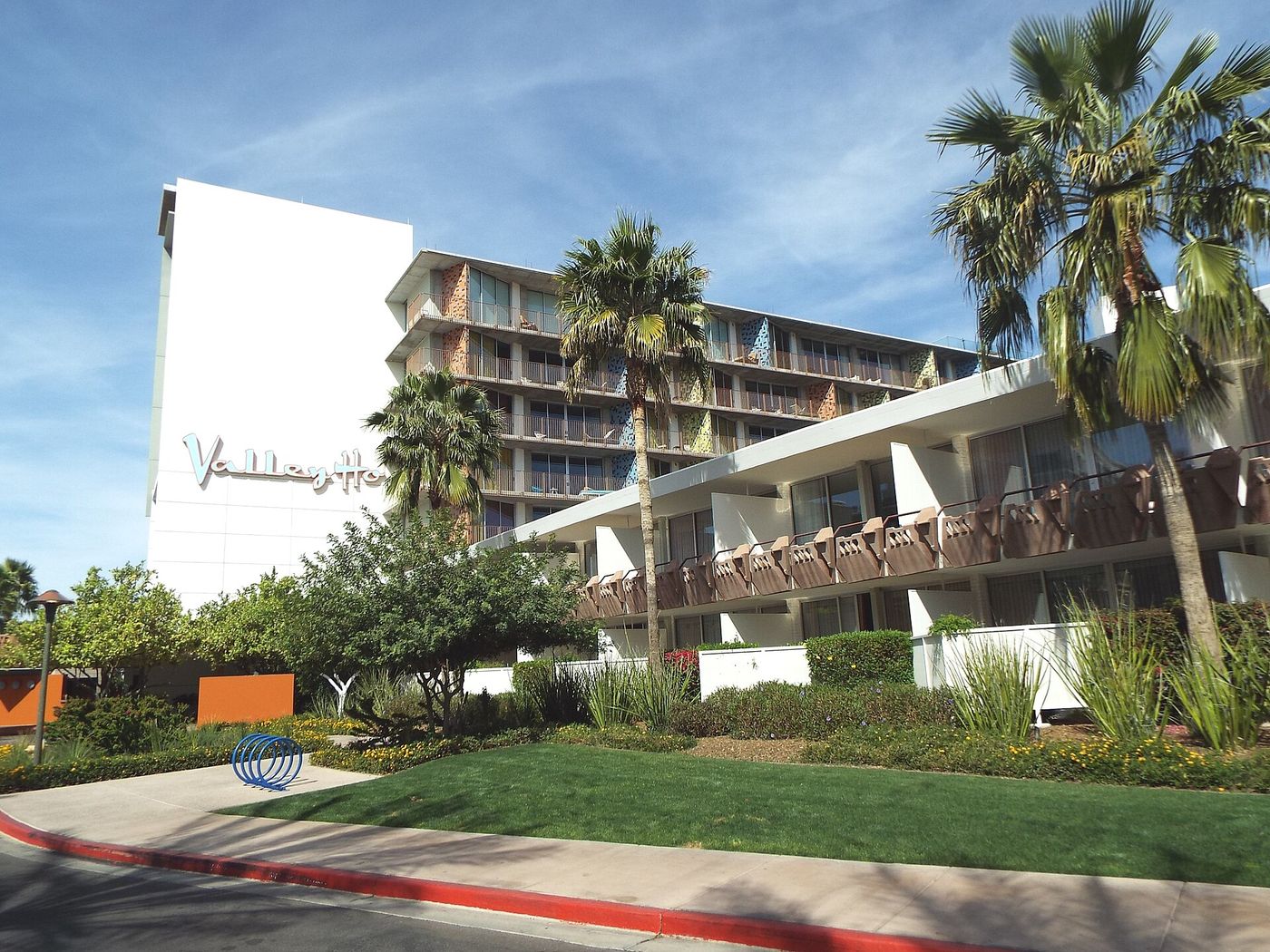
In December 1956 the Hotel Valley Ho opened downtown — architect Edward L. Varney’s horizontal midcentury masterpiece, all glass, concrete, and desert light. With the Safari Hotel opening the same year, Scottsdale suddenly had nightlife: the Hollywood set wintered here, Natalie Wood and Robert Wagner held their wedding reception at the Ho, and the gossip columns did the advertising for free.
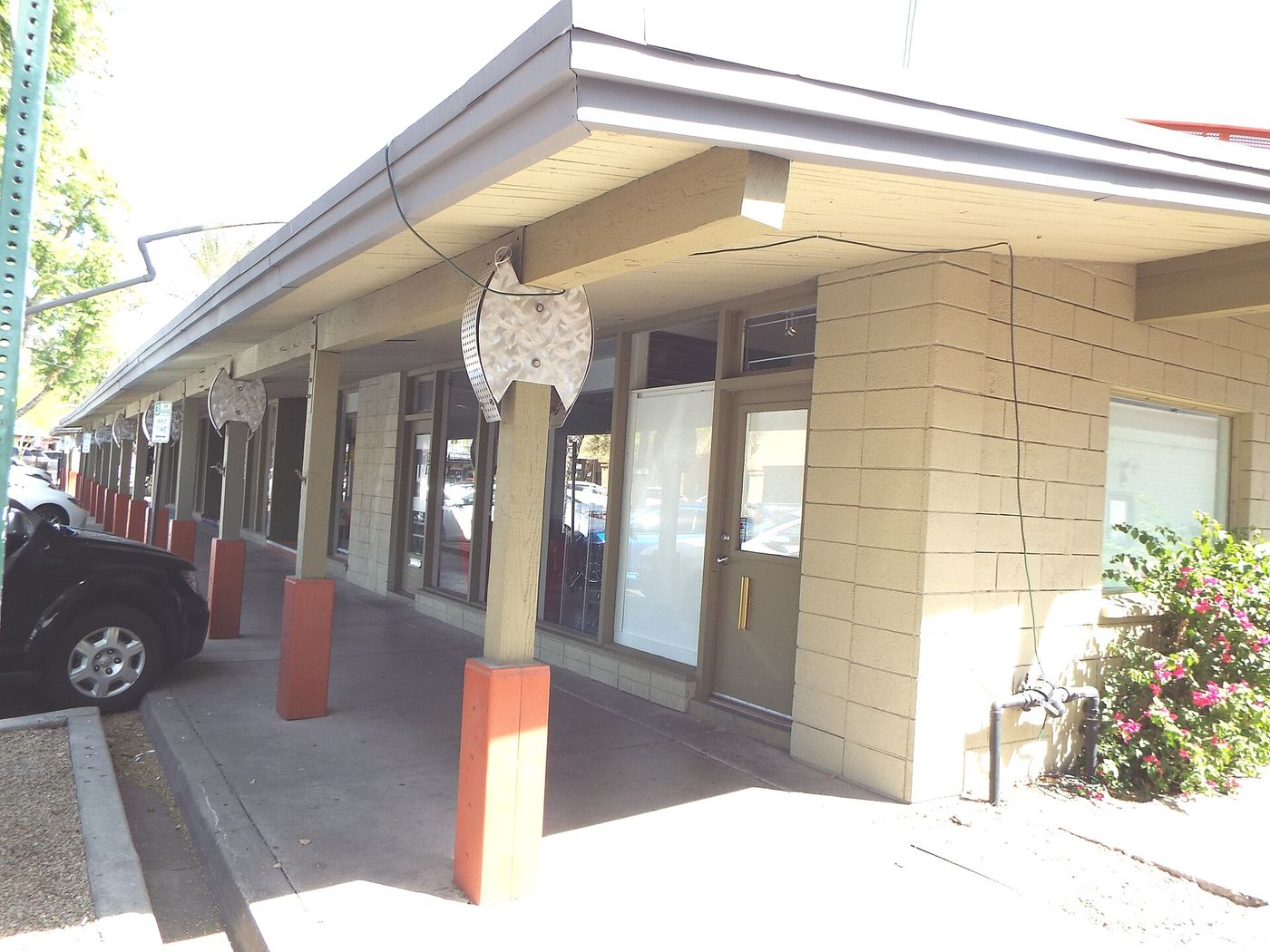
Downtown kept pace. The Fifth Avenue and Main Street artisans got purpose-built quarters like Craftsman Court (1955), galleries multiplied, and the shopping district began its evolution from souvenir row to genuine arts marketplace — the seed of today’s gallery districts and Museum of the West.
The politics of a new town
Behind the postcards, the new town was learning to govern. A part-time council of businessmen, chosen by the county in 1951 and elected from 1952, picked its own mayor, contracted fire protection from a private company and drew the first zoning maps; by the city’s count 24 people sat on it by the end of 1960 and 11 resigned. The resorts kept a color line: in 1954 the attorneys general moved a national convention away from Camelback Inn over its exclusion of Jews, and in 1959 the Red Sox’s Pumpsie Green was turned away at the Safari (see Scottsdale and the color line). In 1956, the city’s historic context says, the water users voted to close their last company camp for Yaqui canal workers, and the families resettled along the Indian Bend Wash. And from 1956 the town and Phoenix filed competing petitions for the same county land, a fight Phoenix mostly won until a 1964 truce (see the annexation war). The 1950s politics chapter tells that side of the decade in full.
The scoreboard at 1960
The census made it official: 10,026 residents, up from 2,032, but on only 3.8 square miles, while Phoenix had reached 185. Phoenix had won the decade’s annexation fights. Scottsdale ended the 1950s with an identity, an economy, and a set of problems — schools, sewers, floods, and a neighbor named Phoenix — that would define the 1960s, the single fastest decade in the city’s history.