Why she matters
Every founding story has a person who kept the place running while the founder was out telling the story. In Scottsdale that was Helen Scott. When Winfield Scott retired from the Army in 1893 and threw himself into promotion, preaching and, later, territorial politics, the town’s histories credit Helen with running much of the ranch: the daily work of making a desert claim pay.
That is most of what the record holds, and it is worth saying so plainly. Lynch’s 1978 biography of Winfield gives her dates (born 1836 or 1838, died 1931) and a few lines on her church work, but no letters or recollections of hers are quoted. What survives is a handful of dated facts and one photograph.
Where to find her mark today
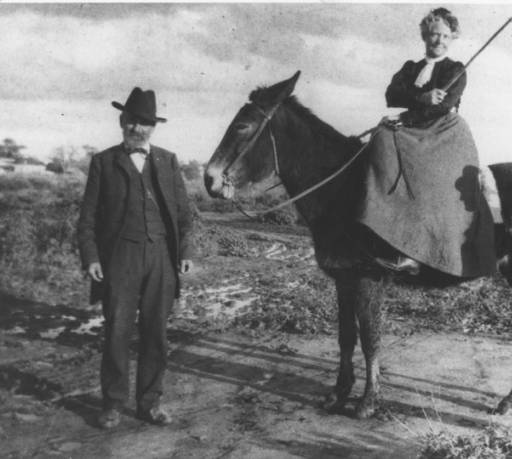
The photograph. Winfield and Helen Scott, around 1900, is the image the 1890s chapter uses to show the founding couple.
The Scott. The Scott Resort & Spa on Scottsdale Road took its name in 2017 as a tip of the hat to Winfield and Helen together.
The museum. The Scottsdale Historical Museum in the Little Red Schoolhouse tells the founding story with period photographs.
What the record can and can’t tell us
The dates line up around a working farm. In 1891, with Winfield still a serving chaplain, the ranch was already in large part Helen’s to run. In 1893 the couple settled on it for good. Days before Christmas in 1895 the Scott home burned to the ground, and the neighbors Winfield had recruited took the family in and helped rebuild. It was the first real test of the colony, and it passed with the founders as beneficiaries.
After that the record goes quiet on her, with one exception. Lynch, Winfield’s biographer, writes that the first election of School District No. 48, in 1897, drew twenty-nine votes, many of them cast by women Helen Scott brought to the polls. It is the only account of her acting in the settlement’s public life, and the 1888–1911 politics chapter notes that it rests on Lynch alone. Lynch adds her church work: she presided over the Women’s Missionary Society at an Arizona Baptist convention, filled Winfield’s Prescott pulpit one Sunday evening when he was called away, and in 1902 was elected president of the Arizona Baptist Association. There is no documented role for her in the store.
The ranch she ran
What “running the ranch” meant can be read from the farm’s own record, which the Ledger for 1888–1909 assembles from Lynch and the newspapers. By the autumn of 1891 the Scott nursery was advertising orange and lemon trees in the Phoenix Herald by the hundred and the thousand, at sixty to seventy cents a tree. The record cold of 1891 and 1892 and the drought of the late 1890s turned the farm away from citrus: in December 1897 five acres of vines were plowed under for alfalfa, and in his 1898 campaign Winfield told a Phoenix rally, “I was compelled to grub out eighty acres of orchard at my ranch because there was not sufficient water.” By 1905 the ranch was running about a hundred head of dairy cattle and selling spare alfalfa at $12 a ton. The Scotts kept about 200 acres around today’s Scottsdale and Indian School roads and farmed them until 1908.
The founder was often away. He sat in the 20th Territorial Legislature in 1899, served as pastor of Lone Star Baptist Church in Prescott from September 1899 to August 1900, running the colony by correspondence, and from 1903 presided over the territorial university’s regents. The site’s pages credit the day-to-day farm to Helen through those years, on the authority of the town’s histories rather than any record in her hand.
The full story
Helen Scott enters Scottsdale’s story alongside her husband, a Baptist minister and Army chaplain who had bought a square mile of desert beside the Arizona Canal in 1888. For its first years the claim was worked by Winfield’s brother George Washington Scott while Winfield was still on active duty.
By the early 1890s the ranch was, by most accounts, largely in Helen’s hands, and in 1893 Winfield’s old war wounds ended his Army career and brought them both onto the land full-time. The division of labor from then on is the one fact about her the record repeats: Winfield preached, recruited and politicked; Helen ran much of the ranch. When the promotional name “Orangedale” gave way to Scottsdale in 1894, the place carrying her husband’s name was, day to day, a farm she managed.
The December 1895 fire is the most vivid moment the record gives her. The Scott home was lost days before Christmas, and neighbors took Winfield and Helen in until it could be rebuilt. Around 1900 the couple sat for the photograph that still illustrates the founding era. Winfield died in 1910. In the last months of his life he had contracted for a chapel in San Diego; Helen took on a $1,000 mortgage on her new home to see it built, the Scott Memorial Chapel was finished in February 1911, and she presented the congregation a clear title in June 1913. In the spring of 1911 she took Winfield to San Diego’s Mount Hope Cemetery for burial and, in Lynch’s words, “said good-bye to Arizona for the last time.” She spent the rest of her life on that church and died in 1931, by Lynch’s family chart.
The photograph, and the name
The picture is the one firm image the record keeps of her. The 1900 year page dates it to that year and says the couple were photographed at the ranch with the mule Old Maud; the site’s captions give it as around 1900. It hangs over the founding story in the 1890s chapter and on this page.
Her name came back to Scottsdale Road in 2017, when the former Executive House Arizonian, opened in 1961, was renamed The Scott in a nod to Winfield and Helen together. The city’s own history, quoted in the Desert Land Act entry, also puts her on the founding transaction, saying that Scott and his wife Helen bought the 640 acres for $2.50 an acre; Lynch, reading the land office record, gives the payments under Winfield’s entry. The 75th-anniversary booklet says the city keeps a Founders’ Day each February 26 in honor of the two of them, though it names no organizer, and the quiet calendar suggests where to ask.