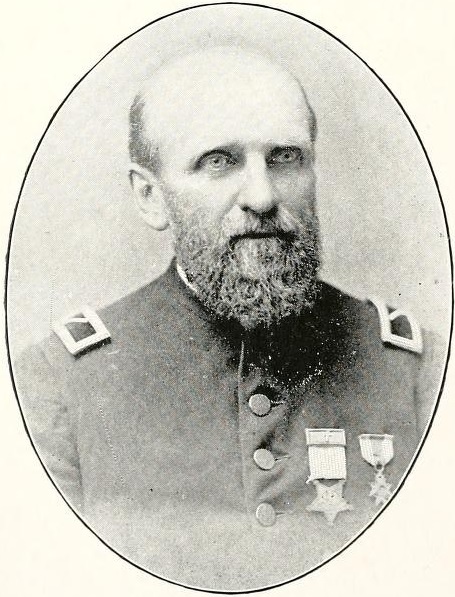
Why he matters
Scottsdale is the rare American city named for the man who actually started it. Winfield Scott did not discover the land or dig its water; the Hohokam and William J. Murphy had done those jobs. What he did was bet on it. In July 1888 he put about $320 down on a square mile of creosote flats beside the brand-new Arizona Canal, and then he spent twenty-two years talking other people into joining him.
That second part is the real founding. Scott was a salesman in a minister’s collar: preacher, recruiter, farmer and one-man chamber of commerce. He pitched cheap irrigated land, dry air and a dry town, and he drew exactly the settlers he wanted, sober churchgoing families from the Midwest and East. He was his own best advertisement, a wounded, asthmatic veteran visibly thriving in the desert.
He was right about the land and wrong about the oranges. The citrus colony nicknamed “Orangedale” froze. The town that grew instead kept his name.
Where to find his mark today
The claim itself. Scottsdale, Hayden, Indian School and Chaparral Roads trace the section he bought. Old Town is inside it, and the Old Town on foot walk starts from his story.
The Little Red Schoolhouse. The Scottsdale Historical Museum in the 1909 schoolhouse is the one room that tells the founding story with artifacts.
The Arizona Canal. The ditch that made his claim farmable still runs past the Waterfront. Stand on the bank and you are looking at the reason he came.
The colony he sold
Scott’s settlement was a deliberate project, and the milestones came fast once he was on the land full-time. Utley’s townsite and the new name in 1894. A school district and a one-room school in 1896, taught by Hattie Green. J.L. Davis’s store and post office at Brown and Main in 1897, now remembered at the Davis store site. His own seat in the Territorial House, won in 1898.
It was not an easy run. The Scott home burned days before Christmas in 1895, and neighbors took the family in. The area’s first recorded murders happened on his property in 1901. A drought nearly emptied the colony at the turn of the century, until Valley farmers pledged their land to fund Roosevelt Dam in 1903. Scott signed on with everyone else. The name he left is on a resort now, too: The Scott on Scottsdale Road was named in 2017 for Winfield and Helen.
The full story
Winfield Scott was born in Michigan in 1837 and named for the War of 1812 general, no relation. He fought as a Union infantry captain at Antietam and Fredericksburg, where he was badly wounded, and after the war he became a Baptist minister and then a U.S. Army chaplain. Postings took him west, and promotional literature about the Salt River Valley took him the rest of the way.
In 1888, while stationed on the Pacific coast, he toured the valley under the new Arizona Canal and liked what he saw. That July, at about 51, he filed on 640 acres under the Desert Land Act at $2.50 an acre, with 50 cents an acre down: roughly $320 on a square mile of desert, in a transaction the site’s 1880s chapter treats as the city’s founding act. Still on active duty, he sent his brother George Washington Scott to work the claim in 1889. The brothers planted citrus, figs, almonds, grapes, peanuts and barley. Freezes killed most of the citrus.
In 1893 the Fredericksburg wounds forced his retirement, and he and his wife Helen Scott moved onto the ranch. His most consequential recruit, the retired Chicago banker Albert G. Utley, platted a 40-acre townsite next door in 1894. The paperwork said “Orangedale”; by the time it settled, the town was Scottsdale. The 1890s filled in around him: a school, a store, a post office and a founder in the territorial legislature, where he took his seat in January 1899.
The 1900s were harder. Drought starved the canals and drove families out, and Scott, like the rest of the valley’s landowners, pledged his land in 1903 as security for the federal dam that would save it. That same year he was appointed chancellor of Tempe Normal School, the future Arizona State University.
Winfield Scott died on October 19, 1910, aged 73, as the count recorded 267 residents in the town that carried his name. His funeral drew mourners from across the Valley. Roosevelt Dam was dedicated months later. He lived long enough to see the bet assured and not long enough to see it paid, and the 1910s cotton boom that followed belonged to his neighbors. The Founding & Pioneer era is, in every sense, his.