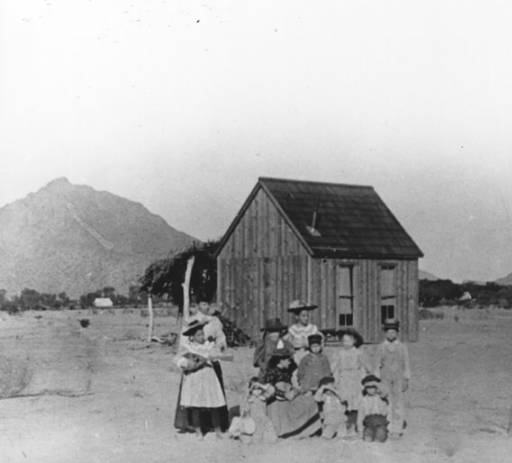
Seventeen children
In the summer of 1896 the settlement beside Winfield Scott’s ranch had no name anyone agreed on, no store, no post office and no church building. It had children. Seventeen of them, by the count the families made when they petitioned the county that summer to form a school district, and the petition — which spelled the place “Scotts-Dale” — was granted on July 13, 1896. The new district was numbered 48, a number the Scottsdale Unified School District still carries.
The first classroom was a front room. Alza Blount, who had come from Illinois with her husband George for her health, taught the first eight to ten pupils in the family’s adobe house just south of today’s Civic Center Plaza, for $40 a month. The first school board was Scott himself, John Tait and Frank Titus. By fall the settlers had pooled their labor — the same neighborly labor that had rebuilt the Scott home after the fire the previous Christmas — and raised a plain frame room sixteen feet by eighteen on donated land. It opened with fourteen pupils in all eight grades, taught by Hattie Green for $45 a month, and on the days it was not a school it was the church and the meeting hall.
Why a school first
The order of Scottsdale’s firsts is a clue to the kind of place it was. The chaplain’s colony was recruited from temperance-minded, church-going families, many of them with sick relatives sent west for the dry air, and their first act of collective government was to educate their children. The store and the post office came the next year, in 1897; the townsite plat had been filed by Albert Utley in 1894 but the name was not yet fixed. The school was the first thing that made the scattering of farms a community with a boundary and a tax.
It also outgrew itself almost immediately. A twelve-foot room was added in August 1897; by 1909 the frame building was hopeless, and thirteen voters — every one of them a yes — approved a $5,000 bond for the two-room brick school that opened that fall and was dedicated on February 26, 1910. That building, the Little Red Schoolhouse, is the museum where the district’s story is told today. The rest of the founding decade is in the 1890s chapter.