Why she matters
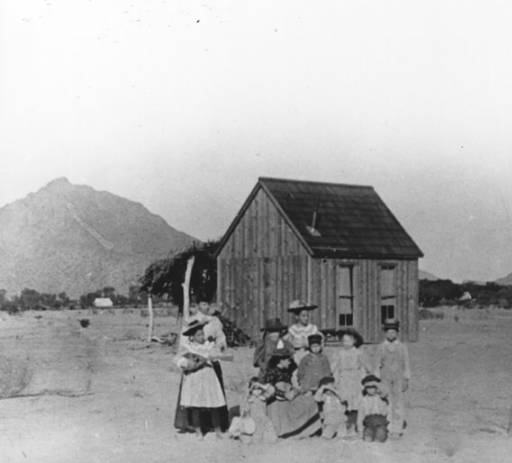
Scottsdale’s first public building was a school, and Hattie Green was its teacher. (The district’s first classes, before the building went up, met in Alza Blount’s adobe home, with Blount paid $40 a month.) In 1896 the settlers organized School District No. 48 and, with the same pooled labor that had rebuilt the Scott home after the fire the winter before, put up a plain frame room sixteen feet by eighteen. It opened with fourteen pupils. Green taught them for $45 a month.
The building worked a full week: schoolroom on weekdays, church and meeting hall the rest of the time. For a colony founded by a temperance-minded chaplain, that was the right first civic statement, and she was the person standing at the front of it.
Where to find her mark today
The Little Red Schoolhouse. The frame school is gone, but its 1909 brick successor, the Little Red Schoolhouse, now the Scottsdale Historical Museum, tells the story, with a classroom furnished as it would have looked in 1910.
The Civic Center mall. The schoolhouse stands at the heart of Old Town’s civic blocks, a short walk from Brown and Main.
What we know, and what we don’t
The record of Hattie Green is essentially one sentence: the teacher of the 1896 schoolhouse, fourteen pupils, $45 a month, after Alza Blount had taught the first term in her home. Her life dates, where she came from and how long she taught are not documented in the sources this site draws on, and this profile will not invent them.
The school itself tells the rest. The town kept arriving, so a twelve-foot room was tacked on in August 1897. By 1909 the frame building was hopeless, voters passed a bond, and the town spent about $4,500 on a brick grammar school, the one that still stands. The 1890s chapter and the founding era place the school among the three firsts, townsite, school and store, that turned a farm colony into a town.
The full story
By 1896 Winfield Scott’s colony had a name, a townsite and a few dozen families, and it needed a school. The settlers organized School District No. 48 and built the one-room frame schoolhouse themselves. Hattie Green took the job of teaching its fourteen pupils for $45 a month.
A year later J.L. Davis opened the first store and post office a short walk away, and the school got its twelve-foot addition. The frame building served until 1909, when the brick Little Red Schoolhouse replaced it. That building went on to be town hall, justice court and library, and since 1991 the town’s history museum. The room where Scottsdale first went to school is gone, and the teacher is a single line in the record, but the district she started teaching for is the reason the town’s most important old building exists.