Why he matters
Scottsdale has plenty of famous things. It has exactly one that historians of the twentieth century are obliged to mention, and Frank Lloyd Wright built it. In December 1937, seventy years old and rebuilding his career, he bought a mesa of creosote, granite and saguaro at the foot of the McDowell Mountains, bought for very little because nobody else wanted to be that far from a paved road. A month later his apprentices were quarrying rock.
Taliesin West made a farm village of a couple of thousand people a name in the history of architecture. It also drew architects and craftsmen who went on to build the city itself. When Scottsdale’s boosters of the 1950s sold the place as an arts capital, this mesa was their evidence.
Where to find his mark today
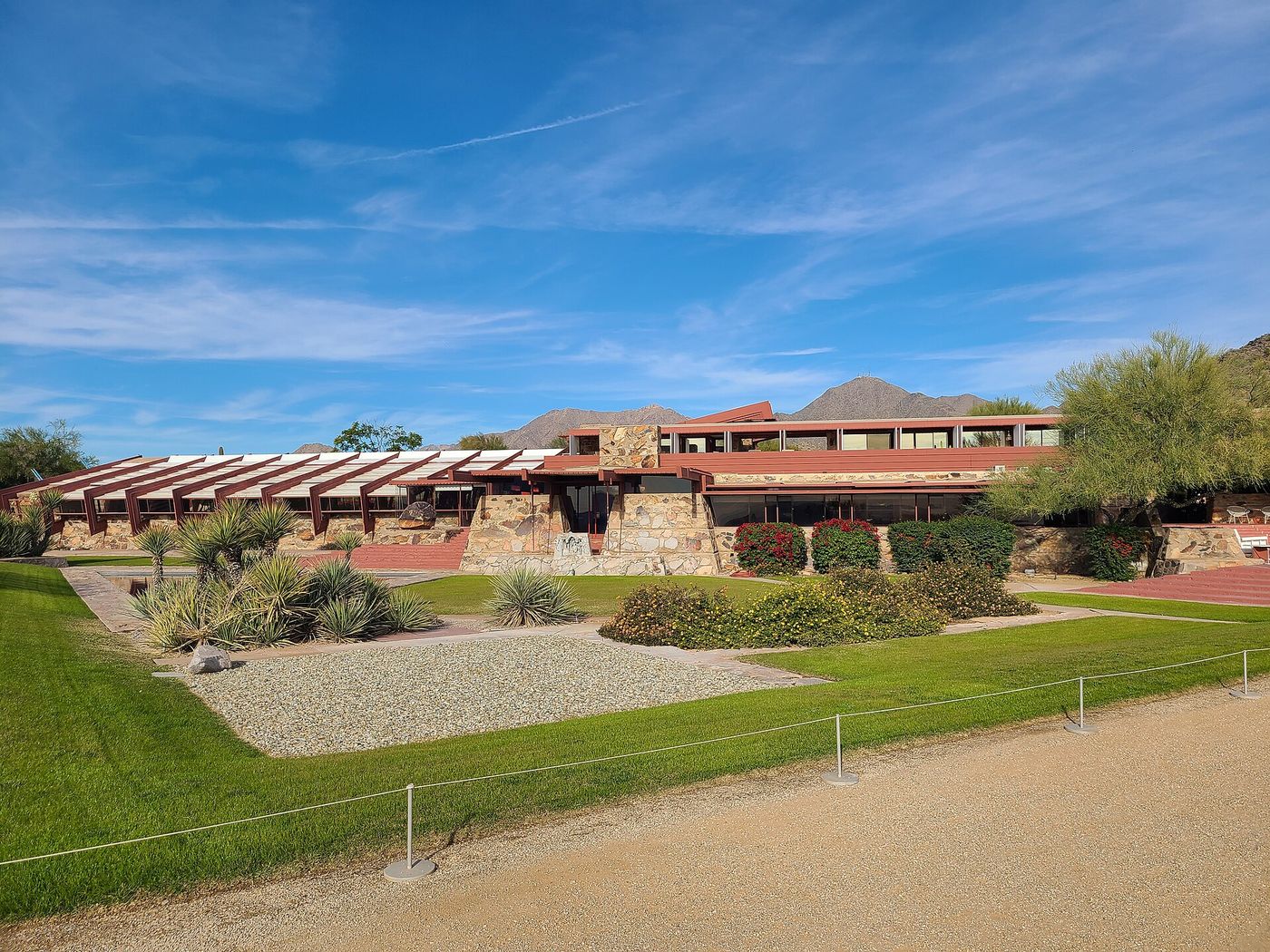
Taliesin West. His winter home, studio and school, still run by the Frank Lloyd Wright Foundation and open for ticketed, timed tours. A National Historic Landmark since 1982 and a UNESCO World Heritage Site since 2019.
The Frank Lloyd Wright Spire. A 125-foot turquoise steel-and-glass tower in a shopping center lot, the only built piece of his 1957 design for an Arizona capitol. Free, any hour, best after dark.
Frank Lloyd Wright Boulevard. The six-lane spine of north Scottsdale runs to his compound and carries his name. He would have hated the traffic.
The desert that taught him
Wright had been circling the Valley for a decade. He came in 1928 to consult on the Arizona Biltmore and in 1929 built Ocatilla, a temporary camp of canvas-roofed boxes south of Phoenix. That one season convinced him that desert light called for translucent roofs rather than glass, and that a building here should be low, angular and made of the ground. The December 1937 purchase put that into practice, and the 1930s chapter covers the town he arrived in.
His influence ran through his students. Paolo Soleri apprenticed on the mesa in the 1940s and later built Cosanti and the Soleri Bridge. Edward Varney, who trained under Wright, designed the Hotel Valley Ho. In 2020 the school Wright founded left his mesa and moved to Soleri’s sites.
The full story
Frank Lloyd Wright was born in Wisconsin in 1867 and was already the most famous architect in America when pneumonia caught him there in 1936. His doctors told him to winter somewhere dry. He knew where. In December 1937 he bought about 600 acres of raw desert on a mesa below the McDowell Mountains, well outside the Scottsdale townsite, with no water, no power, and the diagonal mountain lines he wanted to build against. The Taliesin West page puts the price at a few dollars an acre and the holding at “several hundred acres.” Most local histories say about 600.
He did not wait for spring. The Taliesin Fellowship, his family and some thirty apprentices who paid tuition for the privilege of manual labor, came west, pitched tents, and in January 1938 began to build. The method was desert masonry: rocks chosen for their faces, set in wooden forms, and backed with concrete mixed from desert sand, under redwood frames stretched with canvas so the Sonoran glare came through as working light. The apprentices quarried, mixed and hauled all of it themselves, and Wright kept revising it every winter. A cabaret theatre went in early in the 1950s, and a music pavilion seating about 135 followed in 1957.
That same year, at 89, he offered the state an unsolicited capitol design called Oasis: a honeycomb glass canopy in Papago Park with a spire over each wing. The legislature found it too modern and too expensive. Wright died in April 1959, at 91, having spent every winter since 1937 on the mesa (1959). His widow Olgivanna kept the Fellowship and the school running for decades.
The honors came afterward: the National Register in 1974, National Historic Landmark in 1982, and UNESCO World Heritage in 2019. In 2004 apprentice Arnold Roy adapted one Oasis spire to modern building codes, and it was lit on April 28 at Scottsdale Road and the boulevard that already bore Wright’s name (2004).
The desert he moved to did not stay empty. The subdivisions he went fifteen miles to avoid reached his property line decades ago. But the town that grew up to meet him learned to sell itself as an arts capital, and it was selling what he started.