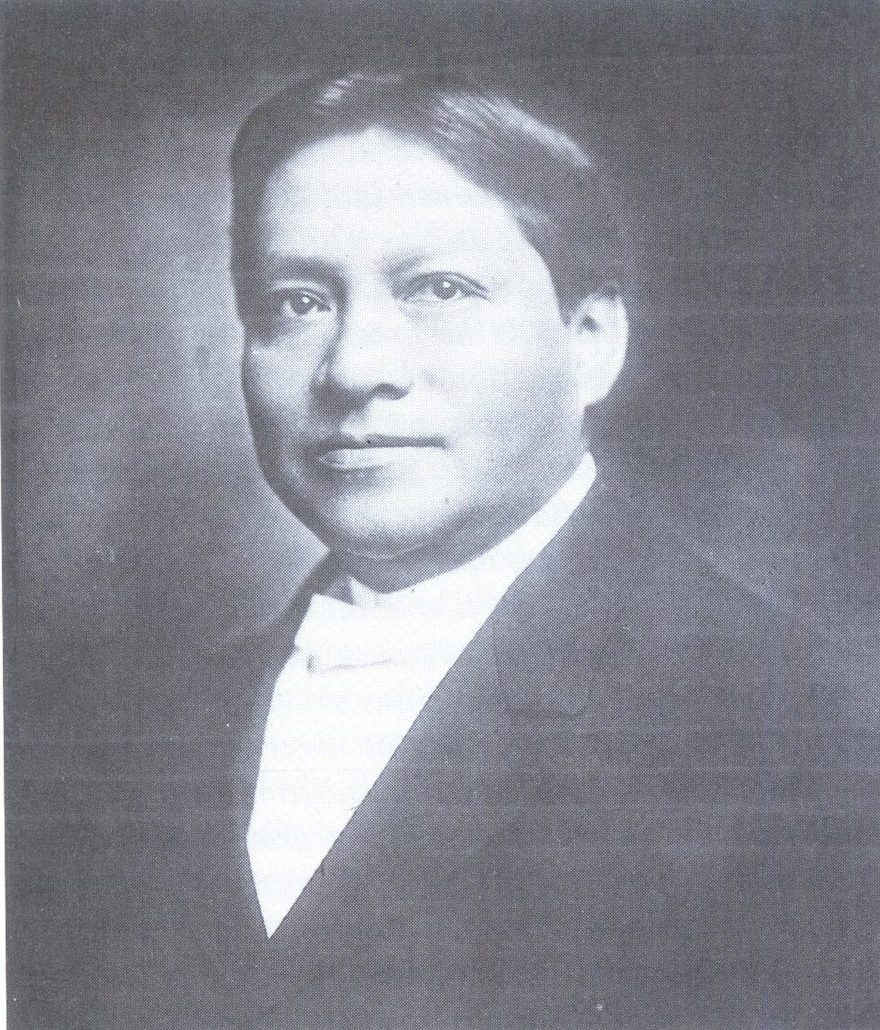
Why he matters
The Yavapai of Fort McDowell, on the Verde River over the mountains from Scottsdale, were nearly moved off their land twice. The second time, in the 1970s, it was a dam. The first time, from 1910, it was the water itself: the Salt River Valley Water Users’ Association — the same association that built Roosevelt Dam and ran the canal that watered Scottsdale’s farms — wanted the Verde, and the Indian Bureau proposed to solve the problem by moving the tribe to allotments on the Salt River reservation. The man who stopped it was a Chicago physician who had been born in the Mazatzals, sold as a five-year-old for thirty dollars, and had only learned at 35 what nation he belonged to. Carlos Montezuma, Wassaja, spent the last thirteen years of his life on the fight, and came home to die on the land he had kept.
Where to find his mark today
Fort McDowell. The reservation created in 1903, forty minutes from Old Town beyond Fountain Hills, with the Wassaja Memorial Health Center and his grave.
The Verde. The river bottom below the old fort that the Water Users’ Association wanted and the Orme Dam would have drowned.
Wassaja Hall. The University of Illinois residence hall named for him in 2015.
Seeing it for yourself
Drive the Beeline north from Shea Boulevard: the road crosses the reservation, and the We-Ko-Pa resort, the tribal offices and the health center are the modern face of the nation he defended. The 1903 day page tells how the reservation was created, the November 12, 1981 page how it beat the dam, and the May 12, 1992 page how its gravel trucks faced down the FBI. For the earlier chapter — Camp McDowell, Skeleton Cave, the 1875 Exodus that scattered his people — read 1450–1887. The McDowell Mountains in the Preserve were Kwevkepaya country before they were anyone else’s.
The full story
He was born about 1866 near Four Peaks, in the range that fills the eastern horizon from north Scottsdale, and named Wassaja. In October 1871 — ten months before the Army’s massacre at Skeleton Cave — a Pima war party struck his band’s camp at Iron Peak, killed some thirty people, and carried off the children. His sisters were sold into Mexico. He was bought at Adamsville, on the Gila, by an Italian photographer named Carlo Gentile for thirty silver dollars, baptized Carlos Montezuma at Florence on November 17, 1871, and taken east. He performed as “Azteka” in Buffalo Bill Cody’s stage show at six, went to school in Chicago, Galesburg and Brooklyn, graduated from Urbana High School with honors, and took a chemistry degree at the University of Illinois in 1884 and a medical degree at Chicago Medical College in 1889 — the first Native American man to earn one. Charles Mayo was a classmate.
He spent seven years as a government physician on reservations and at Richard Henry Pratt’s Carlisle Indian School, absorbing Pratt’s assimilationist creed and then, over the following decades, turning it against the bureaucracy that ran it. In 1896 he opened a practice in Chicago. In 1901 he went back to Arizona for the first time and found, at the old fort on the Verde, cousins he had never met: Charles and George Dickens, and the chief Yuma Frank. They told him he was not a “Mohave-Apache,” the Army’s label, but Yavapai. He supported the executive order of September 15, 1903 that turned the abandoned Camp McDowell into the tribe’s reservation, and returned nearly every autumn after.
The letter came on March 29, 1910. “Lately I learned,” Charles Dickens wrote, “that our agent have heard from Washington that we are to move to the Pima Indian Reservation.” The Indian Bureau’s plan was to give the Yavapai allotments on the Salt River reservation, where their claim to water would be weak, and free the Verde for the Salt River Valley Water Users’ Association, whose dam at Roosevelt had just been finished and whose members farmed the canal country that included Scottsdale. Montezuma accepted power of attorney for the tribe. For thirteen years he wrote, lobbied, testified and printed: he co-founded the Society of American Indians in 1911, delivered “Let My People Go” to it in 1915 and had it read into the Congressional Record, and from April 1916 to November 1922 published Wassaja, “Freedom’s Signal for the Indian,” at his own expense. “In these forty years’ absence from my people,” he wrote, “I have not forgotten them. They have been in my heart day and night.” The removal was never carried out.
Tuberculosis found him in 1922. That December he went home to Fort McDowell, had the Dickens family build him a traditional brush shelter, refused a Tempe doctor’s advice to enter a sanatorium, and died in it on January 31, 1923, aged about 56. He is buried in the Ba Dah Mod Jo cemetery. The tribe he kept on the Verde voted 144 to 57 against the Orme Dam in 1976 and won; it named its clinic for him in 1996. The farm-town era is the Scottsdale that drank the water he would not let them take.