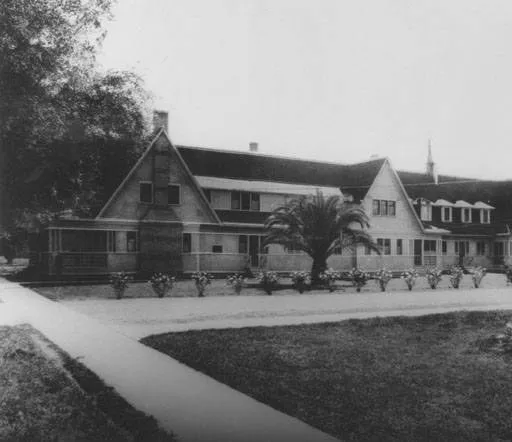

What was the Ingleside Inn?
Before Scottsdale had a single hotel, the resort industry that would define it was invented in an orange grove two miles west of town. The Ingleside Club, opened for the winter of 1909–10, was the project of William J. Murphy — the audacious contractor who had built the Arizona Canal in the 1880s and taken desert land as payment — and his son Ralph. The Murphys’ problem was salesmanship at continental scale: how do you convince rich, cold Midwesterners that a cactus flat is paradise? Their answer created an industry: build them a genteel club among your citrus trees — golf, cottages, formal dinners, saddle horses — let them winter in it, and sell them the neighborhood on the way out.
By the early 1920s the club had become the public Ingleside Inn, and by any honest accounting it was the Valley of the Sun’s first luxury resort: the first to package sunshine, sport and society as a season, complete with one of the region’s earliest golf courses and a clientele that arrived by Pullman car. The health-seeker era’s medical sunshine and the coming resort era’s recreational sunshine met on its verandas.
It also wrote the industry’s ending first. The winter-society model died with World War II; the inn closed in the early 1940s, hosted the Brownmoor School for Girls from 1945, and disappeared under apartments and shops by the 1960s. Nothing remains but the canal, the neighborhood’s name — and the business model of every resort in this archive.
Why Ingleside mattered
It fused resorts and real estate — permanently. The club existed to move land: Murphy’s Ingleside colony needed believers, and two weeks of graded roads, grapefruit at breakfast and Camelback at golden hour converted them. That formula — hospitality as the showroom for property — built the Biltmore district, Gainey Ranch, McCormick Ranch, Kierland, DC Ranch and Troon. Scottsdale’s entire growth machine is Ingleside’s marketing plan at metropolitan scale.
It proved the season. Ingleside demonstrated that the Valley’s product wasn’t land or even health, but winter itself — November-to-April as a sellable luxury. The rail-era wealthy who wintered at Ingleside taught their heirs to winter at Jokake and Camelback Inn; their heirs’ heirs book the Phoenician. The migration Ingleside started never stopped — it just got faster planes.
It set the amenity canon. Golf, riding, cottages over corridors, dressed dinners, desert excursions: the 1920s Ingleside brochure reads like a modern resort site with the fonts changed. Even the health subtext survives — today’s spa-and-wellness positioning is the medical-sunshine pitch of 1910 wearing yoga pants.
Its ghost is walkable. The Arizona Canal still runs its 1885 course past the old grounds near 64th Street and Indian School; the Ingleside name persists on the district; and the mature palms and citrus scattered through the neighborhood are the colony’s living remnant. As lost-resort pilgrimages go, it’s the Valley’s oldest — and its emptiest, which is its own lesson.
The canal-builder’s long game
Ingleside’s deep story is water arbitrage. W.J. Murphy took enormous risk building the Arizona Canal (completed 1885) for a consortium that paid him substantially in the desert acreage the canal would irrigate — a bet that made him one of the Valley’s great landholders and its most motivated promoter. His Ingleside colony (the name conjuring cozy English gentility, aimed straight at homesick Midwestern money) planted citrus as proof-of-concept and the club as theater. The sequence matters: infrastructure → agriculture → hospitality → real estate. Scottsdale historians sometimes note that Winfield Scott’s neighboring experiment ran the same play at farm scale; Murphy ran it at empire scale, and the 1909 club was its stagecraft.
The club-to-inn evolution tracked the Valley’s first tourism wave. The 1910s–20s brought the health-seekers (tuberculosis sanatoria dotted the desert) and the rail-leisure class in overlapping streams; Ingleside served the respectable overlap — sunshine as both cure and pleasure. Its 1920s heyday made it the social capital of the eastern Valley: golf tournaments, society-page winters, the first sustained demonstration that this desert could host aristocracy. Crucially, its success seeded its own eclipse: the proven model drew imitators with better sites — Jokake (1926) closer under Camelback, the Biltmore (1929) with Wright-adjacent glamour, Camelback Inn (1936) with Jack Stewart’s genius — and Ingleside, oldest and increasingly dated, slid from flagship to elder.
The ending was structural, not scandalous. The winter-resort economy presumed a leisured class with rail-era travel rhythms; the war requisitioned both. Closure in the early 1940s, the Brownmoor School interlude from 1945 (girls’ boarding schools in former resorts were a minor Arizona genre — Jokake ran one too), then the quiet postwar demolitions as land value outran nostalgia — completed by Brownmoor Estates (1962), Charles Polacek’s senior apartments, and the development that holds the rest of the ground today. No preservation fight; the movement that would later save the Valley Ho was decades unborn.
What deserves remembering is the asymmetry between fame and consequence. Ingleside is the least-known name in this archive and arguably its most important: the property that proved the Valley’s fundamental business — selling winter to people from somewhere else — and wrote the operating manual for a century of copies. Every resort page on this site is, in the deepest sense, an Ingleside footnote.