Why the desert
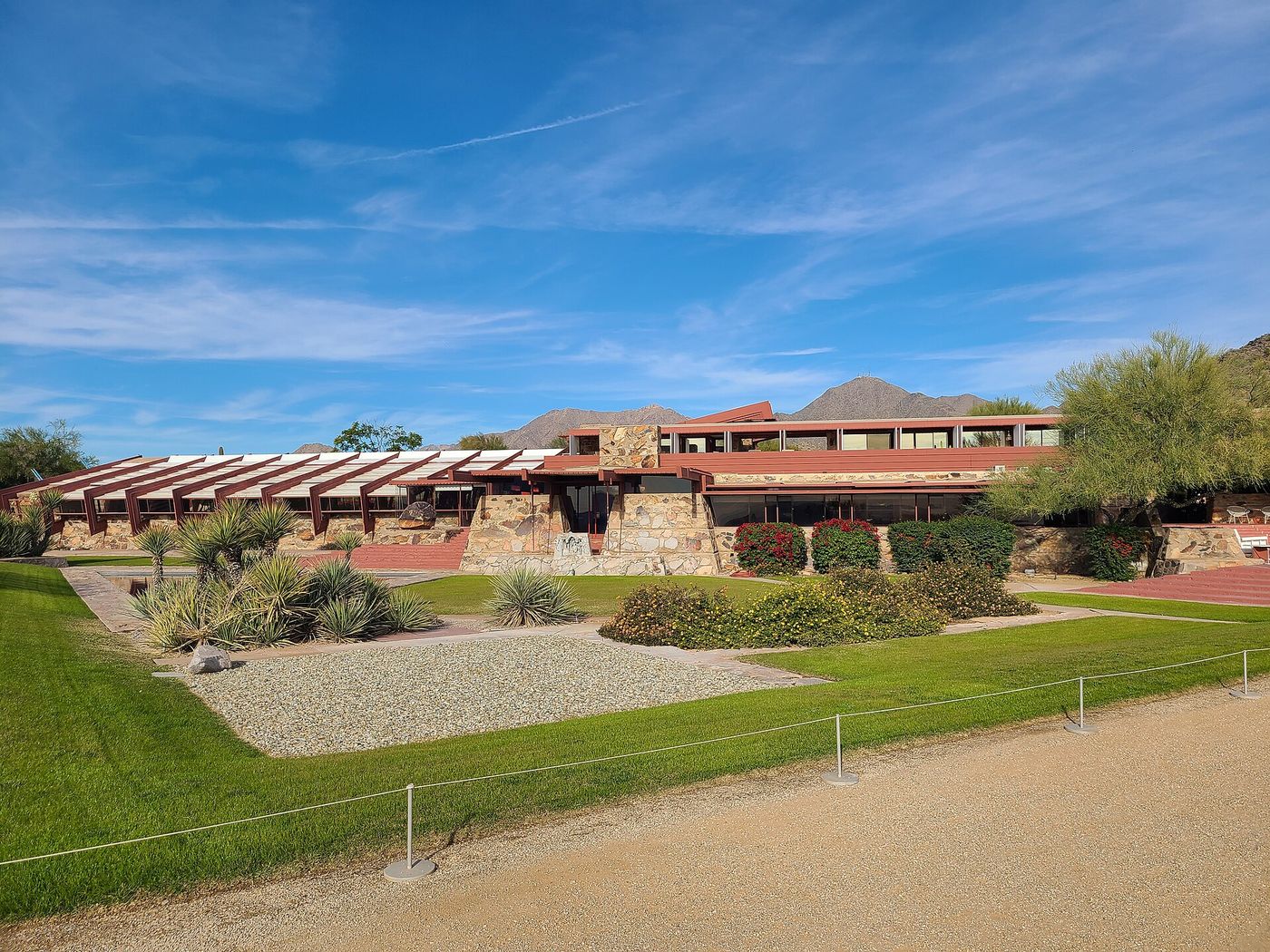
Wright had known the Valley for a decade. He came in 1928 to consult on the Arizona Biltmore, built a canvas-roofed camp called Ocatilla in the desert south of Phoenix the following winter, and left convinced that the Sonoran light and the diagonal lines of its mountains were the most instructive landscape he had ever worked in. A bout of pneumonia in Wisconsin in 1936 turned the conviction into a prescription: his doctors told him to winter somewhere dry. He wanted land that was cheap, remote, and untouched, and in December 1937 he found it — a mesa of creosote, rock, and saguaro at the base of the McDowell Mountains, about 600 acres, bought for very little because nobody else wanted to be that far from anything.
He did not wait for spring. The Taliesin Fellowship — Wright’s family and some thirty apprentices — came west that winter and camped on the site in tents while Wright walked the ground and drew. In January 1938 they began to build, and the method was the building’s meaning: local rock set in wooden forms and packed with concrete, which Wright called desert masonry; redwood beams; canvas panels for roofs so the light came through white. The apprentices quarried, mixed, and hauled it all themselves. For the next two decades Wright would spend every winter here, building and rebuilding, until his death in 1959.
What it meant for the town
Scottsdale in 1937 was a farm village of a few thousand with a brand-new resort at the Camelback Inn and a growing colony of artists and craftsmen — George Ellis was homesteading the compound that became Cattle Track that same year. Taliesin West gave that colony an anchor of world importance. The architects who trained or worked under Wright shaped the city he had chosen: Edward Varney, who designed the Hotel Valley Ho; Bennie Gonzales, who gave Scottsdale its Civic Center; Paolo Soleri, whose bridge spans the Arizona Canal downtown. When the boosters of the 1950s sold the town as an arts capital, this was the credential they pointed to.
The compound was named a National Historic Landmark in 1982 and a UNESCO World Heritage Site in 2019, and the Fellowship’s school operated on the mesa until 2020. The year’s other milestone — four inches of snow on the saguaros — is at January 20, 1937; the rest of the year sits at 1937, and the decade in the 1930s chapter.