Bricks by hand
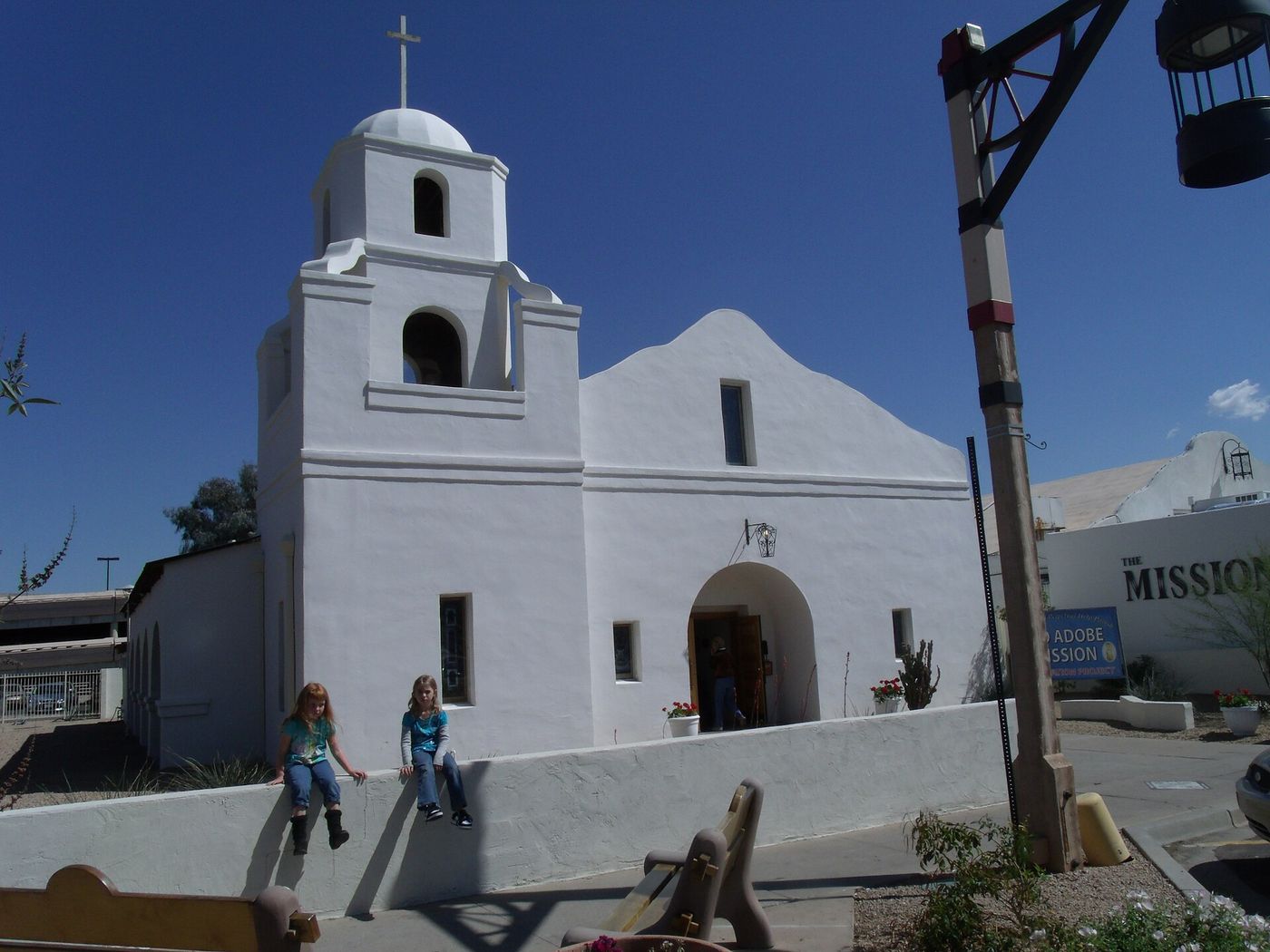
The Catholic families of Scottsdale’s south side had been talking about a church since the late 1920s, and the crash of 1929 had stalled the talk. In 1931 they started anyway. Treasurer Doña Dolores Rivera de Ochoa collected donations from as far away as Chicago; Grandvell Shumaker drew the blueprints; Robert T. Evans, the adobe architect of the Jokake Inn, shaped the design. The material came out of the ground. The Corral family, whose adobe yard had supplied the town’s early buildings, and their neighbors mixed clay, silt, sand, straw and water, molded more than 14,000 bricks of about fifty pounds each, let them cure in the sun, and laid them by hand, course by course, at the corner of First Street and Brown Avenue.
The tinsmith Bernabé Herrera, the parish’s first catechist, made the windows from salvaged church glass. The accounts of that glass differ. The mission’s own history says Herrera made fifteen panes from glass discarded in the renovation of St. Augustine’s Cathedral in Tucson. The parish’s history says Father Davis got the glass from Bishop Gercke, who was renovating “the Old Pueblo Church in Tucson.” The city’s 2001 historic register report counts five windows, four with their original stained glass. According to Salt River Stories, the windows retell the Miracle of the Roses, the story of Our Lady of Guadalupe that the Gonzales brothers would sing on the schoolhouse steps in 1949, beginning the pageant the town still stages. On Sunday, October 15, 1933, with the walls up and the bell hung, the Rev. James Davis said the first Mass.
The people who built the town
The families who built the church had built a good deal else. They had come for the cotton boom of 1917 — the Corrals among the first, in sponsored work crews from Sonora and beyond — and had stayed through the bust, digging the laterals, making the adobe, working the citrus and the dairies. The Yaqui families who had worked the canals settled the Penjamo neighborhood south of town. In the Depression’s worst year, with the Farmer’s State Bank shut since March and cotton worth nothing, they were the only people in Scottsdale building anything, and what they built was for themselves.
What became of it
The parish outgrew the adobe church and built a larger one nearby; by the 1970s the old building was a hall and, for a time, a demolition candidate. Restoration began in 2002, the eightieth anniversary was celebrated in 2013, and in September 2018 the Old Adobe Mission went on the National Register of Historic Places. It stands a block from the bank building of 1921 and the pool hall of 1923, the oldest church in a city that has since built hundreds — and the one whose walls were made by the congregation. The Old Adobe Mission guide has visiting hours; the 1930s chapter has the decade around it.