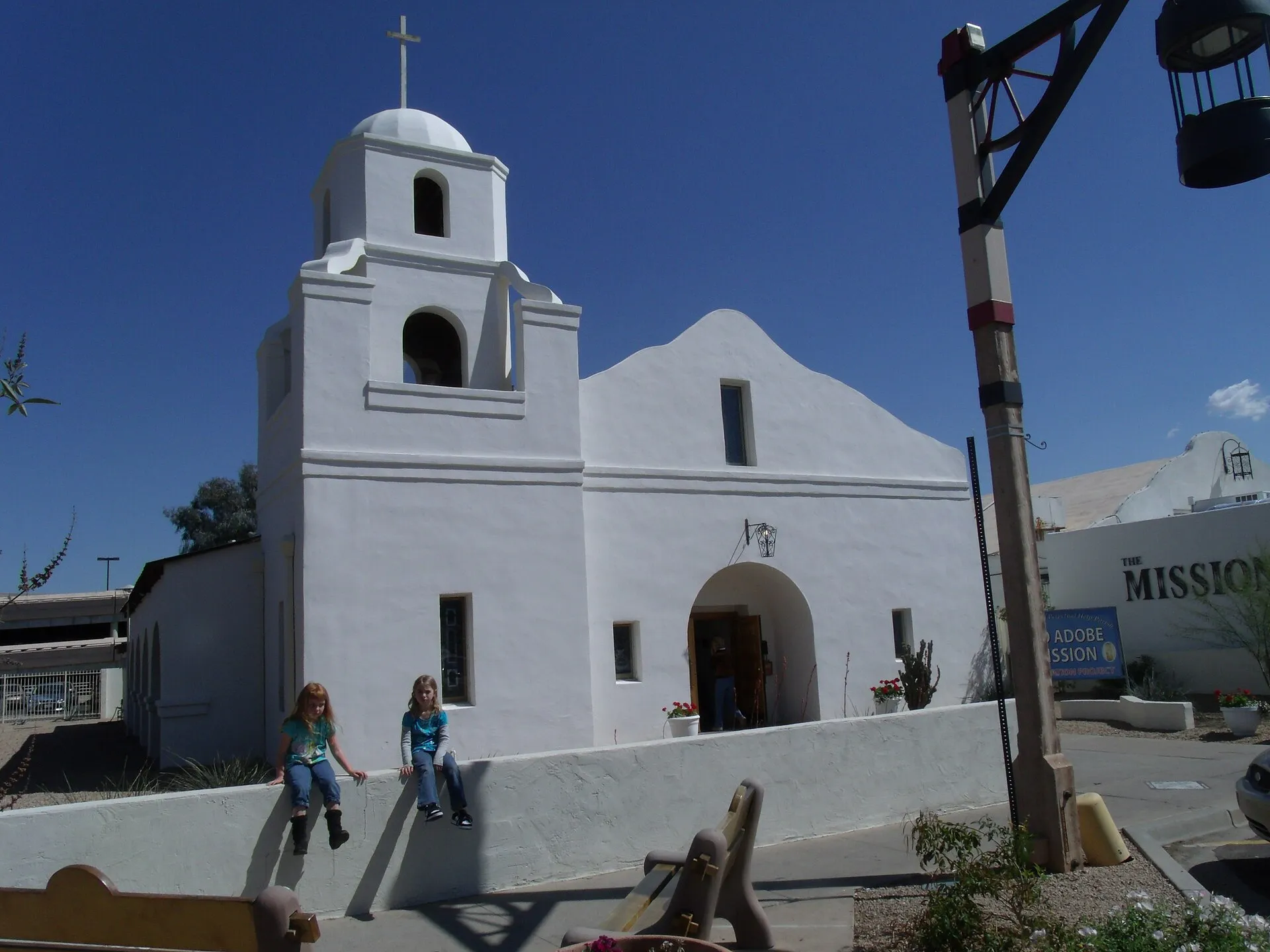

What is the Old Adobe Mission?
A block east of Scottsdale Road, on a corner most visitors never turn, stands the oldest church building in Scottsdale — and the only major landmark in Old Town that the town’s Mexican-American families built for themselves.
The Old Adobe Mission is the original Our Lady of Perpetual Help church, finished in 1933 at Brown Avenue and First Street. It is small, white and thick-walled, with a squat bell tower, an arcaded porch and a nave that seats about as many people as a school bus. The walls are the story: roughly 14,000 adobe bricks, mixed on site from native clay, silt, sand and straw, each weighing about fifty pounds, each carried and set by hand by volunteers from the families — the Corrals among them, arrived from Cananea, Sonora — who had come north for the cotton and citrus work and wanted a church they did not have to borrow.
The design came from Robert T. Evans, the Scottsdale builder and businessman better known for the Jokake Inn, who worked in a Spanish Colonial Revival idiom lifted from the mission churches of Sonora and New Mexico. The stained glass was made by a local tinsmith named Bernabé Herrera, and according to Salt River Stories its windows retell the Miracle of the Roses, the Guadalupe story the parish still stages every December as a pageant. Nobody was paid much of anything.
It is free to enter, open most afternoons from October through May, and still consecrated: Mass, weddings, baptisms and funerals happen here. What you get for the price of a walk is a cool, dim, hand-made room that predates the resorts, the galleries, the golf and the Civic Center — the actual founding artifact of a city that mostly tore its own down.
How to visit the mission right
Time it for the light, and for the season. October through May the doors are open most days — Sunday through Friday late morning to late afternoon, Saturday from 8 a.m. Winter Saturday mornings are the pick: the sun comes in low through Herrera’s glass, the adobe holds the night’s cool, and the building is at its most itself. From June through September the mission goes appointment-only, so call rather than drive; in July nobody is staffing a stone room for walk-ins.
Park in the garage, not the lot. The mission’s own parking is a handful of spaces and gets taken by event parties. Use the free public garages behind the Main Street Arts District or off Second Street and walk north on Brown — three or four minutes, all of it interesting, and it delivers you to the gate from the direction that makes the building look best.
Give it twenty minutes, not five. The instinct is to photograph the façade and leave. Go inside, sit down, let your eyes adjust, and then look at what the walls do: the deep window reveals that tell you how thick the adobe is, the hand-set irregularity along the arcade, the bell tower that had to be stabilized in 2003 because eighty years of monsoons had been eating it. Ask a docent anything — they are volunteers, most of them know the families, and several can tell you which relative made which brick.
Read it as a working church, not a museum. There is no ticket booth, no timed entry and no velvet rope, which also means no guarantee: if a funeral or a wedding is under way, the polite move is a walk around the block and a second try. Dress like you are visiting someone’s church, because you are.
Pair it with the rest of historic Old Town. The Little Red Schoolhouse — the 1909 grammar school that is now the Scottsdale Historical Museum — is six blocks south and free as well, which makes for the best hour of actual local history in the city. Add the Civic Center grounds, follow our Old Town on foot route, and finish at Sugar Bowl for ice cream in a room nearly as old as the mission’s second act.
Six years, a stock market crash, and 14,000 bricks
The story starts with a congregation that had nowhere to go. By the late 1920s Scottsdale had a substantial Mexican and Mexican-American community — families drawn north by the cotton boom of the 1910s and the citrus and construction work that followed, many of them from Sonora. They were Catholic, they were numerous, and they were worshipping wherever a priest could be arranged. So they decided to build.
Fundraising began in the late 1920s under the organizing of the community’s women, with Doña Dolores Rivera de Ochoa keeping the money. Then came 1929, and the Depression, and the kind of delay that kills most volunteer building projects. This one simply slowed down. Donations of material arrived from Catholic communities in Scottsdale, Tempe and as far away as Chicago. Robert T. Evans — the builder of the Jokake Inn, a man who had studied adobe construction in Sonora and New Mexico — supplied plans, equipment and tools, with blueprints drawn by Grandvell Shumaker. Everything else was labor, and the labor was the congregation.
Adobe was chosen because it was nearly free: dirt, straw, water, sun. What it is not is easy. Each brick came out of the form at about fifty pounds, and the church consumed roughly 14,000 of them. Parishioners and Yaqui neighbors mixed, cast, cured, hauled and laid them across about six years of evenings and weekends, while the same crews were laying adobe in the fancy houses going up around Camelback Mountain. In 1933 the walls closed, the roof went on, Herrera’s stained glass went into the openings, and on October 15, by most accounts (the parish’s own history says October 14), Mass was celebrated in a finished church.
Then the ordinary cruelty of growth. Our Lady of Perpetual Help became a full parish in 1949 and promptly outgrew its own building; in 1956 the congregation decamped to a larger church on Miller Road. The little adobe entered forty-five years of usefulness without purpose — parish hall, meeting room for church societies, rehearsal space for the Scottsdale Symphony, gallery and office space — which is exactly the condition in which adobe buildings quietly dissolve. Water gets in at the parapet, the plaster fails, the brick turns back into dirt.
What saved it was the second volunteer effort. The building went onto the Scottsdale Historic Register in 2001, a restoration committee formed in 2002, and grants from Arizona State Parks’ historic preservation fund paid for the unglamorous work: landscaping and drainage first, then in 2003 the bell tower stabilized, adobe repaired, stained glass restored, the arcade rebuilt. The first Mass in the building since 1956 was celebrated that year. Electrical and HVAC followed in 2006, along with a docent program that is why the doors are open at all. Eagle Scouts restored the confessional and the sacristy cabinet. A new roof went on in 2012. In 2017 a 1,200-square-foot addition and new altars finally gave the mission the back-of-house it had never had. In September 2018 it was listed on the National Register of Historic Places.
Members of the Corral family and other founding families have been working on a book about the mission and about what the Mexican community built here. That is the missing half of nearly every Scottsdale history: Winfield Scott gets a day on the calendar, the 1930s get credit for Taliesin West and the dude ranches, and the people who made the bricks get a sentence. This building is the sentence they wrote themselves.
Why it matters
Scottsdale is a city that markets its past and demolishes its evidence. Almost everything genuinely old here has either been moved, themed or replaced — which makes an unrestored-then-carefully-restored 1933 adobe church, standing on its original corner, doing its original job, the most valuable square footage in Old Town by a measure no appraiser uses. It also corrects the record. The Western-town story flatters cowboys and architects; this building says the town was also made by Mexican-American families who hauled fifty-pound bricks after work for six years because they wanted a place to pray. Go in, sit down, and notice that it is cool inside. That is dirt, straw and somebody’s grandfather, still working.