.jpg)
What was the Jokake Inn?
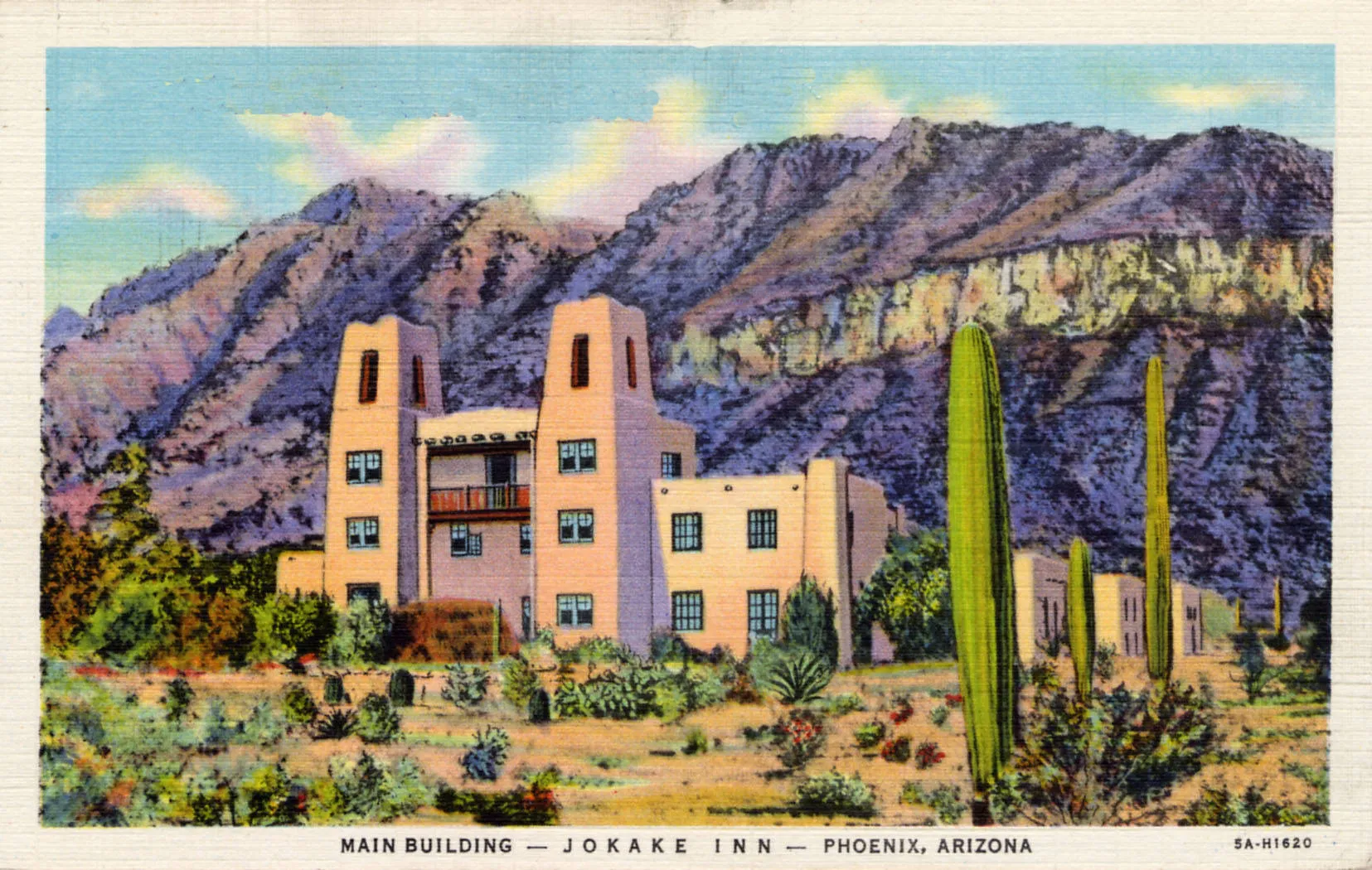
The Jokake Inn began as an accident of hospitality. Jessie Benton Evans — an acclaimed landscape painter who had fallen for the desert’s light — kept a family estate on the empty flats below Camelback, where her son Robert built a rambling adobe house in the mid-1920s. When a young Hopi visitor saw it and called it Jokake — “mud house” — the family kept the name. In 1926, Robert’s wife Sylvia and her friend Lucy Cuthbert opened the house as a tearoom for the desert-touring trade; by 1928 the tea guests were refusing to leave, and the tearoom became an inn.
What grew over the next two decades was winter Scottsdale’s defining address: adobe casitas scattered under Camelback, the American Plan (rooms and all meals, November through April), riding into the untracked desert, and a guest register that mixed industrial fortunes, working artists and titled Europeans — the seasonal aristocracy that Ingleside had first lured to the Valley, now choosing romance over gentility. In 1936 the inn raised its twin bell towers, and Scottsdale acquired the silhouette that would grace its postcards for half a century.
The long fade ran through hotelier Charles Alberding’s 1950s purchase and the resort’s late-1970s closure — and then came the ending with an asterisk. When Charles Keating assembled this land for The Phoenician in the 1980s, the bulldozers took nearly everything… except the towers. They stand today on the Phoenician’s lawn: the oldest resort architecture in Scottsdale, hiding in plain sight at America’s most notorious luxury address.
Why Jokake mattered
It aestheticized the desert resort. Ingleside had sold gentility despite the desert — lawns and citrus as civilization’s proof. Jokake, born of a painter’s estate, sold the desert itself: mud walls, exposed vigas, Camelback as the dining room’s art. That inversion — adobe romance over transplanted refinement — became the region’s signature style, running straight through Camelback Inn (1936, the same year as the towers) to every “authentic Sonoran” lobby renovation of the present day.
It anchored the Camelback corridor. Jokake proved the mountain’s southern base was the Valley’s premium hospitality dirt — a judgment the Paradise Inn (next door, 1946) ratified and Keating’s quarter-billion-dollar Phoenician monetized. The same acreage has now hosted three generations of flagship, which is the strongest land-endorsement in Arizona hospitality.
It ran on women’s enterprise. Sylvia Evans and Lucy Cuthbert built and ran the operation — as notable in 1926 as it was unremarked in the brochures — part of a quiet pattern (school mistresses, inn proprietors, ranch hostesses) by which women ran early Scottsdale’s hospitality while the histories credited the era’s colonels and magnates.
Its towers are a five-minute pilgrimage. Park at The Phoenician, walk the lawn, and stand under 1936 adobe with 1926 sightlines to the mountain. Pair it with the Hermosa Inn — Lon Megargee’s surviving hand-built contemporary — and you’ve toured what remains of the artists’ chapter of Scottsdale hospitality in one afternoon.
The mud house between two eras
Jokake’s four decades trace the whole arc of the winter-resort economy. Its 1920s birth caught the flood tide: rail-borne eastern wealth, the desert-romance vogue that Arizona Highways would soon industrialize, and the health-and-sunshine migration reaching its leisured phase. The Evans family’s art-world gravity gave the inn a bohemian-aristocratic tone its competitors couldn’t fake — Jessie Benton Evans’ salon connections seeded the guest list, and the property doubled as a plein-air campus (the desert-school tradition that would later flower at Cattle Track). The campus even ran the Jokake School for Girls in season — the resort-as-finishing-school hybrid that Ingleside’s Brownmoor afterlife echoed.
The 1936 towers deserve their architectural footnote: functional bell towers in mission-revival massing, they were built as the inn’s ceremonial front just as Camelback Inn opened across the valley — the moment the winter-resort market graduated from inns to institutions. The towers photographed so well that they became Scottsdale’s de facto logo through the 1940s, the image beneath which “The West’s Most Western Town” first marketed itself to the postwar boom.
That boom, ironically, was the solvent. Air conditioning, automobiles and year-round operation favored the new generation — the Safari’s urban glamour, Mountain Shadows’ modernism — while the American Plan’s dressed dinners aged into quaintness. Alberding’s Chicago hotel money (his Alsonett group collected fading grandes dames nationwide) kept Jokake operating through the 1950s–70s as a beloved anachronism, until operations wound down in the late 1970s and the land’s value eclipsed its buildings entirely.
The Keating ending is the corridor’s great irony. The developer whose Phoenician embodied everything Jokake wasn’t — marble against mud, leverage against seasonality — was also the one who kept the towers, whether from sentiment, marketing instinct or a preservationist whisper in the entitlement process. The result is the rarest artifact in Scottsdale hospitality: physical continuity. Every other pioneer resort in this archive survives as a street name at best. Jokake survives as architecture — two mud towers on a billionaire’s lawn, outlasting the fortune that spared them and quietly older than the city around them.