Why he matters
Saba’s was the Western-wear store at the center of Old Town for seventy years, and for most of that time the town told its story backward. The red-brick building at Brown and First avenues went up in 1921 as the Sterling Drug Store, and the date on the brick slid onto the business: this site, among others, used to credit a “Syrian-born E. M. Saba” with a 1921 Main Street dry-goods store. No source supports that. The business began with David Saba Sr., an immigrant from Lebanon who peddled goods to mining camps and ranches and opened his own Western-wear store in Chandler in 1927.
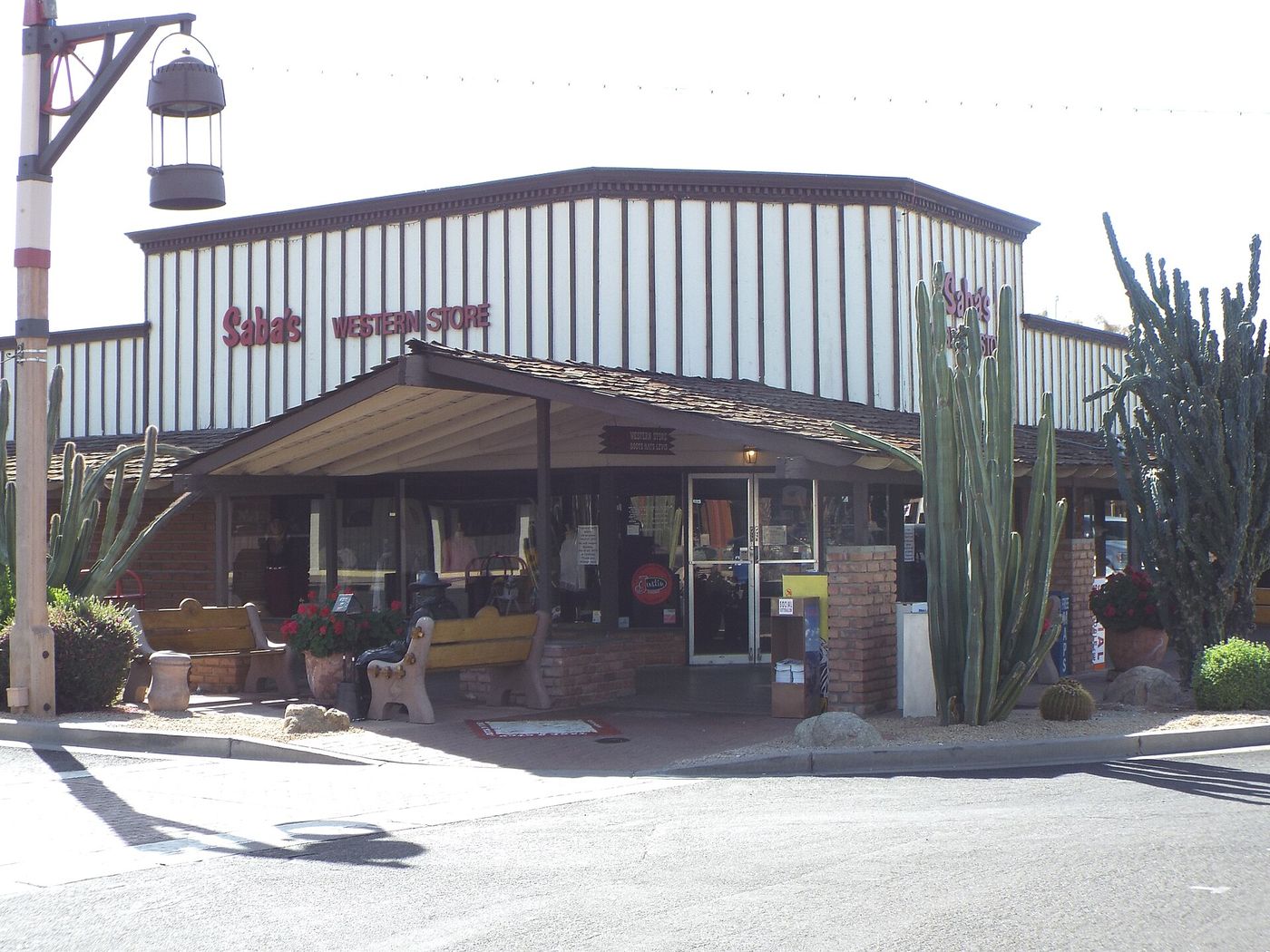
The Sabas came to Scottsdale in 1948, and the timing is the story. The town was dressing itself up as “The West’s Most Western Town,” with false fronts and hitching rails, and the family bought the old drugstore, built a rustic Western facade and porch across its front and opened Saba’s Department Store. The city’s own history of the period names it as one of three downtown buildings remade that way, with the post office that became Porter’s and the bank that became the Rusty Spur.
Where to find his mark today
The building. The 1921 Sterling Drug building on Brown Avenue keeps the porch the Sabas added. It has been on the Scottsdale Historic Register since 2001, and since 2019 it has housed The Merchantile of Scottsdale (sources differ on the corner: the city’s register and walking tour list Saba’s Department Store at 7254 East Main, now Sunrise Jewelry & Gallery).
The neighbors. The Rusty Spur Saloon pours in the 1921 bank building across Main Street, and the Song family’s store in Johnny Rose’s 1923 pool hall shared the corner with Saba’s from 1948 to 2019.
The store in the Western town
When the Sabas arrived, downtown Scottsdale was a farm town deciding to become a tourist town. The Chamber of Commerce, incorporated in 1947, would soon call it “The West’s Most Western Town,” Malcolm White had already dressed his business for the winter trade, and the 1940s and 1950s filled Brown Avenue and Main Street with board-and-batten and knotty pine. A Western-wear store from Chandler was the natural tenant for that stage set, and for the next seventy years Saba’s sold boots and hats to working ranchers, Parada del Sol riders and the winter visitors who wanted to look like both.
The Saba’s guide follows the store itself, and the 1920s chapter has the 1921 merchant row that built the building.
The full story
David Saba Sr. came from Lebanon to California in 1913 and made his living peddling goods to gold camps and ranches. In 1916 he moved to Arizona and opened a mercantile store in Ray-Sonora. Three years later he sold his share and moved to Chandler, and he kept peddling to the mining camps until, by 1927, he had saved enough to open a store of his own in Chandler, specializing in Western wear. That is the year on the family’s “Since 1927” signs. In 1972 the Chandler store moved into the old J. C. Penney building on Boston Street, and the business grew into a chain of stores across the Valley and as far as Flagstaff.
The Scottsdale chapter began after the war. In 1947, by one account, the Saba family of Chandler bought the 1921 brick building at Brown Avenue that had been the Sterling Drug Store and the Scottsdale Pharmacy; the city’s historic context dates its conversion to Saba’s Department Store to 1948, when the new owners added the rustic Western facade and porch. The store stayed for seventy years. In 2019 Saba’s left Old Town, and the Brown Avenue store became The Merchantile of Scottsdale.
A note on the record. Earlier pages on this site, and some other local histories, dated Saba’s to 1921 and gave its founder as “E. M. Saba.” The 1921 date is the building’s. What the founder’s family did in Scottsdale before 1948, if anything, is not in the sources this site has read, and his own birth and death years are not recorded in them either.