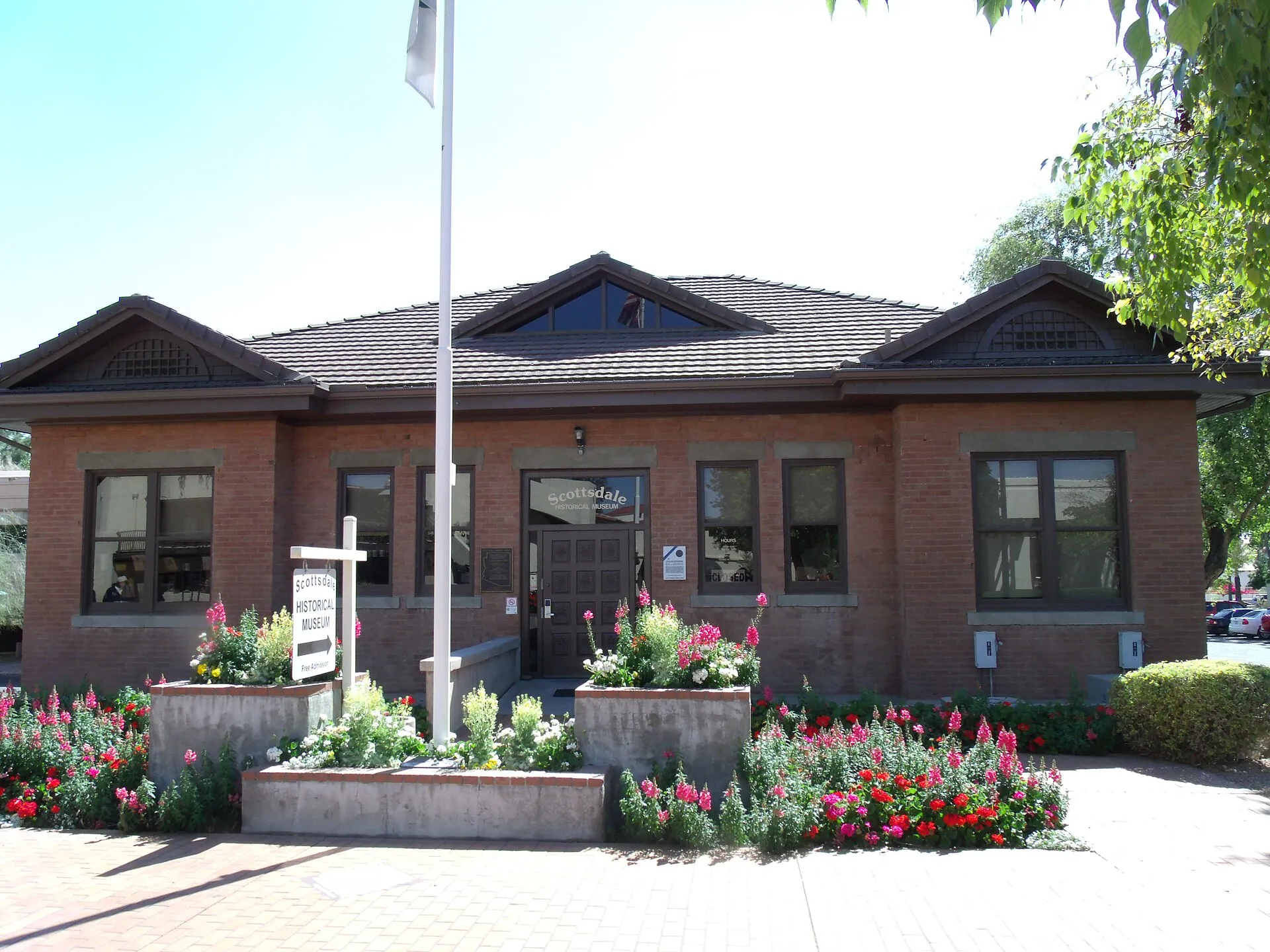

What is the Little Red Schoolhouse?
Of all the buildings on the Civic Center grounds, the important one is the small brick box everybody walks past to photograph the LOVE sculpture.
The Little Red Schoolhouse was built in 1909 as the Scottsdale Grammar School: two large classrooms, an entrance hall, a couple of storage rooms and a full basement, in red brick, for about $4,500 raised by a school bond. It replaced the town’s original one-room frame school of 1896 — sixteen feet by eighteen, fourteen pupils, a teacher named Hattie Green on $45 a month — and for the next two decades it was where Scottsdale’s children learned to read.
Then it became everything else. Renamed the Coronado School in 1928 and used for Mexican-American children in the early grades, it later served in turn as the town hall, the county justice court, and from 1963 to 1968 the entire Scottsdale Public Library. When the Scottsdale Mall project threatened to knock it down in 1968, a group of residents formed the Scottsdale Historical Society — in 1969, for this one building — and won. The chamber of commerce leased it from 1972, moved out in 1991, and the society opened the Scottsdale Historical Museum in the rooms it had spent twenty years saving.
Today it is free, small, volunteer-run, and the only place in the city that lays out Scottsdale’s whole arc in one visit: irrigation and cotton, dude ranches and cowboys, the resort boom, the incorporation fight, the Parada del Sol years. One room is furnished as a 1910 classroom. The building was listed on the National Register of Historic Places in 1994. Forty minutes, no charge, and you will understand Old Town better than most people who live here.
How to do the schoolhouse right
Check the calendar first, seriously. This is the single most common way a visit fails. The museum is closed all of June, July and August, runs shorter hours in May and September, and is dark Monday and Tuesday year-round. Peak season — October through April — is Wednesday through Saturday during the day plus Sunday afternoons. Holidays close it too. It is a volunteer operation in a hundred-year-old brick building with no reason to bake through an Arizona summer, and the schedule reflects that.
Park once and walk. The free public garages a few blocks out on Second Street and around the Fifth Avenue area are the right answer; the surface lots near Drinkwater fill with Civic Center event traffic and you will circle. From any of the garages it is five to eight minutes on foot, and the walk in past City Hall is half the context.
Give it more time than it looks like it needs. The instinct with a two-room museum is a lap and out. Slow down in the reconstructed 1910 classroom — desks, slates, the works — and then spend real time with the photographs, which are the collection’s actual treasure: Scottsdale as farm town, the schoolhouse doing each of its jobs, streets you recognize with nothing on them. Ask the volunteer at the desk a question. They are historical society members and several of them are the reason specific artifacts exist.
Bring kids, with a plan. It works beautifully for roughly ages six and up, particularly the classroom — the comparison to their own school does the teaching for you. Under six, the appeal is thin and there is no play space, so keep it short and let the Civic Center lawns and water features do the rest. Restrooms and food are a short walk away on the Civic Center campus rather than inside.
Stack it into a free Old Town history morning. Start here, walk a few minutes south down Brown Avenue to the Old Adobe Mission — the 1933 hand-built adobe church, also free — and loop back through the Fifth Avenue shops and the Civic Center grounds using our Old Town on foot route. Finish at Sugar Bowl, which has been serving ice cream in the same pink room since 1958 and belongs on this itinerary for exactly that reason. Total cost: parking, and a scoop.
Four government functions and a demolition order
Frontier towns did not build single-purpose buildings, and the Little Red Schoolhouse is what that principle looks like a century later.
Scottsdale’s first school went up in 1896, built by townspeople, a plain frame room sixteen by eighteen feet that opened with fourteen pupils. Hattie Green taught them for $45 a month. A twelve-foot room was tacked on in August 1897 because the town kept arriving. By 1909 the frame building was hopeless, voters passed a bond that May, and the town spent about $4,500 on a proper brick grammar school — two large classrooms, entrance hall, storage, and a full basement that immediately became the multipurpose room the community lacked: Sunday school, church services, polling place, Farm Improvement Society meetings, Red Cross work during the First World War. The building had an architect, too, though he rarely gets named. The Arizona Republican’s Scottsdale column of December 18, 1909, reported that work on “the new school house” had stalled for several days over a misunderstanding between the contractors and the architect, A. B. Coats, who came out to Scottsdale on business that week. That one line is the only source we have found for his name; the school district’s 1909 board minutes would confirm it.
The schoolhouse’s second life is the part Scottsdale took a long time to tell honestly. When a new, larger elementary school opened in 1928, the brick building was renamed the Coronado School and assigned to Mexican-American children in roughly the first three grades — a segregated arrangement, in plain terms, that persisted alongside the building’s role as a community center for newly arrived Mexican-American families into the 1960s. Those were the same families building the Old Adobe Mission a few blocks away in the same years. The museum’s own materials no longer dodge this, which is to its credit.
After the classrooms emptied, the building simply kept working. It was Scottsdale’s city hall and the county justice court; from 1963 to 1968 it held the city’s entire public library, which tells you something about the scale of Scottsdale on the eve of its boom. Then the boom arrived with a bulldozer. The Scottsdale Mall — the landscaped civic campus that became the Civic Center, built out around Bennie Gonzales’s white 1968 City Hall and library — needed the ground, and in 1968 the old schoolhouse was slated for demolition.
What happened next is the founding act of historic preservation in this city. Residents organized in 1968, and in December 1969 the Scottsdale Historical Society was incorporated essentially to keep one brick building standing. They won a reprieve, and in 1972 a lease arrangement put the Chamber of Commerce inside — the classic preservation move, because a building with a tenant is a building with a budget. For nineteen years the chamber worked in the old classrooms. When it moved to an adjacent building in 1991, the society finally got the keys and opened the Scottsdale Historical Museum: old photographs, artifacts, rotating exhibits and a classroom dressed as 1910. The National Register listing came on June 10, 1994.
Look at the odds it beat. Scottsdale demolished or relocated almost everything from its first fifty years; the ranch houses, the packing sheds, the original storefronts are nearly all gone. A modest school that had been converted four times over, sitting directly in the path of the city’s flagship redevelopment, should not have survived 1968. It survived because a couple of dozen people decided that a town selling itself as historic ought to keep some history, and then did the unglamorous work — leases, grants, volunteer shifts, a museum schedule — for the next half century.
Why it matters
There is a version of Scottsdale that exists entirely in brochures: cowboys, canvas, golf, art. The Little Red Schoolhouse is the corrective, because it is a real building that did real municipal work and survived by the skin of its teeth. It is also the birthplace of the instinct that later saved other things — the same civic reflex that funded the McDowell Sonoran Preserve and restored the Old Adobe Mission starts here, in 1969, with a handful of residents refusing to lose a schoolhouse. Go in, look at the 1910 classroom, then step outside and look at the glass towers on Camelback Road. Same town, one lifetime apart, and this brick box watched all of it.