The chaplain’s long bet
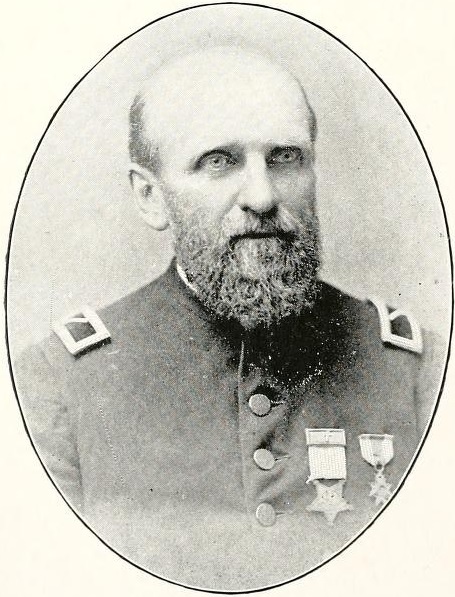
Winfield Scott’s road to the desert ran through the worst of the Civil War. Born in Michigan in 1837 and named for the general (no relation), he fought as a Union infantry captain with the 126th New York — wounded at Harpers Ferry, Gettysburg and Spotsylvania — then returned to the Baptist ministry and became an Army chaplain in 1882. Promotional literature about the Salt River Valley found him in 1888; he toured the new country under the Arizona Canal, liked it, and filed on 640 acres of creosote flats at $2.50 an acre — $320 in earnest money for the square mile that became downtown Scottsdale. His brother George Washington Scott cleared the land while the chaplain finished his Army service and started selling.
Selling was the real work of his last two decades. Scott recruited church-going families across the country to his dry, hard-praying colony, served in the territorial legislature, and in 1903 took a final public post as chancellor, the presiding officer, of the University of Arizona’s Board of Regents. He also lived through the settlement’s nearest brush with death, the drought years around the turn of the century, and signed on when Valley farmers pledged their own land in 1903 to fund a federal storage dam.
Months short of the payoff
That is what gives October 19, 1910 its particular ache. When Scott died, Roosevelt Dam stood nearly complete in its canyon 80 miles up the Salt River; five months later Theodore Roosevelt would dedicate it in person, guaranteeing forever the water Scott’s colony had gambled on. The founder saw the bet assured but never saw it paid. The count that year — 267 residents — measured a village that still had no bank, no newspaper, and no legal existence beyond a school district, and would not incorporate until 1951.
Yet the inheritance held. The town kept his name, his church — the Baptists formally organized in 1912 — and his salesman’s conviction that the desert could be marketed as paradise, an instinct later generations refined into an entire economy. The decade that opened with his funeral brought statehood, the dam, and a cotton boom; that arc runs through the 1910s chapter.