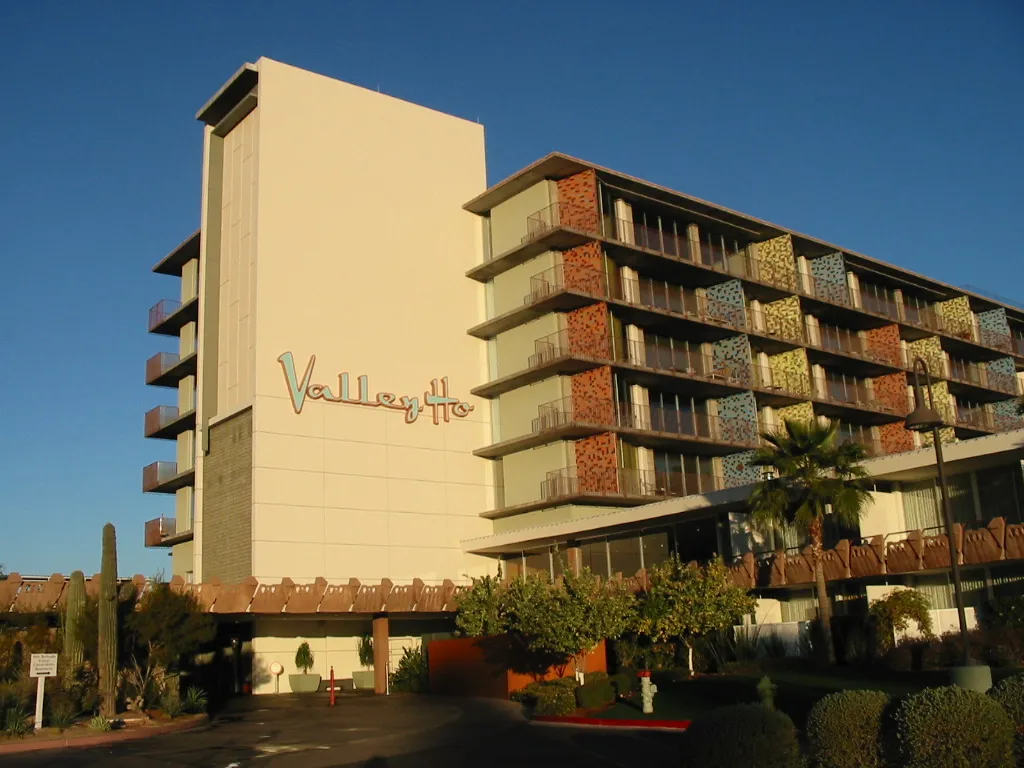

What is Hotel Valley Ho?
Most resort towns tear down their best building and spend fifty years apologizing. Scottsdale got lucky exactly once, and the luck is named Hotel Valley Ho — a 1956 modernist landmark on Main Street that survived decades of neglect to become one of the finest restored midcentury hotels in the country.
Architect Edward L. Varney designed it as something Scottsdale had never seen: not a dude ranch, not an adobe casita colony, but pure optimistic modernism — horizontal lines, breezeblock screens, cantilevered concrete, terrazzo underfoot and pastel panels catching the desert light. It opened in December 1956, the same boom season as the Safari Hotel up the road, and Hollywood adopted it immediately. The location — resort comfort inside the walkable downtown — made it the discreet choice: Natalie Wood and Robert Wagner celebrated their 1957 wedding here dodging press, and everyone from Bing Crosby to Tony Curtis passed through.
Then came the long fade. Ramada bought it in 1973, and the Ramada Valley Ho spent three decades sliding from landmark to budget stop, its architecture buried under chain-hotel beige. By the late 1990s, the smart money assumed a teardown — the fate that had just claimed the Safari.
Instead, local operator Westroc bought it in 2001 and executed the great save of Scottsdale preservation: an $80 million restoration, faithful down to the original color palette, reopening in December 2005. In 2008 they even built the tower Varney had designed in the 1950s but never raised. Today the Valley Ho is that rarest thing — a museum piece with a DJ by the pool.
How to do the Valley Ho right
Choose your wing by personality. The original low-rise rooms put you inside the 1956 architecture — patios, breezeblocks, steps from the pool. The 2008 Tower rooms trade some vintage soul for space, wraparound balconies and the best views in downtown Scottsdale. First-timers who care about the design should go original; view-chasers and light-sleepers go Tower.
Time the pool, don’t fight it. The OH Pool runs two personalities: weekend scene (DJ, cabanas, strong Old Town energy in season) and weekday calm. If you want the sceney version, commit — book a cabana. If you don’t, weekdays and mornings return the deck to its 1956 languor.
Eat the kitsch proudly. ZuZu is genuinely good — a midcentury glam-diner doing elevated comfort food, famous for its over-the-top showstopper desserts. Sunday brunch there is a local ritual. And because you’re in the walkable core, the rest of Old Town — FnB, Citizen Public House, the Sugar Bowl three blocks away — is your extended room service.
Do the architecture properly. The hotel leans into its history: ask about tours, photo walls and the lobby’s design story. Detail-hunters should find the terrazzo, the conversation-pit fireplace, and the way Varney’s roofline frames Camelback. Fans of the era should pair a stay with a Mountain Shadows dinner and a drive past what’s left of the midcentury corridor — this hotel is the survivor telling their story.
Exploit the summer. Landmark design doesn’t raise its rates in July. The Valley Ho’s off-season pricing is among the best value-per-icon ratios in American hotels.
Demolition bait to design pilgrimage: the save that changed Scottsdale
To understand why the Valley Ho matters, look at its graduating class. The 1956–57 building boom gave Scottsdale its glamour infrastructure: the Safari Hotel (1956), the Valley Ho (1956), Mountain Shadows (1959), with the Executive House Arizonian following in 1961. By 2005, the Safari was rubble, Mountain Shadows was shuttered awaiting the wrecking ball, and the Executive House had been remodeled past recognition. The Valley Ho is the only one of Scottsdale’s midcentury resort class still standing as built — which is why architecture tourists now fly in for it.
The survival was never guaranteed. Robert Foehl, the original owner-operator, ran it with his wife Evelyn as downtown’s clubhouse — Hollywood found it through the movie productions shooting Westerns in the desert, and the adjacent Trader Vic’s (from 1962) gave the block a tiki-hour heartbeat that old-timers still describe like a lost Eden. The Ramada decades (1973–2001) were death by a thousand renovations: dropped ceilings, carpet over terrazzo, paint over pastel. What saved the bones was, ironically, cheapness — Ramada never spent enough to truly destroy the structure.
Westroc’s 2001 purchase was a bet that heritage could out-earn a teardown, made at the exact moment Scottsdale’s preservation movement found its voice (the city’s midcentury survey and the Safari’s 1999 demolition radicalized a generation of local design nerds). The restoration team worked from Varney’s drawings and period photographs; the 2005 reopening was national news in design circles, and the 2008 tower — built from Varney’s own unrealized concept — remains one of the few examples anywhere of a midcentury building completed posthumously to plan.
The result rewrote the local playbook. The Valley Ho proved a landmark could be a scene, not a museum — a lesson the reborn Mountain Shadows (2017) and half the boutique-hotel Southwest have since borrowed. Its Westroc siblings, Sanctuary and Mountain Shadows, form a family tree of the same idea: Arizona hospitality that treats design history as the amenity. In a town whose default answer to old buildings has always been a bulldozer, the Valley Ho is the counterargument — and the counterargument has a pool.