
The beige decades
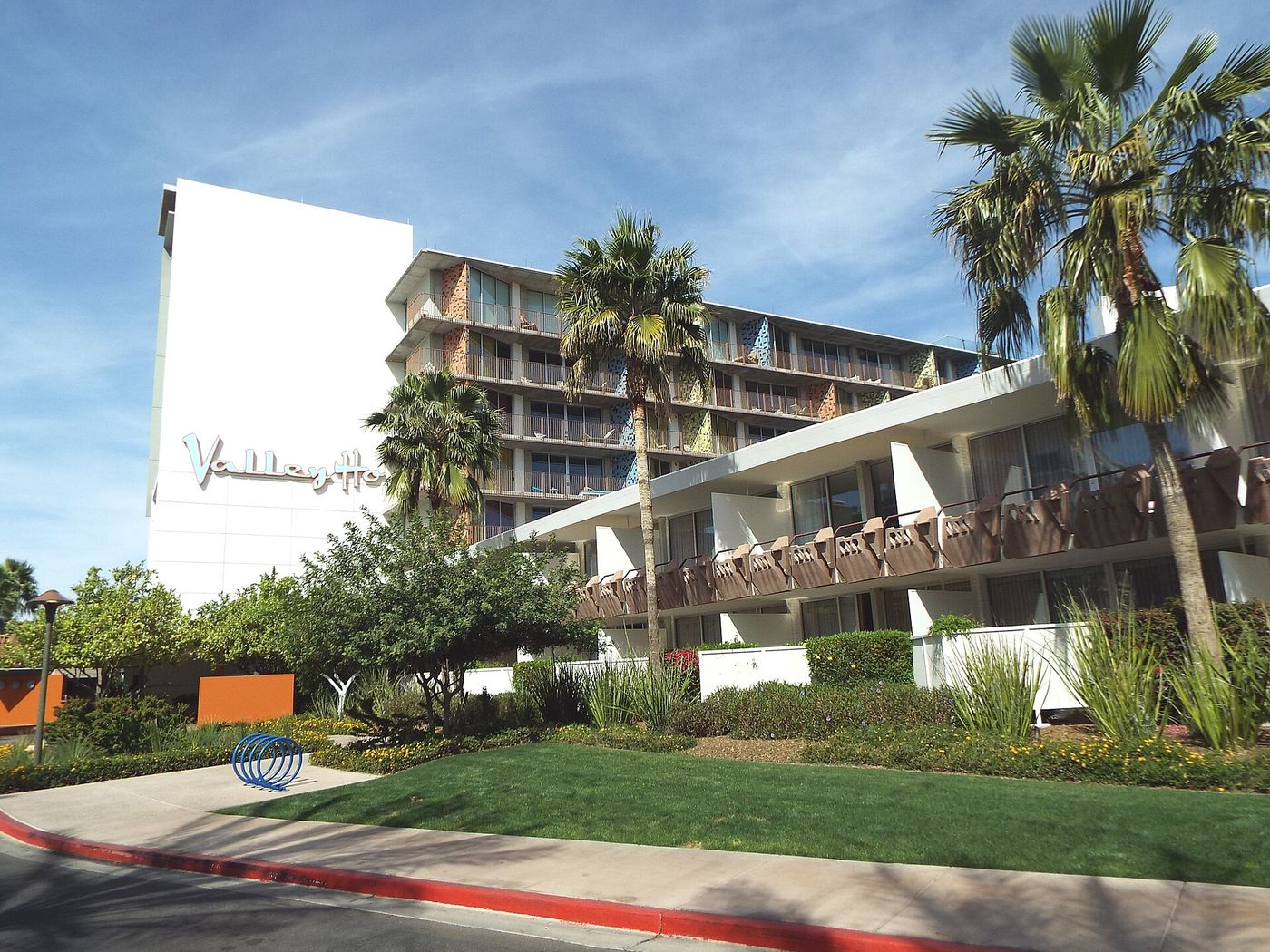
The Valley Ho had opened on December 20, 1956 as the most glamorous building in town: Edward Varney’s long, low modernist hotel, all glass and concrete and desert light, with a guest book that ran from Bing Crosby to the Natalie Wood–Robert Wagner wedding reception. It was also, for most of its life, a business in decline. Ramada bought it in 1973 and ran it for nearly three decades as the Ramada Valley Ho, painting over the pastels, dropping ceilings, and carpeting the terrazzo until Varney’s design was buried under a generic motel. By the late 1990s the property was tired, cheap, and sitting on some of the most valuable land in Old Town. The obvious next step was a bulldozer.
Westroc Hospitality bought it instead, in 2002, and on July 1, 2002 the city council placed the hotel on the Scottsdale Historic Register by Ordinance 3453. It was one of the first big moves of a preservation instinct that was just then taking hold in Scottsdale: a city that had spent fifty years selling itself as brand new. The restoration that followed was archaeology as much as construction: stripping the additions, rediscovering the original colors and materials, rebuilding the breezeblock screens and cantilevered balconies to Varney’s drawings, and adding only what the 1956 hotel would have wanted, a spa and a pool scene. The budget ran to roughly $80 million. In December 2005, forty-nine years to the month after its debut, the Hotel Valley Ho reopened.
A city late to preservation
The Valley Ho was saved in a city that had only just started saving buildings. Scottsdale made its first historic register listings in 2000 and its first postwar ones in 2002, after many of its best modern buildings were gone. Al Beadle’s Safari Hotel, which had opened on Scottsdale Road in November 1956, weeks before the Valley Ho, was demolished in 1999; the lost midcentury Scottsdale note counts it and the others. The Valley Ho went onto the register the same day, July 1, 2002, as Craftsman Court, the 1955 shopping court by T.S. Montgomery, and in 2005, the year the hotel reopened, the city listed a 1958 tract of Ralph Haver houses, early for the Valley; the midcentury districts note has the full list.
Edward L. Varney had trained under Frank Lloyd Wright, and the restoration treated his drawings as the authority. The building that came back was the one that opened in December 1956, when Bing Crosby signed the guest book; Natalie Wood and Robert Wagner held their wedding reception there on December 28, 1957.
What it proved
The timing was the point. Scottsdale in 2005 was at the top of the boom, with the Waterfront towers rising on the canal and Old Town’s older blocks going under for condos and clubs. The Valley Ho showed that the alternative could pay, that a restored midcentury landmark could charge more than a new one, and that the city’s 1950s identity was a brand rather than an embarrassment. Varney’s unbuilt tower went up in 2008 from his original concept; the city’s midcentury inventory became something to protect rather than clear; and the hotel settled in as the best midcentury museum in Arizona that also rents rooms.
Its full story is in the resort guide. The year’s other milestones: the city fire department’s first shift, the SkySong deal, a state population estimate of 221,130: are at 2005, and the decade’s rise and crash in the 2000s chapter.
Reading the record
Two dates were soft. The hotel’s own history and Wikipedia put the reopening on December 20, 2005; this page was filed under December 1 before the day was found. The hotel’s history says it went up for sale in 2002 and was redeveloped by Westroc; Phoenix New Times also dates the sale to 2002, naming the buyer as MSR Properties. The tower is dated December 2006 by the hotel and 2008 by New Times. The hotel is a few blocks from the galleries and bars of Old Town.