.jpg)
What is Camelback Inn?
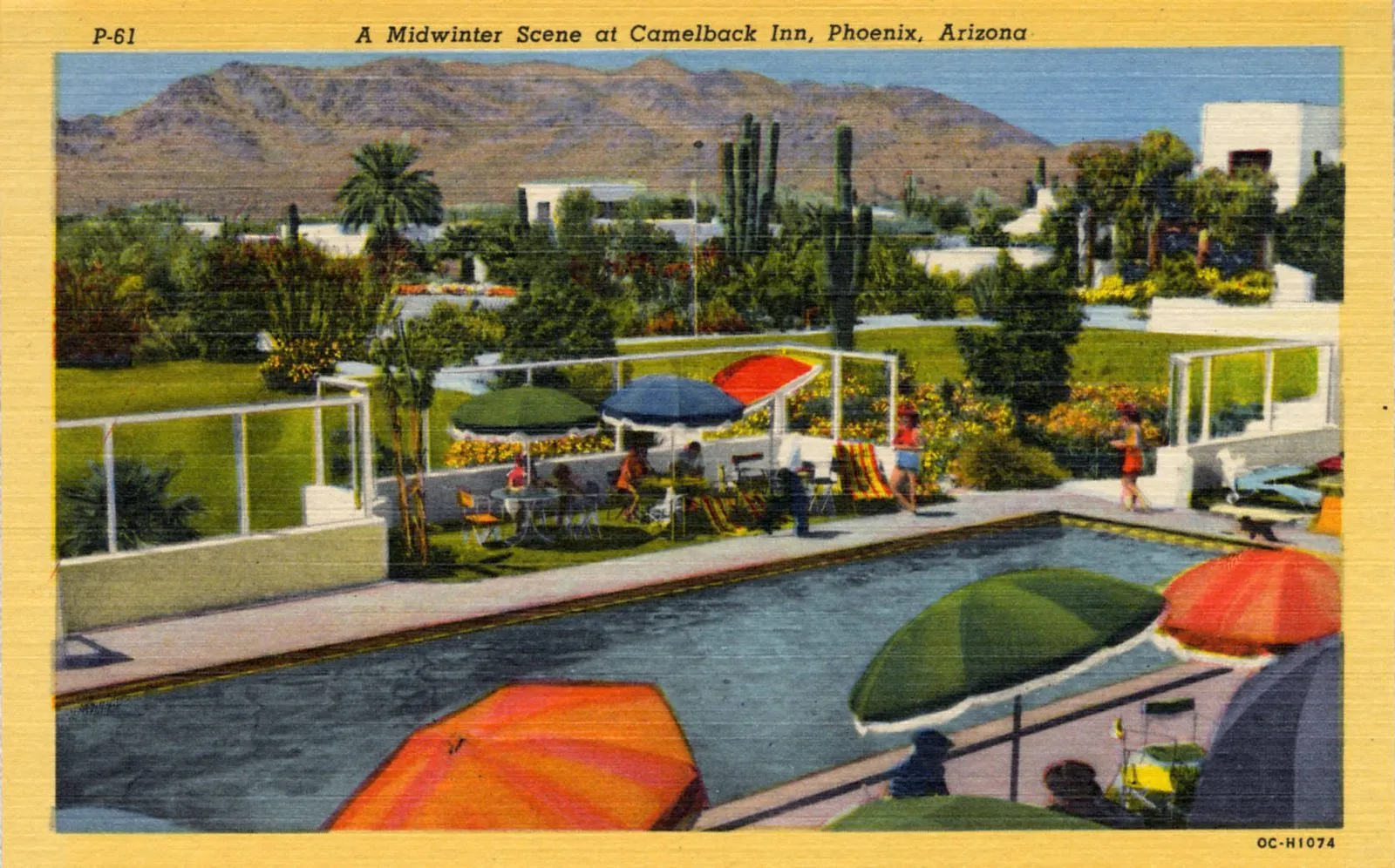
Before Scottsdale was a resort town, it was a farm town with one great idea, and the idea was Camelback Inn. Opened in December 1936 on empty desert between Camelback and Mummy mountains, it was the joint project of John C. Lincoln — the Phoenix electrical magnate and philanthropist — and Jack Stewart, a young hotelier with a theory that wealthy Easterners would cross the country for sunshine, adobe walls and unhurried service. The slogan they chose, “Where Time Stands Still,” turned out to be both marketing and prophecy.
The formula was casitas: low pueblo-adobe cottages scattered through the desert instead of a single hotel block, so every guest got privacy, a patio and a mountain. Nearly every Scottsdale-area resort built since — from the Phoenician’s casita wings to the Four Seasons and Boulders — is running some version of Stewart’s 1936 play.
The Inn’s guest book became a century of American history: presidents, industrialists, and enough Hollywood to fill a studio lot wintered here. Then in 1967 came the twist that secured its future — the Marriott family bought it, their first resort purchase ever. J.W. Marriott Sr. loved the property personally, and when the company later created a luxury tier bearing his initials, Camelback Inn became its spiritual flagship.
Today it runs 453 casita-style rooms, a destination spa, and 36 holes at Camelback Golf Club, and it is still — by every measure that matters in this town — the original article. Newer resorts are taller, flashier, more Instagrammed. None of them is first.
How to do Camelback Inn right
Come for the classic, not the cutting edge. Camelback Inn’s whole value proposition is continuity: adobe casitas, hand-painted details, staff tenure measured in decades, and a pace set in 1936. If you want DJ pools and lobby scenes, book Old Town. If you want to feel like a guest at the Valley’s longest-running house party, this is the address.
Casita choice matters. The property spreads across huge grounds; ask for the quieter northern sections toward Mummy Mountain for the old-Inn feel, or closer to the main building if walking distance to breakfast outranks serenity. Patios are the point — mornings out there, coffee in hand, mountains on both horizons, are the product.
Work the institutions. The Sunday brunch is a multigenerational Valley ritual — reserve well ahead. The spa (with its own restaurant and pool) is a full day, not an hour. Golfers head to Camelback Golf Club’s 36 holes a short shuttle away — the Ambiente course is the modern test, Padre the friendlier classic. And the lobby bar’s patio at sunset is one of the Valley’s original happy hours; the Chaparral Room, the Inn’s famed continental dining room of the mid-century decades, lives on in local memory as the standard that era’s fine dining chased.
Use the location. Lincoln Drive is the old-money hospitality belt: El Chorro is minutes west for sticky buns and sunset lawns, Lon’s at the Hermosa minutes south for adobe romance, and Old Town is a ten-minute drive. You can do a whole classic-Valley trip without ever touching a freeway.
Nine decades where time stood still
The genius of Camelback Inn was timing and stubbornness. It opened in the depths of the Depression, when building a luxury resort on roadless desert looked insane — but Lincoln’s capital and Stewart’s conviction caught the exact moment the American rich began trading steamships to Europe for winters in the Southwest. Within a decade the Inn was profitable, famous, and the anchor of a new geography: the Lincoln Drive corridor, which would collect the Casa Blanca Inn, Mountain Shadows, La Posada and the Smoke Tree Resort over the next twenty years. Every one of those neighbors has since closed, burned, or been bulldozed and reborn. Camelback Inn just kept opening every season.
The 1967 Marriott purchase is one of hospitality’s great sliding-door moments. The Marriotts were a hot-shop-and-hotel company with no resort experience; Camelback Inn taught them the leisure business. J.W. Marriott Sr. treated it as a personal retreat, and the family protected it from the worst instincts of chain ownership — expansions came (convention space in the ’70s, the spa, the golf club), but the casita fabric and the 1936 scale of hospitality survived. When Marriott created the JW Marriott brand in 1984 to honor its founder, Camelback Inn effectively became the template: the brand’s promise is, more or less, “every property should feel like J.W. felt about this one.”
Its cultural ledger is absurd. The Inn hosted sitting and future presidents, foreign royalty, and the mid-century celebrity migration that made the Valley glamorous — the same wave that filled the Safari Hotel’s lounges downtown and Mountain Shadows’ pool deck across the road. What distinguishes Camelback Inn is that it converted glamour into permanence. It has held AAA’s top honors for longer, continuously, than any resort in the state.
The ledger has a darker line. In the 1950s Camelback Inn ran a “restricted” policy that kept out Jewish guests, and the Anti-Defamation League’s Arizona members made it their test case, warning conventions away; one national meeting of prosecutors cancelled its booking over it. In late 1956 the Inn answered a Cleveland man’s request for rooms by asking about his church and club affiliations and then his “nationality,” and it eventually turned him down. He wasn’t Jewish, and he let the ADL publish the letters. In August 1961 the Jewish Telegraphic Agency reported that the policy was gone, quoting Stewart: “It is true that several years ago we had a restricted policy at Camelback Inn. Personally, I never favored it, but it was requested by those who were guests here.” The full account is in Scottsdale and the Color Line.
An honest appraisal for the modern traveler: rooms, even renovated, are casitas — charming, not cavernous; the vibe is heritage-luxury, not hip. But stand on the lobby terrace at dusk, Camelback going copper in front of you, and you’re seeing precisely what a 1936 guest saw. In a town that demolishes its landmarks with enthusiasm, that’s not nostalgia. That’s the rarest amenity in Scottsdale.