
Finishing Gonzales’s campus
When the city hired Bennie Gonzales in 1965 to design a civic center, the plan was always for more than a city hall. Gonzales’s 1966 master plan laid out a mall: lawns, fountains, and low sculptural buildings in white stucco and adobe-inflected forms: with government at one end and culture at the other. The City Hall and library opened first, in 1968, and became instant icons. The arts building waited seven years for money, momentum and land. The land came from the city’s federally funded clearance of about 18.5 acres west of City Hall, much of the old Mexican barrio (see The Barrio Under the Civic Center); the money and momentum arrived in the early 1970s, as McCormick Ranch sold, the Greenbelt rose, and the town’s cultural boosters organized a symphony with no hall to play in.
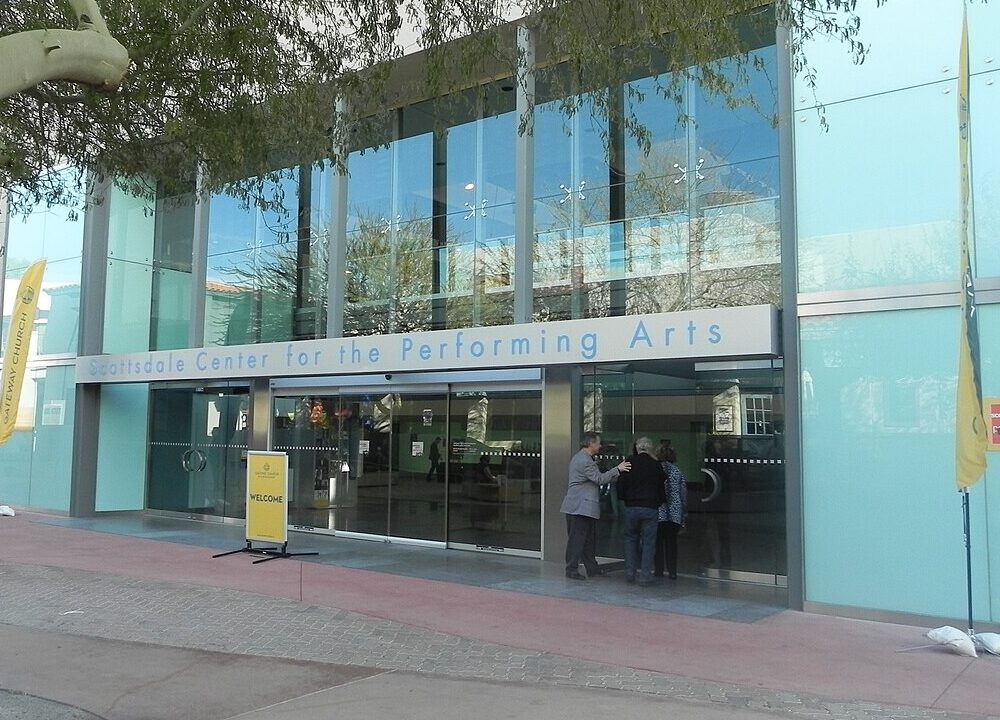
On October 23, 1975, the Center for the Arts opened on the south side of the mall, on Second Street. Gonzales gave it the same vocabulary as City Hall, thick sculpted walls, deep-set openings, forms that read as both modern and Southwestern, around an 800-seat theater, gallery space, and a small cinema. The opening act was Roger Miller, which was exactly right for a city that still called itself the West’s Most Western Town and was quietly becoming something more.
The land under it
The clearance came in stages. After the 1966 bond the homes on the first twenty-acre site were demolished for City Hall; in 1969 a STEP committee asked for redevelopment west of it, and the city won federal money “for land acquisition, demolition and to relocate displaced residents for the mall,” in its own words. In 1974 the landscaped mall was dedicated and Main Street was closed for good from Brown Avenue east to what is now Drinkwater Boulevard, with a parking deck designed by Taliesin Associates. The Center followed, and on the same assembled land came the Pepperwood retail buildings and a 206-room Doubletree Hotel. The Old Adobe Mission the barrio’s families built in 1933 still stands a few blocks away.
What the building did
The Center immediately became the town’s cultural address. The symphony had a stage; the Scottsdale Arts Festival had a lawn; touring theater and chamber music had a room that did not belong to a hotel. The Scottsdale Men’s League, formed in 1978 to raise money for it, started the food event that became the Scottsdale Culinary Festival, which the League billed as the longest-running festival of its kind and which ran until 2019. Over the following decades the campus grew around the building: SMoCA in a converted cinema next door in 1999, the renovated Civic Center in 2023, and the arts district that spread into Old Town from here gave the city the museums and galleries it sells today.
The city ran the Center itself, with a volunteer support group, the Scottsdale Arts Center Association, until the Scottsdale Cultural Council, chartered in June 1987, took it over under a 1988 agreement; the council became Scottsdale Arts in 2016. A $14 million upgrade completed in 2009 re-raked the hall into the 853-seat Virginia G. Piper Theater. The building was renamed the Scottsdale Center for the Performing Arts and remains Scottsdale Arts’ main stage; its architect’s other work is on his profile. The year’s other business: the East Shea annexation and a special census of 78,065: is at 1975, and the decade’s arc in the 1970s chapter.
The same autumn
The Center was one of three 1975 openings still running half a century later. On October 4 the McCormick-Stillman Railroad Park opened on 30 of the acres the McCormicks had given the city, and the same year the new Scottsdale Gallery Association and the city launched the Thursday evening ArtWalk on Main Street and Marshall Way. The cost of the Center is given as $4.9 million by the city and $3 million by Salt River Stories. The decade’s politics are in the 1970s politics chapter.