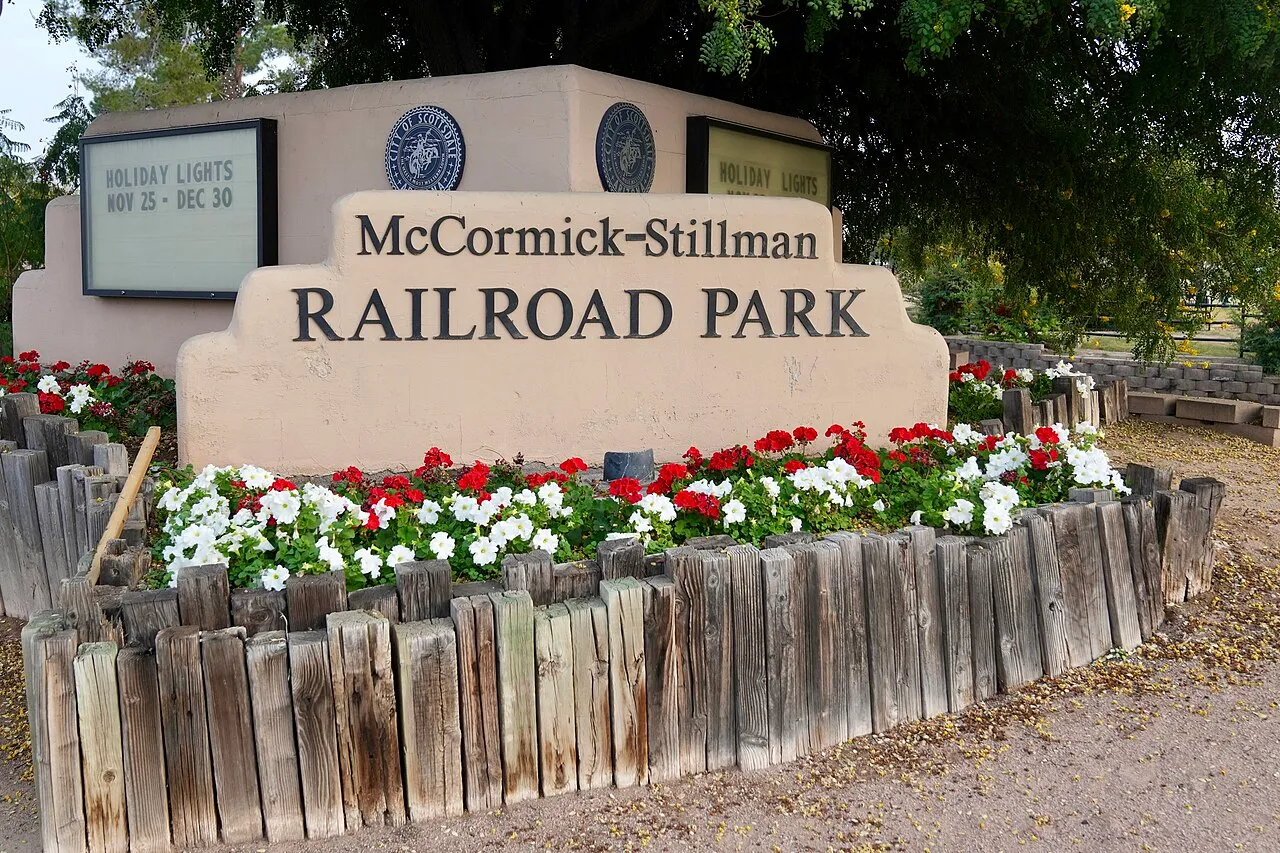

What is McCormick-Stillman Railroad Park?
Every Valley kid has a core memory set here. Most Valley adults do too.
McCormick-Stillman Railroad Park is 30 acres at Scottsdale Road and Indian Bend where a real, rideable steam-era railroad — the Paradise & Pacific, built at 5/12 scale on 15-inch track — loops past playgrounds, ramadas and a museum’s worth of full-size railroad history. A ride costs $3. It has been the best three dollars in Arizona for fifty years.
The supporting cast would anchor a lesser park on its own: the Charros Carousel, an Allan Herschell machine completed in 1950 with 30 hand-carved horses; the Roald Amundsen, a 1928 Pullman car that carried four U.S. presidents — Hoover, FDR, Truman and Eisenhower, who rode it through his entire 1952 whistle-stop campaign; a hulking Magma Arizona Railroad locomotive; and a 10,000-square-foot Model Railroad Building where local club volunteers run miniature empires in blessed air conditioning, free of charge.
Around all that: shaded playgrounds, grass, picnic ramadas that host approximately every birthday party in the 85250–85258 zip codes, and a snack bar. Entry is free. The park is technically part of the city system, but nobody thinks of it as “a city park.” It’s the train park — the one attraction every family, every visiting grandparent, and every generation of Scottsdale agrees on.
How to do the train park right
Go early, especially October through April. The park’s magic hours are the first two after opening: short ride lines, cool air, and locomotives fresh out of the shed. By late morning on a winter weekend the place is a joyful zoo of strollers and party balloons. Summer inverts everything — morning or nothing, then retreat to the Model Railroad Building when the asphalt starts shimmering.
Ticket math: rides are $3 each, kids two and under free. If you have one child who likes trains (you do), the 8-pack for about $20 beats singles, and the all-day wristband (~$12) pays off the moment anyone says “again” a fourth time. The carousel takes the same tickets as the train.
The circuit: ride the train first (it’s the longest line later), carousel second, then let the kids loose on the playgrounds while you actually look at the historic equipment — the Roald Amundsen Pullman rewards a slow walk-past, and the model railroad building is the park’s secret best exhibit. True train-obsessed households should ask about the separate 7½-inch-gauge live-steam track that club members run on select days.
Birthday parties and ramadas: this is the Valley’s single most-booked party venue for the under-8 set. Reserve ramadas well ahead for winter and spring weekends, or aim for a weekday.
Holiday Lights: from late November through December 30 the park runs evening train rides through the light displays, roughly 5:30–9:30 p.m. It’s wonderful and it is mobbed — go on a weeknight, dress warmer than you think Arizona requires, and expect the line anyway.
Beyond the holiday lights
The lights get the crowds, but the park runs a special event in almost every season. Dates below are from the park’s 2026 calendar at therailroadpark.com; they shift a little each year.
- Spook-Track-Ula (October 1–31, 6–9:30 p.m.). This is the Halloween version of the train ride. A $15 wristband (members $5 off, two and under free) covers unlimited train and carousel rides with timed entry from 6 to 8 p.m. Tickets go on sale online September 1 through the city’s ActiveNet system. 2026 added two things. The Haunted Train Walk Through is a jump-scare walk through parked train cars, and the park itself says it is best for older kids and adults. The Storybook Train Ride is the gentle option for small children: it runs on the River Rambler with Engineer Bones and Choo Choo Charley. Expect fog, haze and the occasional clown.
- Noon Year’s Eve (December 31, 11 a.m.–1 p.m.). There’s a countdown to midday, a sparkling-cider toast, and a golden railroad spike that drops at noon. It’s the New Year’s Eve for kids who go to bed at seven.
- Exclusively Little Expo (March; Saturday, March 14 in 2026, 9 a.m.–1 p.m.). This is a family expo of summer camps, schools, youth sports and city programs, with rides at the regular $3.
- Tents by the Tracks (April; April 11–12 in 2026). Families camp overnight on the park grounds, from 3 p.m. check-in to 10 a.m. the next morning. The price covers a catered dinner, a movie, breakfast snacks, lawn games, the bluegill fishing pond and unlimited rides. In 2026 it cost $100 for a 10-by-10 space for two, $200 for 12-by-12 for four, and $300 for 18-by-18 for six, with $45 for each extra person. Reservations opened March 2 in 2026.
- Tracks N Tunes (Saturday nights, late April through May, 7–8:30 p.m.). These are free concerts by local bands on the lawn. Bring a blanket; trains and the carousel run at $3 until 8:30.
- Slide the Rails (early August, 9 a.m.–1 p.m.). The park turns into a mini water park with inflatable slides, a foam pit and water balloons. A $10 wristband includes the rides; in 2026 wristbands went on sale the week before, for pickup at the station only.
The holiday lights page covers the July fireworks night and the 50th-anniversary Railfair.
While you’re in the neighborhood: Chaparral Park and its lake are five minutes south, and the Greenbelt path runs right past the park’s back fence if anyone still has energy.
A millionaire’s gift and a rich man’s train set
The train park exists because of one of the great land gifts in Scottsdale history — and one of its stranger family trees.
Fowler McCormick was American aristocracy squared: grandson of Cyrus McCormick, whose reaper built International Harvester, and of John D. Rockefeller. He and his wife Anne ran Arabian horses and cattle on McCormick Ranch, the enormous spread that then covered much of what’s now central Scottsdale. In 1967, as the city grew toward their fence lines, the McCormicks donated 100 acres of the ranch to Scottsdale — land valued at $1 million even then — with one stipulation: it had to become a park for all to enjoy.
Enter Guy Stillman, Anne’s son, who happened to own something most people don’t: a personal, working, narrow-gauge miniature railroad. In 1971 he chartered the Scottsdale Railroad & Mechanical Society and began moving his Paradise & Pacific Railroad — track, rolling stock, and two 5/12-scale steam locomotives — onto the donated land, donating the lot to the cause. Four years of volunteer track-laying later, on October 4, 1975, McCormick Railroad Park opened with free train rides and a Wild West shootout. In 1996 the city added Stillman’s name to the gate, which was only fair: the McCormicks gave the ground, but Guy Stillman gave it a soul.
The park has spent five decades compounding that inheritance. The Scottsdale Charros helped land the 1950 Herschell carousel that now bears their name. The Roald Amundsen Pullman — one of six built in 1928 at a staggering $205,000 apiece, and Eisenhower’s rolling home during the 1952 campaign — was donated to the society and parked here, meaning Scottsdale’s kiddie park casually owns a more presidential railcar than most museums. Model railroad clubs built out the 10,000-square-foot exhibit hall. None of it was a master plan; all of it was accretion by people who loved trains.
Why it matters
Scottsdale’s other landmark parks are triumphs of engineering (the Greenbelt) or of ballot-box willpower (the Preserve). The Railroad Park is a triumph of generosity — private wealth converted, permanently and completely, into public delight. The McCormick name is all over the city’s map as a resort, a golf course, a master-planned community; this is the one place where it just means a gift.
And unlike nearly everything else from 1975 Scottsdale, it hasn’t been upscaled, reconcepted or priced out. CrackerJax is gone. Rawhide got moved off its own land. The train park is still here, still volunteer-hearted, still three dollars. Fifty years in, that might be the most impressive engineering in the city.