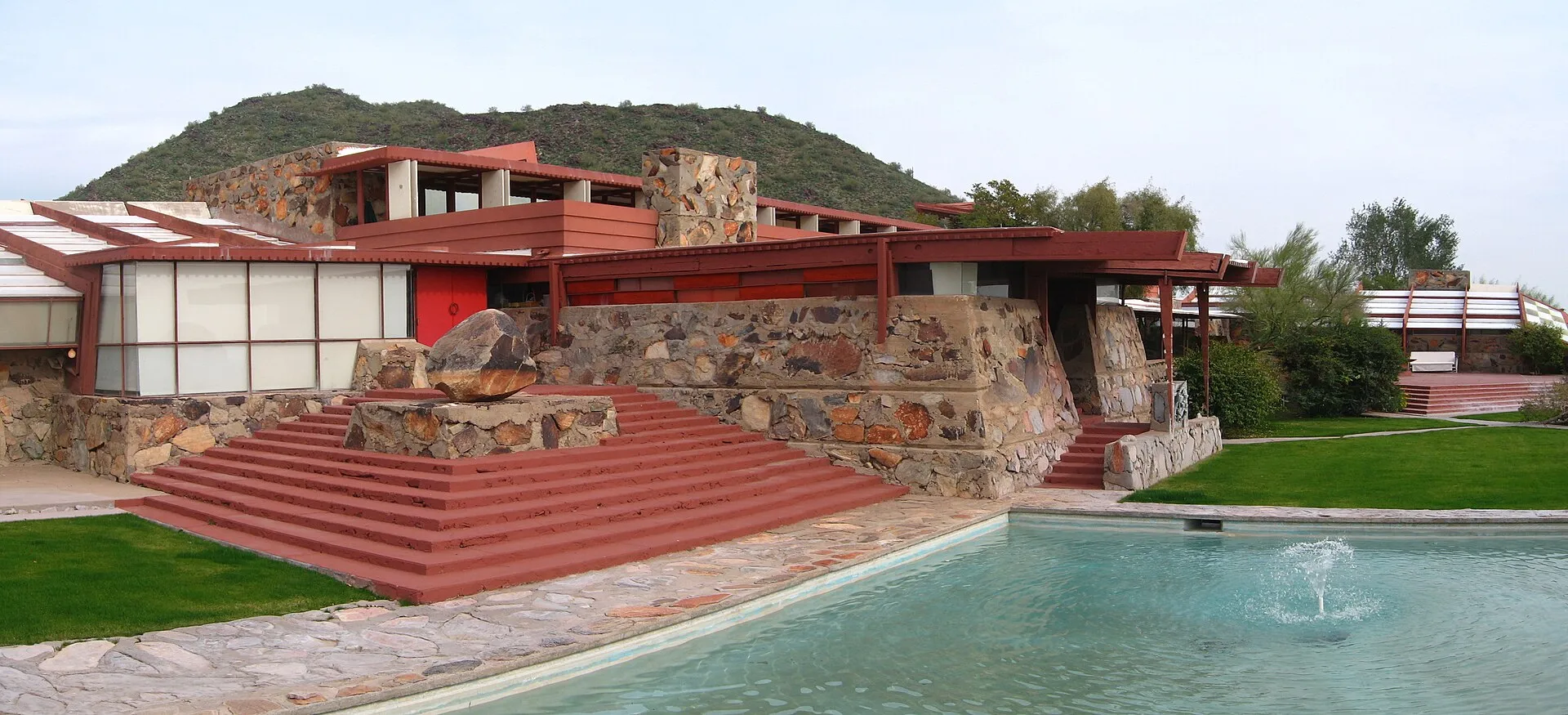

What is Taliesin West?
Scottsdale has a lot of famous things. It has exactly one that historians of the twentieth century are obliged to mention.
Taliesin West is the winter home, studio, drafting room and architecture school that Frank Lloyd Wright began building in January 1938, a month after buying the land — several hundred acres of creosote, granite and saguaro on a mesa below the McDowell Mountains, bought for almost nothing because nobody else wanted to be that far from a paved road. He was seventy. He would spend every winter of the rest of his life here, building and rebuilding, until he died in April 1959.
The construction method is the building’s argument. Desert masonry: rock gathered on site, stacked by hand into wooden forms, packed with concrete mixed from desert sand, then stripped to leave walls that look like the ground stood up. Over the walls, redwood frames and canvas panels — a roof you could see through, which turned the brutal Sonoran light into something you could draft under. The apprentices of the Taliesin Fellowship quarried, mixed, hauled and stretched all of it themselves, living in tents while they did it.
It is now a National Historic Landmark (1982) and a UNESCO World Heritage Site (2019), one of eight Wright buildings inscribed together. Tours are ticketed, timed and seasonal; the standard self-guided audio tour runs roughly $39–$44 for adults, with longer behind-the-scenes options costing far more. The school Wright founded left the mesa in 2020 after a split with the Frank Lloyd Wright Foundation, relocating to Paolo Soleri’s Cosanti — a detail almost too neat, since Soleri was a Taliesin apprentice in the 1940s.
Everything else in north Scottsdale grew up around this. The boulevard is named for him. So is the Spire.
How to do Taliesin West right
Book ahead, and book early in the day. Tickets are timed, capacity is capped, and winter mornings are the first slots to disappear — sometimes days out. There is no reliable walk-up. Once you are choosing a time, choose the earliest one offered. The whole building is an argument about light, and the low-angle morning light coming through canvas and clerestory is what Wright designed for; the same rooms at 1 p.m. in June are a different, worse building. In hot months the last audio-tour entry is often late morning anyway, because the Foundation knows this too.
Choose your tour honestly. The self-guided audio tour covers the essentials — living room, Wright’s office, the drafting studio, the garden court and the terraces — and is what most people should buy. The guided and behind-the-scenes tours add rooms, depth and a human being answering questions, and if you care about architecture rather than sightseeing, they are worth the jump in price. Do not buy the long tour for a restless eight-year-old.
Dress for a desert site, not a museum. Much of the visit is outdoors, on gravel and uneven stone, with steps and level changes everywhere — Wright’s famous compression-and-release does not care about your knees. Closed shoes, hat, sunscreen, water. October through April this is genuinely pleasant. June through September it is a morning-only proposition and you should treat it like any other summer outdoor plan in the Valley, which is to say get it done before 10.
Photography and pace. Interior photography rules vary by tour, and the site is small enough that you cannot outrun your group — plan on ninety minutes for the basic tour, two-plus for the longer ones. The single most-missed thing is the view out: stand in the garden court and look at how the terraces frame the McDowells and the Valley floor, because that framing is the reason the building sits at this exact angle.
Pair it well. The obvious companion is Cosanti, Soleri’s earth-cast studio in Paradise Valley — the apprentice’s answer to the master, free to visit, thirty minutes away. Closer by, the Frank Lloyd Wright Spire at Scottsdale Road and Frank Lloyd Wright Boulevard is a five-minute stop for a design Wright drew in 1957 and nobody built until 2004. And for the free view from above, drive to the Lost Dog Wash trailhead and hike out to Taliesin Overlook — about a mile of spur off the main trail, with the compound laid out below you and Camelback on the horizon. Our 48 hours in Scottsdale itinerary puts the tour on a winter morning for exactly these reasons.
A seventy-year-old man, thirty apprentices and a canvas roof
Wright had been circling the Valley for a decade. He came in 1928 to consult on the Arizona Biltmore, and the following winter built Ocatilla, a temporary camp of canvas-roofed boxes in the desert south of Phoenix, for the Chandler resort project the Depression killed. Ocatilla lasted a season and taught him everything: that the desert light demanded translucence rather than glass, that a building here should be low and angular and built of the ground, and that he liked working outdoors in January.
Then 1936 brought pneumonia in Wisconsin and a doctor’s instruction to winter somewhere dry. In December 1937 Wright, aged seventy, bought his mesa — remote desert northeast of a farm village of a couple of thousand people, land so cheap it cost a few dollars an acre. He did not wait for spring. The Taliesin Fellowship — his family plus roughly thirty apprentices who paid tuition for the privilege of manual labor — came west that winter, pitched tents, and started building in January 1938.
What they built has no real precedent. Desert masonry meant walking the site, choosing rocks for their faces, setting them into wooden forms with the good side out, and pouring a mix of cement and desert sand behind them; when the forms came off, the walls read as geology. The roofs were redwood frames stretched with canvas, later replaced with fiberglass and then acrylic as the fabric rotted, so the interiors glowed rather than glared. Corridors were deliberately low and dim so that rooms would feel enormous. Everything pointed at the McDowells or down the Valley. The apprentices quarried it, mixed it, hauled it and stretched it, and then did it again the next winter, because Wright never stopped editing — the compound was substantially complete by the early 1940s and substantially different by 1959.
The place functioned as a household, an office and a school simultaneously. Saturday evenings meant formal dinners and performance, which is why the compound acquired a cabaret theatre in the early 1950s and a music pavilion in 1957 seating about 135. Apprentices designed, drafted, cooked, farmed and built. Among them, in the 1940s, was a young Italian named Paolo Soleri, who would later build Cosanti and, eventually, the Soleri Bridge downtown. So was Pedro Guerrero, the photographer whose images of Wright’s work were made a few miles from the Cattle Track compound where he kept a studio.
Wright died in April 1959. Olgivanna Wright ran the Fellowship and the school for decades after, and the Frank Lloyd Wright Foundation still occupies the site, with a few Legacy Fellows in residence. The honors accumulated: National Register in 1974, National Historic Landmark in 1982, UNESCO World Heritage in 2019. The desert did not hold: the subdivisions Wright moved fifteen miles to avoid reached the property line decades ago, and the Foundation has fought light pollution and encroachment for most of its existence.
The most Scottsdale twist came in 2020. After a long dispute with the Foundation, the School of Architecture at Taliesin vacated both Wright campuses, surrendered the Taliesin name, and moved its students to Cosanti and Arcosanti — Soleri’s sites. The school Wright built left Wright’s building and went to live with his apprentice’s. Eighty-two years after thirty people pitched tents on a mesa, the Fellowship’s descendants were still arguing about how to teach architecture in the desert, which is arguably the most faithful thing they could have done.
Why it matters
Scottsdale’s origin story usually runs through cotton, cattle and canvas-roofed dude ranches, and it is a good story, but it is a local one. Taliesin West is the moment the town stopped being local. A farm village of two thousand acquired, essentially by accident of a real-estate bargain, the winter workshop of the most famous architect alive — and with it a gravitational pull that brought architects and craftsmen who then built the city itself: Bennie Gonzales’s white Civic Center, Soleri’s bridge and bells, a hundred houses that look like they grew out of the caliche. When Scottsdale’s boosters of the 1950s sold the place as an arts capital, this mesa was the evidence. It is still the best two hours of building you can spend anywhere in Arizona, and the light at nine in the morning is the reason.