
What is The Phoenician?
Every resort town has a flagship. Scottsdale’s is The Phoenician — 645 rooms of Luxury Collection polish spread across the southern base of Camelback Mountain, with a pool complex the size of a city block, an 18-hole golf course threaded through the foothills, and a backstory juicier than anything else in Arizona hospitality.
The short version: in the mid-1980s, financier Charles Keating decided Scottsdale deserved a resort that would embarrass Europe. He assembled the grounds of two historic properties — the 1926 Jokake Inn and the postwar Paradise Inn — and spent roughly $250 million on Italian marble, hand-cut crystal, gold-leafed ceilings and a pool tiled in mother-of-pearl. The Phoenician opened in October 1988. Within a year, Keating’s Lincoln Savings & Loan had collapsed in the largest S&L failure in American history, the resort was effectively in federal hands, and “The Phoenician” was shorthand on the evening news for everything wrong with the 1980s.
Here’s the twist: the resort outlived the scandal and got better. Ownership stabilized, Marriott’s Luxury Collection took the flag, and a $118 million renovation finished in 2019 stripped out the gilt in favor of desert-modern calm — sandstone, brass, saguaro-rib textures, Camelback framed in every window that matters.
And the history is still physically there. Walk the lawn and you’ll find the Jokake Inn’s twin adobe bell towers, built in 1936, standing quietly amid the luxury — the oldest resort architecture in Scottsdale, preserved on the grounds of its newest money. That juxtaposition is The Phoenician in one image.
How to do The Phoenician right
Book by season, ruthlessly. January through April is peak everything — rates, crowds, weather — and the pool complex runs at full theater. May and October are the value plays: near-perfect weather at a real discount. Summer is genuinely cheap and genuinely 110 degrees; that’s when locals buy the spa day-passes and resort staycation deals.
The pool complex is a strategy game. There are multiple pools across tiers — family zones, a waterslide, and the famous adults-oriented mother-of-pearl oval. Cabanas book out in season; without one, arrive before 10 a.m. for chairs with Camelback sightlines. The people-watching is a Scottsdale institution in its own right.
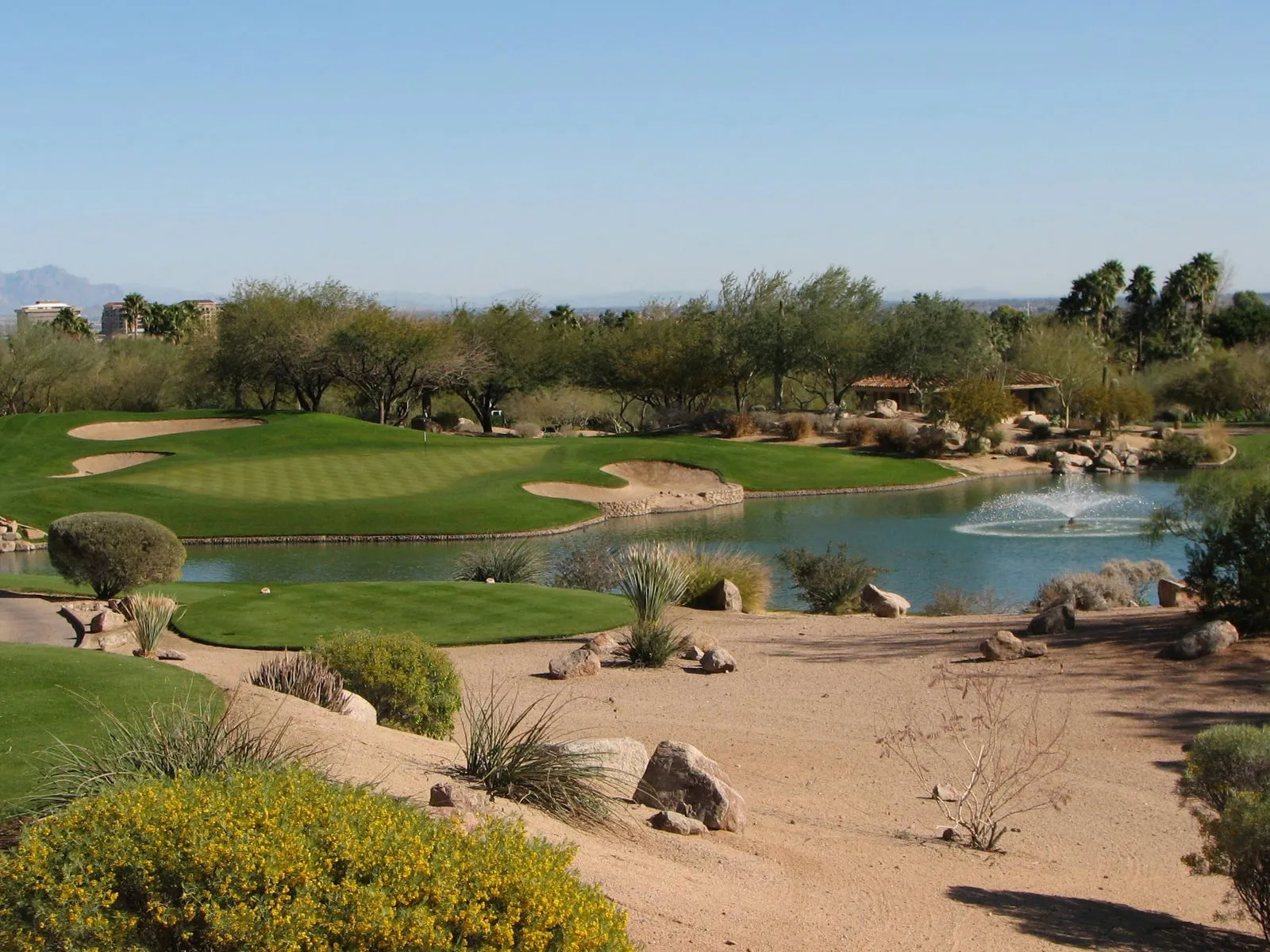
Golf and spa are the grown-up reasons to come. The course was consolidated from a sprawling 27 holes to a tighter, better 18 in 2018 — desert target golf with mountain framing on nearly every hole. The three-story spa (rooftop pool on top) is the most complete in-resort spa operation in the city.
Eat one dinner on property, then leave. J&G Steakhouse handles the special-occasion slot with a view down the Valley, and Mowry & Cotton covers the stylish-casual side. But you’re a ten-minute drive from Old Town’s best rooms — the resort’s location on the Camelback Corridor is the most convenient of any luxury property in town, and it would be a waste to eat every meal inside the gates. History-minded diners should pour one out for Mary Elaine’s, the Five Diamond French landmark upstairs that closed in 2008.
Do the free history walk. Ask the concierge about the Jokake bell towers and the resort’s Cactus Garden — one of the largest private cactus collections in the Southwest. Neither costs a dollar and both outclass most paid attractions in town.
Keating’s palace: scandal, seizure, and the long redemption
The Phoenician exists because Charles Keating wanted a monument. The Phoenix financier — whose American Continental Corporation owned California’s Lincoln Savings & Loan — was the kind of builder who flew planeloads of travel agents in for previews and demanded the marble be re-laid if the veining didn’t match. Contemporary accounts put the cost around $250 million at a time when a very good resort cost $60 million; the joke was that The Phoenician was the only resort in Arizona with a better art collection than the museums. He built it partly on the bones of old Scottsdale hospitality: the Jokake Inn, which had hosted winter visitors since 1926, and the Paradise Inn next door. The Jokake’s adobe bell towers were spared; nearly everything else went under the graders. One neighbor outlasted the opening: Elizabeth Arden’s Maine Chance spa, on the hillside since 1947, kept taking guests into the early 1990s, and the resort’s 1996 Canyon Suites went up on its site.
The collapse came almost immediately. Lincoln Savings failed in 1989 at a cost to taxpayers of over $3 billion, Keating went to prison on fraud convictions (later overturned on technical grounds; he pleaded to lesser charges), and the “Keating Five” senators he’d lobbied became a national ethics scandal. The resort itself passed into the hands of the Resolution Trust Corporation era’s cleanup machinery — for a stretch in the early 1990s, the most opulent resort in America was, functionally, a government asset. Kuwaiti investors and eventually institutional ownership steadied it; Marriott’s Luxury Collection flag arrived via the Starwood lineage.
The modern chapter began in 2015, when Host Hotels & Resorts paid roughly $400 million for the property and made a decision that sounds obvious now but wasn’t: instead of preserving the 1988 opulence as kitsch, they spent $118 million (2016–19) making The Phoenician what Keating’s money could never buy — tasteful. Rooms went desert-modern, the spa was rebuilt as a three-story sanctuary, the golf went from 27 padded holes to 18 honest ones, and the lobby’s crystal-and-brass shout became a sandstone murmur.
Where does it sit now? The Fairmont Princess outdraws it on spectacle, Sanctuary outdoes it on intimacy, and the Four Seasons beats its service ceilings. But no property combines The Phoenician’s location, completeness and sheer narrative weight. It is Scottsdale’s resort the way the Biltmore is Phoenix’s — and unlike most 1980s legends, its best decade might be this one.