Thirteen yes votes
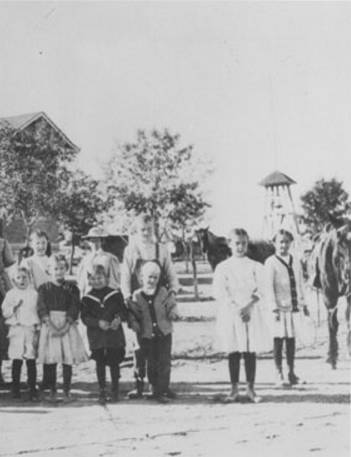
By 1909 the frame schoolhouse of 1896 was hopeless. It had been enlarged once, in 1897, and the town kept arriving; the settlement that had organized District No. 48 with seventeen children now had a hundred or more. On May 1, 1909 the district held a bond election. Thirteen people voted (some accounts say fourteen), all of them yes, and the district was authorized to borrow up to $5,000. The two-room school of red brick and concrete that went up on Main Street just east of Brown Avenue cost $4,500, and classes moved in that fall.
The formal dedication waited for a date with meaning: February 26, 1910, the 73rd birthday of Winfield Scott, the chaplain whose section this was and who had sat on the district’s first board. Scott had eight months to live; he died in October, and the schoolhouse dedication was one of the last civic occasions of a founder who had spent twenty-two years recruiting the families whose children filled it.
The building that did everything
The school taught grades one through eight until 1928, when the Spanish-revival Loloma School opened and the old building was renamed Coronado School for the younger grades. After that it did whatever the town needed: town hall after incorporation, justice court, the public library, and the Chamber of Commerce. By 1968 it was a red-brick anachronism on land the western-themed downtown wanted, and the city was ready to knock it down. The “Old Timers” rallied that July, gathered more than 1,500 signatures that fall, and in 1969 incorporated as the Scottsdale Historical Society; in 1972 the Chamber took a 25-year lease at $1 a year. The Society opened the Scottsdale Historical Museum in the schoolhouse in November 1991, with the west room furnished as a 1910 classroom. The building went on the National Register in 1994, and the Daughters of the American Revolution set a centennial marker on February 26, 2010.
What to see
The museum, on the Civic Center mall a block from Brown and Main, is free and open in the cooler months. Stand in the reconstructed classroom and you are standing in the one room in Scottsdale that has been public since the year of its founder’s death — the 1900s chapter has the town it served, and the Little Red Schoolhouse guide has the hours.