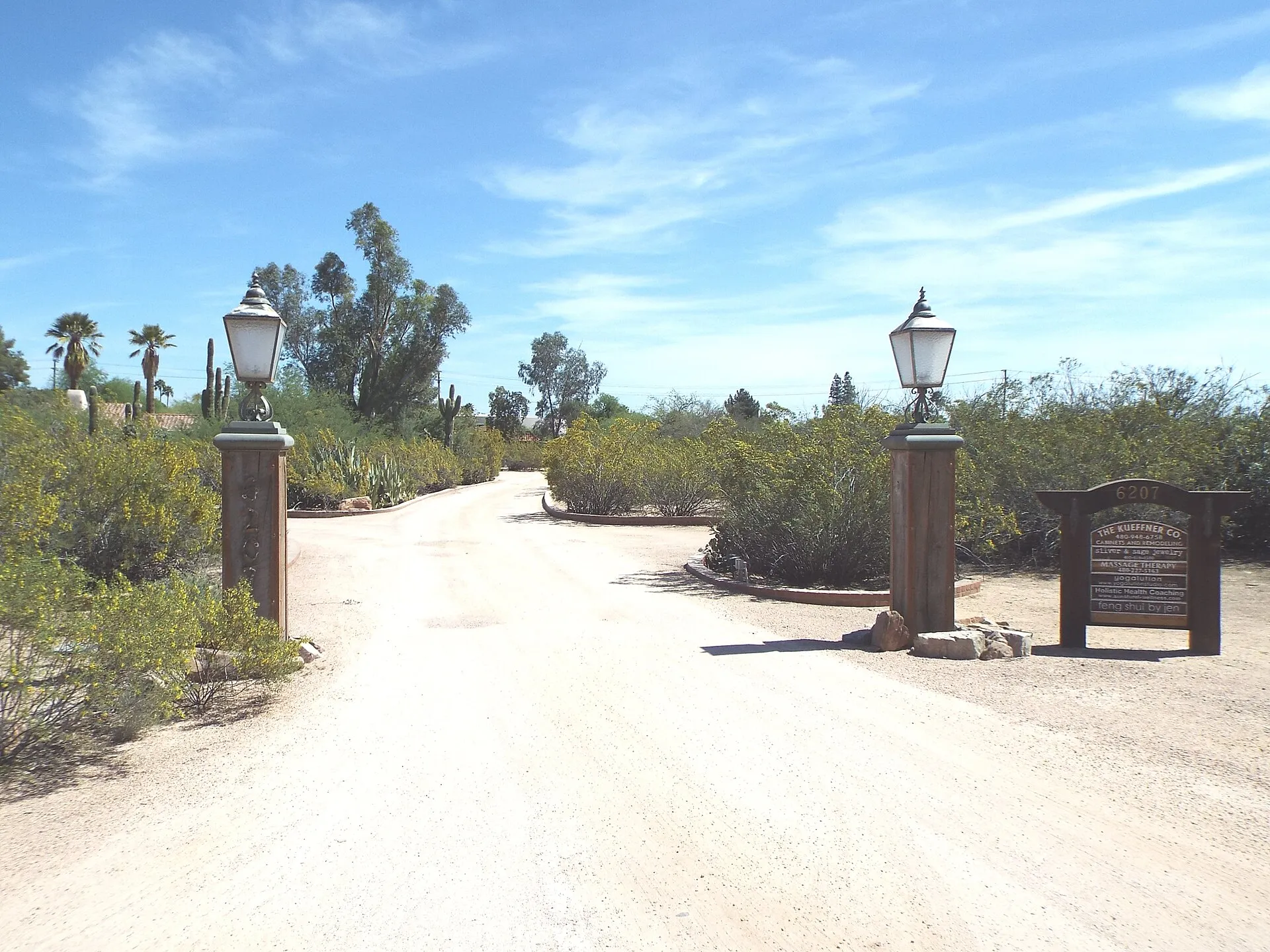

What is the Cattle Track Arts Compound?
Drive McDonald Drive a thousand times and you will never see it. Turn onto Cattletrack Road once and you are in 1937.
Cattle Track is a working artists’ compound on a residential block in central Scottsdale, about two and a half miles north of Old Town, immediately beside the Arizona Canal. It began in 1937, when George and Rachael Ellis homesteaded ten acres of raw desert here and George — a surveyor who had come west in the 1920s with the U.S. Coast and Geodetic Survey — built them a one-room house out of redwood staves salvaged from an abandoned water pipeline. That instinct never left: he made adobe bricks on site, reused whatever the Valley threw away, and built houses all over the area, including, in 1959, a residence for a young lawyer named Sandra Day O’Connor.
Artists came because the rent was nothing and the company was interesting. In 1948 the surrealist painter Philip C. Curtis — sent to Arizona by the Federal Art Project to establish the state’s first art center, the ancestor of the Phoenix Art Museum — met Ellis, and the family moved a barn from a nearby ranch onto the property as a studio and house for him. Fritz Scholder lived across the street. Photographers, sculptors and printers followed.
The astonishing part is that it is still going. The Ellis family still owns it, Janie Ellis — the founders’ daughter — still lives in the original house, and roughly 20 to 30 artists work across about eleven buildings: ceramics, fiber, photography, a fine-art printing press, a blacksmith shop, architecture offices, a gallery and a performance space. The city recognized it as an arts complex in 1996; the National Register listed it in 1999. Visiting is free and the grounds keep daytime hours most of the week.
How to visit Cattle Track right
Understand what you are walking into. This is not a museum, an art walk or a shopping district. It is a compound of working studios and private homes that lets the public in, which means the etiquette matters more than the logistics. Start at the gallery, say hello, say what you are curious about, and let someone point you toward whichever studio is actually producing that day. Do that and people will show you things. Push open a door uninvited and you will get the reception you deserve.
Weekday late mornings, cooler months. Gallery and grounds hours generally run Tuesday through Saturday during the day, and weekday mornings are when the most work is happening — the printing press, the kilns, the metal. October through April the whole compound functions as an outdoor place, shaded by mature trees that have had ninety years to get big. In July, plan a short visit and stay under the canopy.
Time it to an event if you possibly can. Cattle Track runs seasonal group shows, performances and open studios, and that is the version of the place everybody should see: the buildings open, the artists present, the Ellis family telling stories that exist nowhere in print. Check the compound’s calendar before you pick a date; a random Wednesday is good, a show night is the real thing.
Park like a neighbor. Cattletrack Road is a narrow residential lane. Pull onto the gravel where there is room, not in front of somebody’s house, and walk in. There is no lot, no gate and no attendant, which is part of the charm and also the reason not to abuse it.
Bring a budget and an open mind. Work is for sale, often directly from the person who made it, at prices that range from small-ceramic reasonable to serious. Buying from a studio you just watched someone work in is a different transaction from buying off a gallery wall, and the compound survives on it.
Pair it well. The natural double bill is Cosanti — another handmade compound built by another stubborn person in the same era, twelve minutes northwest — or Taliesin West, founded the same year, for the grand version of the same impulse. Downtown, the Main Street Arts District and Cavalliere’s Blacksmith Shop put Cattle Track in the context of a town that has always had makers in it. The Greenbelt and Chaparral Park are both minutes east if you want grass afterward.
Ten acres, a salvaged pipeline, and ninety years of not selling
The Arizona Canal, dug between 1883 and 1885 and running forty-one miles across the north Valley, made Scottsdale possible and also gave it a road. Cowboys moved cattle along the canal bank toward the auction houses, and the lane they used got called the cattle track — informally for decades, then officially in 2010, when the city named the street Cattletrack Road.
George Ellis arrived in Arizona in the 1920s doing survey work for the U.S. Coast and Geodetic Survey and met Rachael Murdock, a schoolteacher, at a company picnic. In 1937 — a year when Scottsdale was a farm village of a couple of thousand people — they homesteaded ten acres beside the canal for essentially nothing and George built their first house out of redwood staves pulled from a derelict water pipeline. That same winter, fifteen miles northeast, Frank Lloyd Wright bought his own mesa and started quarrying rock for Taliesin West. Two compounds, one year, the same idea about building out of whatever the desert had lying around — except one became a UNESCO World Heritage Site and the other stayed a family business.
Ellis turned into one of the Valley’s more interesting builders: adobe made on site, salvage everywhere, a reputation for houses that fit their ground. He worked on Wright-related projects, built the stairway at Soleri’s Dome House, and in 1959 built a residence for Sandra Day O’Connor, more than two decades before she joined the Supreme Court. Meanwhile the compound filled with artists, and the mechanism was simple: the Ellises had land, spare structures, and a tolerance for eccentrics.
The pivotal arrival was Philip C. Curtis in 1948. Curtis had come to Arizona under the Federal Art Project to establish the state’s first art center — the institution that became the Phoenix Art Museum — and became the most distinctive painter the state has produced, a surrealist of Victorian figures stranded in desert light. The Ellises moved a barn from a neighboring ranch onto the property and made it a house and studio for Curtis and his wife Marge. He stayed for decades. Across the street lived Fritz Scholder, whose paintings broke Native American portraiture open in the 1960s and 70s. Sculptor Ron Hagerty began wintering on the grounds and kept it up for more than thirty years. Photographers Pedro Guerrero — Wright’s photographer — and Jay Dusard worked here; work by Louise Nevelson passed through.
None of this was a program. There was no foundation, no grant cycle, no arts-district branding. It was a family with acreage and a canal, letting people work. Which is precisely why it should not have survived: by the 1990s this was infill land in the middle of a city where infill land gets scraped. Central Scottsdale’s ranch parcels went to subdivisions, its citrus went to cul-de-sacs, and a low-density compound of eleven old buildings on a canal bank was worth vastly more as lots.
It survived because the family declined, repeatedly, to sell. The City of Scottsdale designated the property an arts complex in 1996, the National Register listed it in 1999, and the Scottsdale Historic Register covers the complex along the road. Today Janie Ellis runs it from the house she grew up in, with a stated admissions policy for resident artists that amounts to energy, talent and no loafers. Roughly twenty to thirty people work here in ceramics, fiber, photography, printmaking, blacksmithing and architecture; Scottsdale Arts has partnered with the compound on programming, which is the institution finally acknowledging what was already there.
Why it matters
Scottsdale’s arts reputation is built on things that arrived: Wright, the galleries, the festivals, the public-art budget. Cattle Track is the thing that simply grew — a family homestead that turned into a colony because the land was cheap, the shade was good and nobody was in charge. Ninety years on it is the only place in the city where you can stand in an unrestored 1937 building, watch someone pull a print or throw a pot, and buy the result from their hands. Every growing city tells itself it needs an arts district and then builds one out of retail. Scottsdale already had one, behind a hedge on a lane named for cattle, and the best thing it ever did was leave it alone.