Why they matter
Scottsdale’s biggest employment district exists because two men from outside Arizona won an Army contract in a hurry. Leland Hayward, a Hollywood talent agent who flew, and John H. Connelly founded Southwest Airways, one of the civilian companies the Army hired to teach cadets to fly. Their firm ran Thunderbird Field II, the primary flight school graded out of farmland north of the Scottsdale townsite in the spring of 1942.
The school lasted only twenty-eight months. The runway lasted. It became Scottsdale Airport, and the Airpark that grew around it is now one of the largest job centers in Greater Phoenix.
Where to find their mark today
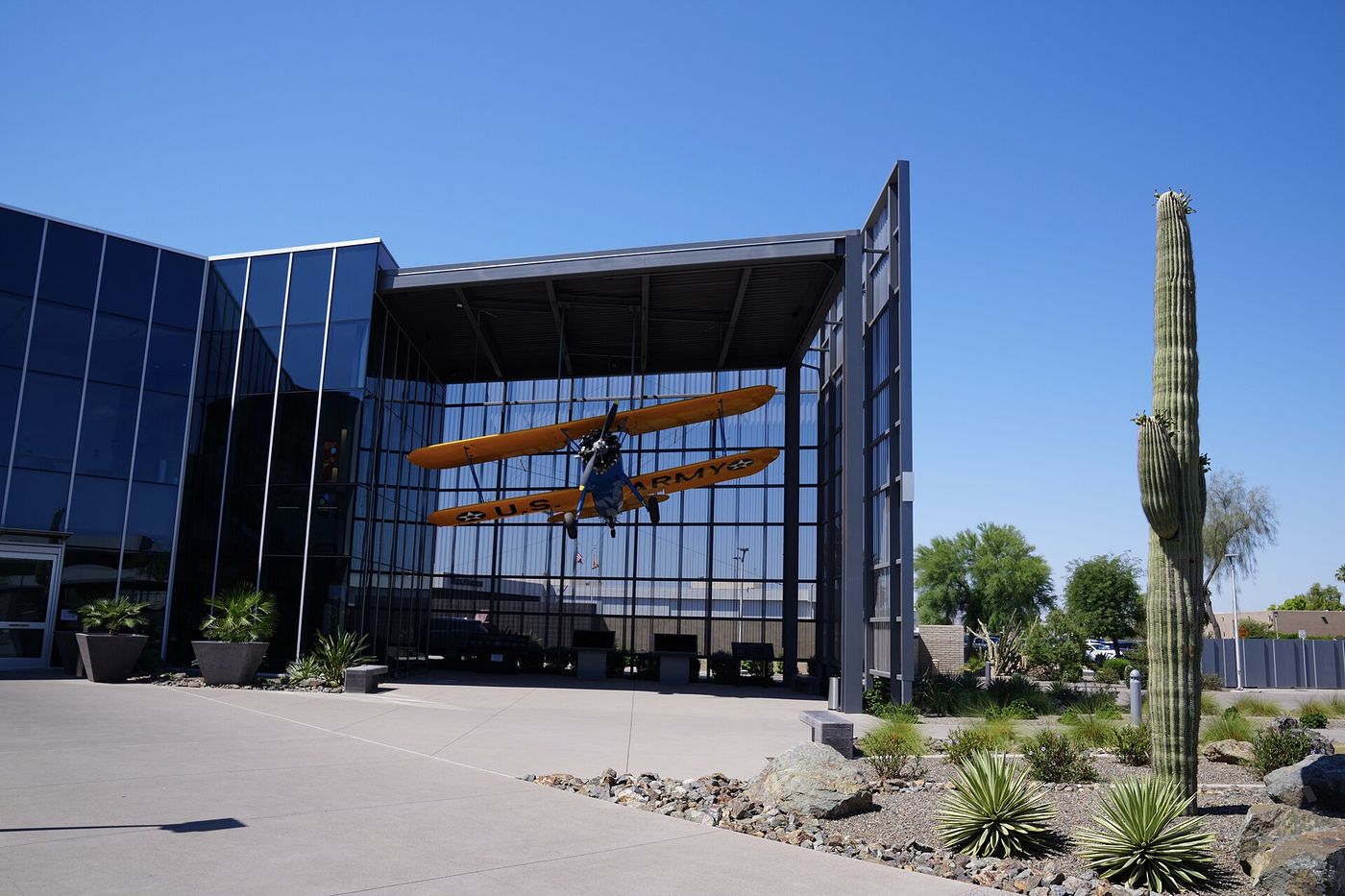
Thunderbird Field II. The field is gone except for its runway, still in use at Scottsdale Airport. The guide covers the whole story and the Veterans Memorial at the entrance, which has a 1942 Stearman PT-17 above a granite monument.
The Airpark. Drive the grid in north Scottsdale and notice how the older streets line up with the airfield rather than with the city’s section lines.
The town they landed in
In 1942 Scottsdale was a farm community of about two thousand people, and the field was the largest thing to arrive since the cotton boom. It brought jobs, boarders in spare rooms, dances, and a steady drone overhead. The cadets were Americans alongside British and Chinese trainees. The June 22, 1942 opening and the rest of the war years are in the 1940s chapter. The town’s crossroads cafe, Malcolm White’s Whitey’s, fed the cadets, and White went on to become the first mayor.
The full story
The Army’s problem after Pearl Harbor was arithmetic. It needed tens of thousands of pilots and had neither the instructors nor the airfields to train them. So it contracted primary flight instruction to civilian operators and went looking for flat, cheap, cloudless land. The Valley offered roughly three hundred flying days a year, and training fields soon ringed Phoenix: Thunderbird I at Glendale, Luke, Williams, Falcon, and the alfalfa ground north of Scottsdale.
Southwest Airways was the contractor at both Thunderbirds. The site’s records call Leland Hayward a Hollywood agent with a serious flying habit (he is better remembered today as the Broadway producer he later became) and name John H. Connelly as his partner. Beyond that the records are thin, and this page won’t pad them. Their company built the Scottsdale field in about ninety days: runways, hangars, barracks, mess halls and a control tower. It opened on June 22, 1942, and twenty-eight civilian instructors relocated to Scottsdale that July.
The course ran about ten weeks, roughly 65 hours in the air and 109 in ground school, in open-cockpit Stearman PT-17 biplanes. Cadets soloed or washed out. At the November 1943 peak, 615 cadets flew about two hours a day each, on the order of 1,845 takeoffs and landings daily. When the Army had more pilots in training than it needed, the contract schools were the first thing cut. Thunderbird Field II was deactivated on October 16, 1944 (1944), with more than 5,500 graduates, about triple the original plan.
Arizona State Teachers College ran an aviation program on the site until 1951, a Seventh-day Adventist academy bought it in 1953, and in 1966 the City of Scottsdale paid $750,000 for the airfield (1966). The first business jets landed in August 1967. Everything in the Airpark grid descends from a runway Hayward and Connelly’s company graded in a hurry in 1942.