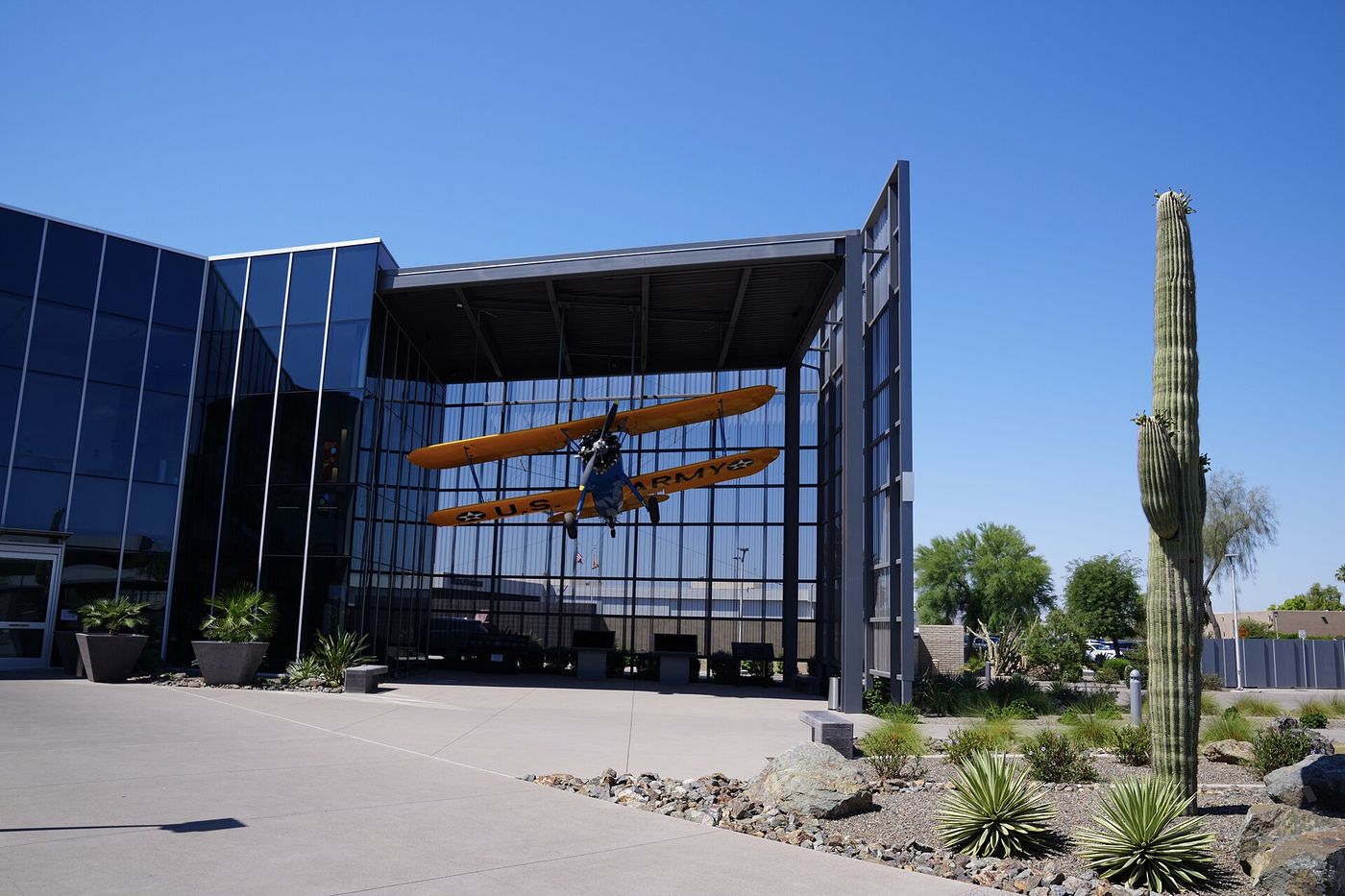
Ninety days from farmland
Pearl Harbor was barely six months old when the first cadets reported, and the speed was the point. The Army needed pilots faster than its own bases could produce them, so it contracted primary training to civilian operators and went hunting for flat, cheap, cloudless land. The Valley had it in surplus — some 300 flying days a year — and by 1942 flight fields ringed Phoenix: Thunderbird I in Glendale, Luke, Williams, Falcon, and now Thunderbird II on the alfalfa north of Scottsdale, where farmland became a working airfield in roughly ninety days.
The arrangement was a hybrid the war made ordinary: civilian instructors, Army supervision, military cadets. The trainees were mainly U.S. Army aviation cadets, the historian Joan Fudala says; Southwest Airways trained its Chinese cadets at Thunderbird I in Glendale and British cadets at Falcon Field in Mesa. The Stearman PT-17 was the yellow-and-blue biplane every WWII pilot remembered fondly and feared slightly, and primary training was where a flying career began: solo, or wash out.
What the town got
For a community of about two thousand, the field was the biggest arrival since the cotton boom of the 1910s — jobs, boarders, dances, and a permanent drone overhead. More than 5,500 pilots graduated before the field closed in October 1944, most getting their first long look at the desert from an open cockpit. Some of those looks stuck. The men who trained at the Valley’s fields were disproportionately the men who moved back after 1945, families and GI Bill loans in hand, powering the growth that consumed the next two decades.
The field itself never really left either. After the war the site cycled through surplus and civilian uses before the city bought it in 1966 and opened Scottsdale Municipal Airport in 1967, and the Airpark that accreted around the runway grew into one of Arizona’s largest employment centers. A memorial with a restored Stearman marks the spot today — biplane for business park, arguably the war’s longest-running local dividend. The rest of the decade is in the 1940s chapter.