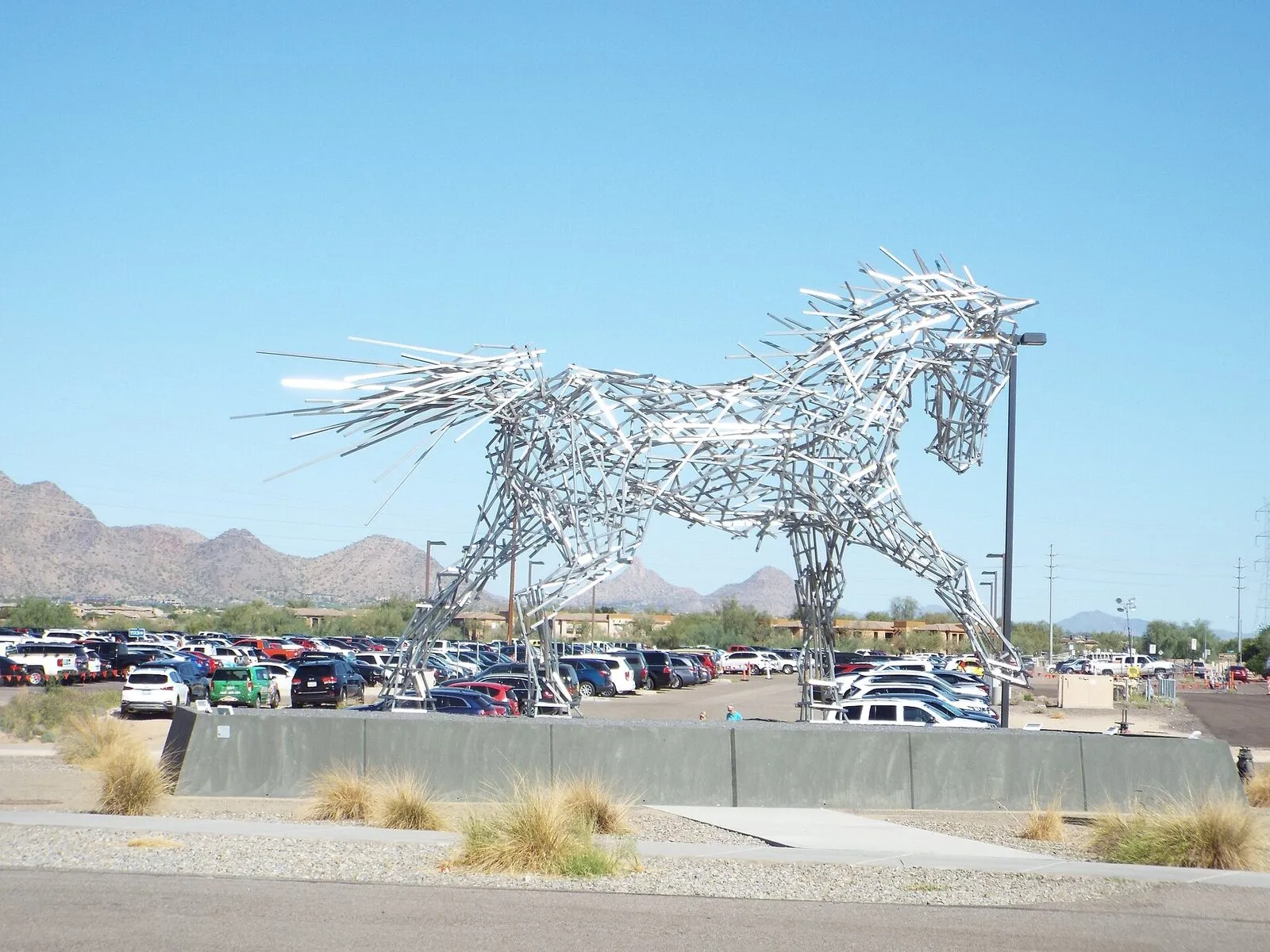
What is WestWorld?
Every city that hosts a nine-figure car auction needs somewhere to put it, and Scottsdale’s answer is WestWorld: 386 acres of city-run event grounds on federal land beside the Central Arizona Project canal, at Pima Road and the Loop 101 in the Princess & WestWorld corridor. It started as an equestrian center in the 1980s and became, almost by accident, the stage for the biggest weekends on the city’s calendar.
The anchor tenants arrived together in 1989. Barrett-Jackson moved its collector-car auction here and grew it into the centerpiece of Arizona Car Week; the Scottsdale Arabian Horse Show moved in the same year and became the largest of its kind in the world. Around them the calendar filled: Arizona Bike Week, the Parada del Sol Rodeo, the Sun Circuit and Cactus Reining Classic horse shows, Goodguys, polo, the Fourth of July, the start of the Tour de Scottsdale.
The infrastructure matches. The covered Equidome is the show arena, part of the Tony Nelssen Equestrian Center; the North Hall, opened in 2014, is a climate-controlled hall of roughly 300,000 square feet built so Barrett-Jackson could stop living in tents; hundreds of permanent horse stalls and a large RV park ring the grounds; and Field West, the grass polo field at the Pima Road end, hosts tournaments between horse events and swallows Phoenix Open overflow parking every February. There is no general-admission day. You come for the event, and on the big weekends you come early.
How to use WestWorld right
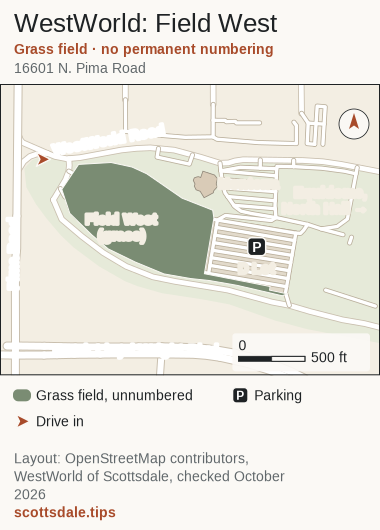
Know which end. The grounds stretch a mile, from Pima Road east to 94th Street and Thompson Peak Parkway. The grass field, Field West, is at the Pima Road end: take WestWorld Road in from Pima and it’s on your left, with D Lot beyond it. The Equidome, North Hall and the barns are at the other end, by 94th Street, and the event signs lead there, so soccer parents should not follow them. The field map above shows the west end.
Barrett-Jackson is a logistics event. The on-site lots fill by mid-morning and Pima backs up to the freeway. Use the remote lots and shuttles, buy the early-week days for the cars without the crush, and read our Car Week survival guide before you go.
The Arabian Show is the underrated visit. A modest gate fee buys the whole grounds for the day: barn aisles open to wander, practice arenas running from dawn, a world-class show in the Equidome by evening. It’s the best way to see WestWorld as the horse facility it was built to be, and the Western heritage guide explains what you’re watching.
Tournament soccer on grass. Field West is unlit natural grass laid out fresh for each event, so the field numbering comes from the organizer’s map, not permanent signs. Shade is scarce; the tournament weekend guide covers what to bring and where the nearest lunch is, and the field maps note has WestWorld next to the city’s three numbered complexes.
Check the corridor calendar. WestWorld shares its corner with TPC Scottsdale and the Fairmont Princess. When the WM Phoenix Open overlaps a horse show or a tournament, the whole intersection becomes an event; the Scottsdale Sports Complex a mile west feels it too.
The RV park. Hundreds of full-hookup sites, reservable, and the reason the same snowbird rigs appear every January. It fills for Barrett-Jackson and the Arabian Show a year out.
Federal land, city stage
WestWorld’s oddest fact is its landlord. The grounds sit on land the U.S. Bureau of Reclamation acquired for the Central Arizona Project, the canal that carries Colorado River water across the state and runs along WestWorld’s edge. The city holds it under agreements with the Bureau signed in 1982 and 1985, for 50 years with a 25-year option, on land the Bureau bought in the 1970s for about $4,500 an acre. A 1991 federal audit faulted the Bureau for taking no rent for it or for the golf courses next door (the TPC land deal page has the story), which is why every conversation about redeveloping, expanding or selling WestWorld runs through Washington as well as City Hall, and why the grounds have stayed grounds while the desert around them filled with resorts and golf.
The site’s evolution tracks the city’s. It opened in the 1980s as Horseman’s Park (1983, 1986 or 1987, depending on the account), a replacement for a horse park the airport runway had displaced, at the northern edge of development; within four years the Princess resort and the TPC courses arrived next door, that were pulling Scottsdale’s center of gravity north. The 1989 arrival of Barrett-Jackson and the Arabian show turned it into a winter economic engine: the two events alone bring hundreds of thousands of visitors and hundreds of millions of dollars into the corridor’s hotels and restaurants each year, which is the argument the city makes every time it invests. The 2014 North Hall, a climate-controlled building roughly the size of an airport terminal, was the biggest of those investments, built to keep an auction that had outgrown its tents from leaving for a rival city.
The tension is what the land should be the other forty-five weeks of the year. Horse shows are WestWorld’s soul and its scheduling backbone, but the business runs on the car auction, the festivals and the RV park, and the polo field’s second life as tournament grass and Phoenix Open parking shows how hard the city works to fill the calendar. Periodic proposals to add a hotel, an arena or a convention center surface and recede. For now WestWorld remains what it has been since 1989: the place the city goes when it needs to hold a hundred thousand people, a thousand horses, or a million dollars’ worth of Corvettes on the same weekend.