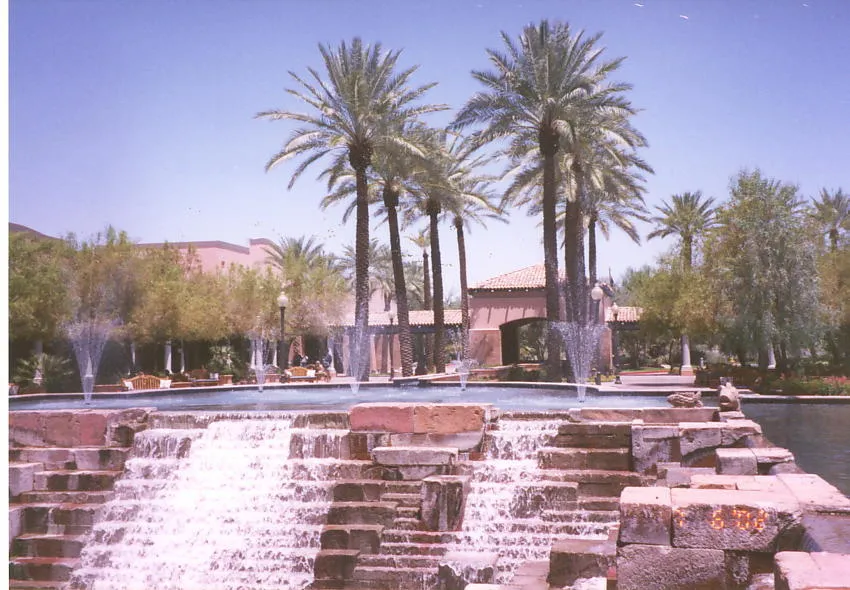

What is the Fairmont Scottsdale Princess?
The Fairmont Scottsdale Princess is what happens when a resort decides its competition isn’t other hotels but the entire concept of an event. Opened in 1987 on what was then far-north desert, it was purpose-built beside the year-old TPC Scottsdale — the stadium golf course created to give the Phoenix Open a permanent home — on the theory that the tournament, the convention trade and north Scottsdale’s growth would all arrive together. All three did, spectacularly.
The architecture is Spanish-colonial at cinematic scale: rose-hued walls, fountains, plazas and a lagoon spread over 65 acres, with roughly 750 rooms across the main building, casitas, villas and newer tower wings. It is the biggest luxury operation in Scottsdale, and — unusually for something this size — it runs on showmanship rather than anonymity.
Twice a year it becomes the center of Arizona. In February, the WM Phoenix Open next door swells past 700,000 attendees and the Princess turns into the tournament’s unofficial capitol — the parties, the players, the corporate hospitality all orbit it. In December, Christmas at the Princess takes over: millions of lights, an ice rink in the desert, a light-tunnel promenade and a musical show over the lagoon that draws more locals than hotel guests.
Between spectacles it’s a family-firepower resort — five pools, waterslides, a huge spa — with a real culinary pedigree: the dining rooms Marquesa and La Hacienda collected national awards for decades, and Bourbon Steak holds the fine-dining line today.
How to do the Princess right
Pick your season like you’re picking a different hotel, because you are. February tournament week is electric, mobbed and priced like a Super Bowl. December is the light festival — magical, busy, family-saturated. March is spring-training-plus-perfect-weather peak. If you want the Princess as a resort rather than an event, aim for early November, early December midweek, or the shoulder weeks of May and October.
Room geography matters at 65 acres. The casitas and villa sections give you quiet and patio life a long walk (or shuttle) from the action; tower rooms put the pools and restaurants at your elbow. Families usually want to be near the water complex; couples should ask for the adults-oriented pool side or the quieter garden wings.
Play the golf angle properly. You can book TPC Scottsdale tee times as a guest — walking the Stadium Course, including the infamous 16th-hole coliseum (empty and silent, eerily), is a bucket-list round even for mid-handicappers. Book far ahead in season.
Eat strategically. Bourbon Steak for the blowout, Toro for Latin energy, and the casual spots for family nights. The resort is big enough that you can never leave — but north Scottsdale’s own scene (The Mission at Kierland, the Market Street spots) is ten minutes out, and Old Town twenty.
Locals’ move for Christmas at the Princess: it’s ticketed for non-guests and sells out around the holidays. Go the first two weeks of December, midweek, right at dusk — full lights, half the crowd.
The bet that built north Scottsdale
The Princess was a real-estate prophecy disguised as a hotel. In the mid-1980s, everything north of Shea Boulevard was empty desert with a road through it. The Phoenix Open’s 1987 move from Phoenix Country Club to a purpose-built stadium course in that emptiness looked like a gamble; building a 600-plus-room Spanish-colonial palace next to it looked like a dare. The city had picked them: while it designed the golf courses it solicited resort proposals nationally, interviewed seven developers and chose Princess Hotels International, and neighboring landowners donated the hotel site. The bet read the map correctly: the 101 freeway would come, the Airpark would boom, and north Scottsdale would become the Valley’s growth engine. The Princess didn’t follow that growth — it seeded it. Within fifteen years, Kierland, DC Ranch and Grayhawk had filled the map around it, each with resorts of their own.
The tournament symbiosis is unique in American golf. Other tour stops have host hotels; the Princess is structurally fused to its event — walkable to the gates, home to the players, sponsors and broadcast crews, and thrower of the week’s biggest parties. As the WM Phoenix Open metastasized into “The People’s Open” (the largest-attended golf tournament on Earth), the Princess rode every wave of it. The resort’s February revenue week is the stuff of industry legend.
For its first two decades the Princess had a second sports week, too. Its stadium court was the home of the men’s tour’s Scottsdale tournament from 1987 to 2005, where Andre Agassi won four titles and Lleyton Hewitt two, until Tennis Channel bought the event and moved it to Las Vegas. The resort’s 2015–16 expansion went up where the courts had been. Our tennis tournament guide has the full list of champions.
The second masterstroke was manufacturing a second high season. Christmas at the Princess began as holiday decor and grew, deliberately, into a ticketed regional festival — the desert’s answer to a snow-town Christmas market. It solved the mega-resort’s eternal problem (December softness) by inventing demand from the local population, and it’s now so embedded that Valley families who’ve never booked a room consider the Princess part of their holiday tradition. Other resorts noticed; none has replicated it at scale.
Culinarily, the Princess pulled off something big resorts rarely do: earning critics’ respect. Marquesa’s Catalan-influenced dining room and La Hacienda’s upscale Mexican both held AAA Four/Five Diamond-tier reputations through the 1990s, proving a convention-scale property could cook. Their spiritual heirs — Bourbon Steak since the Fairmont era — keep the standard respectable.
The honest critique: at 750 rooms, it can feel like a beautiful machine, and peak-season pricing is aggressive. But judged as what it set out to be — the Southwest’s great spectacle resort — the Princess has no real rival. The Phoenician has the address and the drama; the Princess has the show.