What is Reata Sports Complex?
If you have to spend a Saturday watching U-10s chase a ball, do it somewhere with scenery.
Reata Sports Complex is 29 acres of tournament turf in the corner where McDowell Mountain Ranch Road meets Thompson Peak Parkway, with WestWorld next door and the McDowell Mountains filling the eastern sky. It has five lighted fields, all international size, sand-based and watered with reclaimed water, under LED lights. The city finished it in March 2024, and in its first year it hosted 16 events.
The thing to understand before you drive here is the numbering. Scottsdale runs its three tournament complexes as one system and counts the fields straight through: 1 to 10 at the Scottsdale Sports Complex on Princess Drive, 11 to 16 at Bell94 on Bell Road, and 17 to 21 here. So a schedule that says Field 19 means Reata, and a schedule that says Field 6 means you are at the wrong park.
Beyond the fields it keeps things simple: paths, a playground, restrooms, two parking areas. The neighborhood supplies the rest, with McDowell Mountain Ranch Park and its aquatic center right across the parkway.
Finding your field
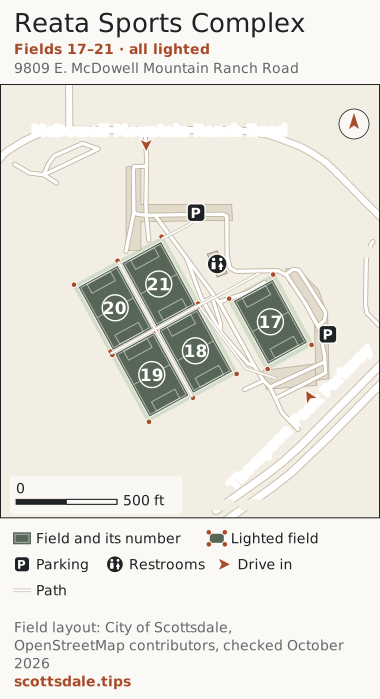
The map above is the whole answer, but here it is in words. Fields 18 to 21 sit in one block set on the diagonal and split down the middle by a walkway that runs from southwest to northeast. Field 20 and Field 21 are on the north side of that walkway, 20 to the west. Field 19 and Field 18 are on the south side, 19 to the west. Field 17 stands alone to the east, across the paths from 21 and 18. The restroom and office building is in between, just northeast of Field 21.
Parking. There are two ways in. The drive from McDowell Mountain Ranch Road leads to the north lot, the shorter walk for 19, 20 and 21. The drive from Thompson Peak Parkway leads to the east lots, the shorter walk for 17 and 18. On a full tournament morning both fill, so arrive a half-hour before your first game, and if the lot you wanted is full, take the other one rather than circling; nothing here is more than a few minutes’ walk. The lots also earn their keep in January and February, when the city uses Reata as overflow parking for Barrett-Jackson and the WM Phoenix Open, so check those dates before you book a field.
Shade and weather. The fields have none. Canopies are the local uniform from October to April, and in summer the complex follows the desert rulebook: early morning or under the lights, nothing in between.
Between games. McDowell Mountain Ranch Park is across Thompson Peak Parkway, with a skatepark, a playground and the aquatic center for siblings who have watched enough soccer. The Preserve’s Gateway Trailhead is a short drive north up Thompson Peak Parkway for the parent who wants a real walk.
Where to eat. Flo’s on Thompson Peak Parkway is a few minutes south and feeds a team without fuss. The Thumb, the barbecue joint in a gas station across Bell Road from Bell94, is the best post-game meal in this part of town. For the team dinner, Market Street at DC Ranch is about ten minutes north, with Fleming’s and The Living Room for the parents. Our tournament weekend guide covers hotels, the heat and the rest, and the field maps note has all three complexes side by side. If the team wants tacos, start with our Mexican list.
A parking lot that learned to play
Reata went in on unused public desert beside WestWorld, and it was given a double life from the start. When voters approved the 2019 bond for new sports fields, the city built Reata to be a tournament complex most of the year and overflow parking when WestWorld and the Phoenix Open come calling, the same deal it struck at Bell94 up the road. Sand-based turf over a gravel drainage layer is what lets grass take a parked car and still play like a field the next week.
The result is the most legible of the three complexes. The Scottsdale Sports Complex grew up in pieces around Princess Drive; Bell94 lines its six fields up along one lot. Reata is a single tilted block of four and one stand-alone field, with the building in the middle and parking at two corners. It’s also the most scenic: the McDowells sit right behind the east goals, and an evening game under the lights with the mountains going purple is about as good as youth sports gets in the Valley.
A $21 million field complex this close to the mountains could easily have been an HOA amenity. Instead it’s city property with a public booking number, where any league in Scottsdale can reserve a Friday night. Third-act Scottsdale gets a lot of grief for its gates. Reata is the counter-argument, striped into five fields.