
What is Eldorado Park?
Before there was a Greenbelt, there was Eldorado.
Eldorado Park covers 60 acres of the Indian Bend Wash at Miller Road and Oak Street, and it’s the oldest trick in Scottsdale’s book — literally. Opened in 1967 as the city’s first major community park, it was built on wash land the city acquired in 1966 (55 acres at the start, by Joan Fudala’s account) as a working prototype: proof that the flood channel everyone wanted to pave with concrete could instead be grass, lakes and ballfields that flood gracefully a few days a year. The demonstration worked, the Greenbelt followed, and half of south Scottsdale’s personality descends from this park.
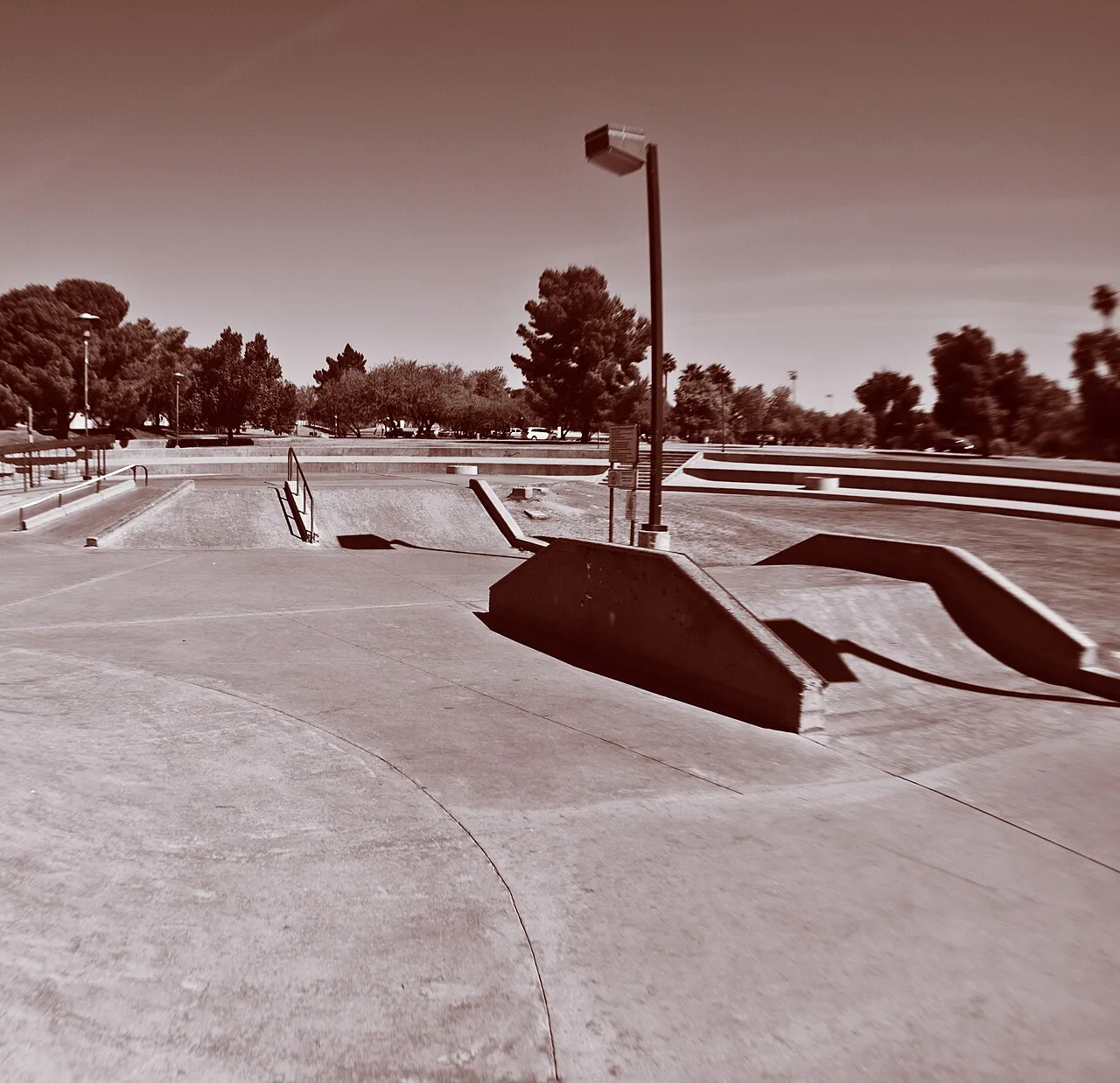
Six decades in, Eldorado is still doing the everyday work. There’s a stocked fishing lake on the state’s Community Fishing Program, ballfields and soccer turf, sand volleyball, playgrounds under genuinely old trees, a community center, and two institutions with their own gravitational pull: the Eldorado Aquatic & Fitness Center, whose heated pool and 13 lap lanes stay open all winter while the rest of the Valley’s pools drain, and The Wedge — the 1999 skatepark that a whole generation of Arizona skaters treats as holy ground.
It’s less manicured than Chaparral, more lived-in, and more loved for it. The Greenbelt path runs right through, so cyclists coast past little-league games the way they have since Nixon was president.
How to do Eldorado right
Pick your entrance. The park stretches long and narrow along the wash, so where you park decides your day. The Miller Road lots serve the aquatic center and The Wedge; the Oak Street side gets you to the lake, ramadas and playgrounds with less walking. Cyclists don’t park at all — the Greenbelt path delivers you into the middle of the park from Vista del Camino to the south or Old Town’s latitude to the north.
Fish the pond like you mean it. Eldorado Pond is stocked through Arizona Game & Fish’s Community Fishing Program — channel catfish spring through fall, rainbow trout in the cool months, with resident sunfish and largemouth bass between deliveries. License required at age 10 and up; buy it online before you come. The first two or three days after a stocking are comically productive.
Swim in winter, on purpose. The aquatic center’s heated pool is the quiet superpower here: 13 short-course lanes, lap swim and lessons running right through December while every resort guest in town shivers. Check the city’s facility schedule — lap lanes share time with programs.
The Wedge has its own etiquette. It’s free and unsupervised. Mornings belong to kids learning to drop in; evenings belong to locals who’ve skated it for twenty-five years. Watch before you roll, and bring lights-out patience in summer, because nobody touches the concrete between 10 a.m. and sunset from June through September.
Summer reality: shade trees help, but this is south Scottsdale asphalt-adjacent heat. Dawn for the lake and fields, the pool for midday, the skatepark after dark. And note that the city has been reinvesting in the park in recent years — sections occasionally close for construction, so check the city’s park page before planning a big group day.
The prototype that saved the city
Eldorado exists because Scottsdale needed to win an argument. In the 1960s the Army Corps of Engineers looked at the flooding Indian Bend Wash and proposed the standard cure: a seven-mile concrete channel through the center of town. City hall and a stubborn coalition of residents countered with something no agency had blessed before — leave the wash open, green it, and let parks absorb the floods. Talk was cheap; the Corps wanted proof.
So in 1967, on land the city had bought in the wash the year before, Scottsdale built its proof and let the public name it. Six hundred schoolchildren entered the naming contest; “Eldorado” won, and the winners collected the most 1967 prize imaginable — free yearly passes to the new park’s swimming pool. The park flooded when the wash ran, drained, and went back to hosting ballgames, exactly as promised. That demonstration, repeated storm after storm, is what turned a civic fantasy into the $54 million, 11-mile Greenbelt dedicated in April 1985 — with Eldorado as its firstborn. Every green acre at Chaparral, Vista del Camino and Indian School is downstream of what got proven here, and the city’s whole flood-control saga starts in the 1960s.
The park kept picking up eras like tree rings. The aquatic center made it south Scottsdale’s swim school. The community center made it a meeting hall. And in 1999 the city poured The Wedge, giving skateboarders — then still treated mostly as a code-enforcement problem — a legal, serious park of their own. A quarter-century later The Wedge is an institution with regulars in their forties, and it quietly repeated Eldorado’s founding trick: take an activity the city didn’t know where to put, give it real ground, and watch it become civic culture.
Why it matters
Flagship parks usually announce themselves. Eldorado doesn’t — it’s the working-class elder of the Greenbelt chain, a little frayed at the edges, busy in four languages on a Saturday, heated pool steaming in January. But it’s the most historically important park in Scottsdale after the Greenbelt itself, because it’s where the city first bet that infrastructure could be a place you’d actually want to spend a Sunday. Fifty-plus years of Sundays say the bet paid.