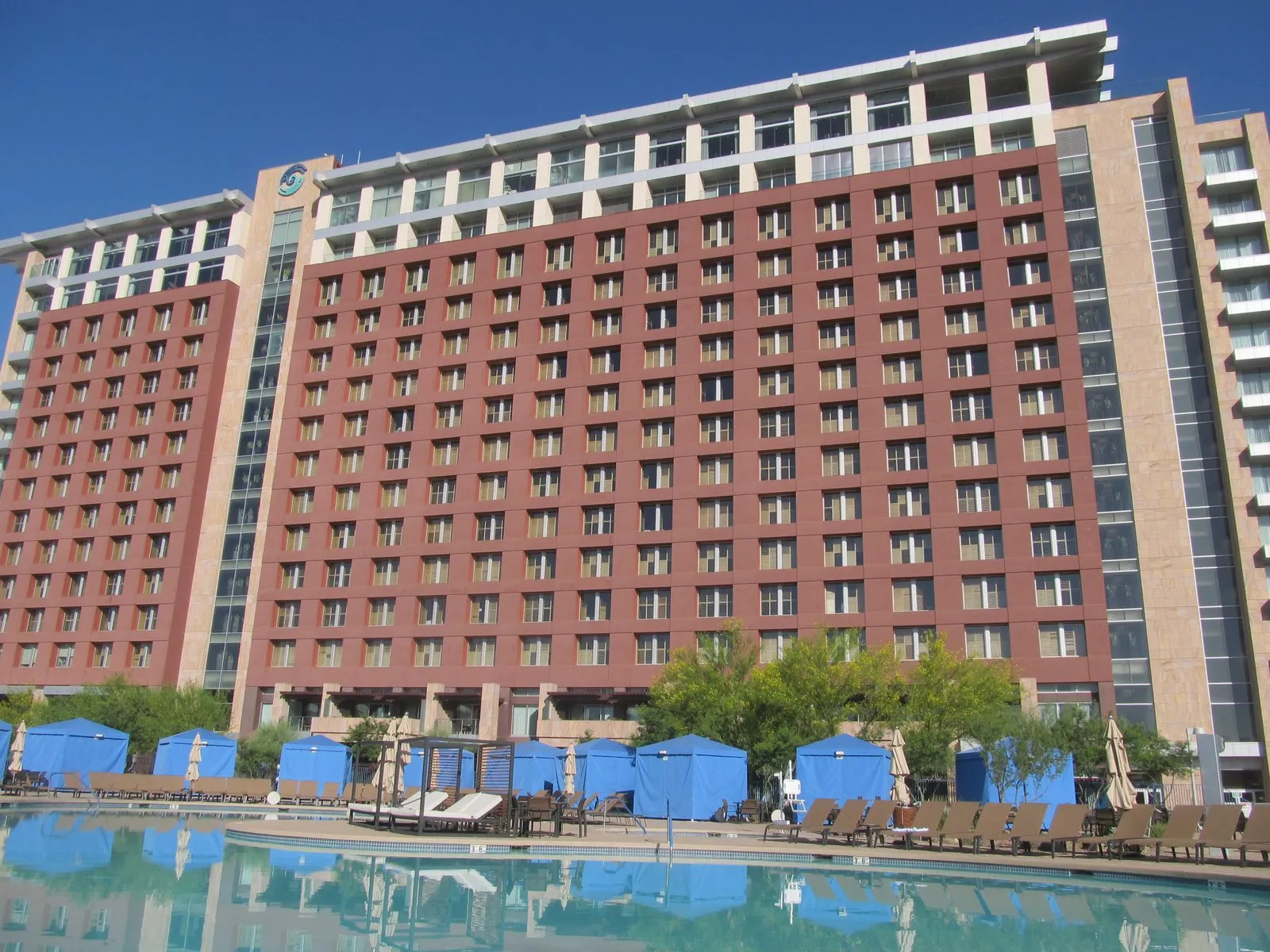

What is Talking Stick Resort?
Drive east on any cross street in central Scottsdale and the horizon does something un-Scottsdale: it grows a skyline. The 15-story twin wings of Talking Stick Resort — opened April 2010 on the sovereign land of the Salt River Pima-Maricopa Indian Community — are the tallest things for miles in a market that zoned itself low forever, and they announce a different theory of the desert resort: not hush and casitas, but voltage.
The engine is the casino — roughly 240,000 square feet of gaming, the state’s showcase floor. Around it the community built a genuine full resort: 496 rooms with some of the best high-floor views in Arizona, pools with a swim-up blackjack-adjacent energy, a spa, showroom entertainment that pulls national acts, golf at Talking Stick Golf Club (a Coore–Crenshaw design, quietly one of the Valley’s best), and Orange Sky, the 15th-floor dining room whose sunset panorama over Camelback has no local rival.
The name is not decoration. It honors the O’odham calendar stick — a carved record of community history — and the property carries one of the state’s significant collections of Native art, with the community’s Pima and Maricopa heritage present throughout.
What’s grown around it since 2010 is the real story: Salt River Fields (spring training’s gold standard), Topgolf, OdySea Aquarium and Butterfly Wonderland make the Talking Stick district the Valley’s entertainment zone — with the resort as its glowing center, priced a full tier below what the west side of the 101 charges.
How to do Talking Stick right
Decide what trip you’re on. Talking Stick is a great casino resort and a mediocre serenity resort — that’s not a flaw, it’s the format. Book it for energy: game nights, concerts, fight watch parties, bachelor-party logistics, spring training. Book Camelback Inn for silence.
High floor, west face. Ask for it. The Valley-and-Camelback panorama from the upper rooms is the amenity nobody prices correctly, and sunset from your window beats most paid experiences in town.
Orange Sky is mandatory. The 15th-floor dining room is the building’s crown — steaks and seafood with a 270-degree sunset. Reserve the patio-side tables 45 minutes before golden hour even if you only do drinks.
Golf the sleeper. Talking Stick Golf Club’s two Coore–Crenshaw courses are understated, walkable, wind-tested designs that golf architecture nerds rate above several famous Scottsdale names — and tee times run cheaper than the trophy tracks.
March math. Salt River Fields next door means Cactus League crowds (Diamondbacks and Rockies) claim the whole district in spring training season. It’s the best time to be here and the worst time to book late — plan months out, and expect the pool scene at full roar.
Mind the calendar both ways. Fight nights and headline concerts electrify the floor and jam the valet; quiet-seeking midweekers should check the entertainment schedule and steer around the spikes — or into them.
Sovereignty, skyline, and the district that changed the east side
Talking Stick is the most visible chapter of one of the Valley’s most consequential economic stories: the Salt River Pima-Maricopa Indian Community’s decision to develop its western edge — the land facing Scottsdale across the 101 — into a diversified entertainment economy. The community (Akimel O’odham and Xalychidom Piipaash peoples, farming this river valley for centuries before Scottsdale existed) had watched the city’s resort boom from across an invisible line for decades. Gaming compacts in the 1990s changed the math; Casino Arizona (1998) proved the demand; and the 2010 resort was the graduation — designed, financed, owned and governed by the community itself, no outside flag on the tower.
The building rewrote the region’s physical logic. Scottsdale’s aggressive height limits had kept the market horizontal since the 1960s; sovereign land isn’t bound by them, so the 15-story tower gave the area its first true high-rise resort views — a product literally unbuildable on the other side of the freeway. That asymmetry (plus casino-subsidized room rates) created a structural niche no Scottsdale property can contest.
Then came the district play, executed with patience: Salt River Fields (2011) — the first spring-training complex on tribal land, instantly the Cactus League’s benchmark — followed by Topgolf, OdySea, Butterfly Wonderland and retail. The strategy diversified beyond gaming while making the resort the anchor tenant of a destination that now pulls millions of visits a year. Regional planners study it; Scottsdale’s east-side hotels quietly feed off it.
The cultural dimension deserves more attention than reviews give it. The calendar-stick name, the commissioned art throughout the tower, the community’s history presented on its own terms — this is the rare Arizona resort where Native heritage is ownership, not theming. Paired with Great Wolf Lodge up the road (another community land development), the Salt River corridor now represents the fastest-evolving hospitality zone in the metro.
Honest ledger: the casino’s sensory field reaches most public spaces, service is efficient rather than pampering, and serenity-seekers will be miserable. Judged as what it is — the Southwest’s most complete casino resort inside a self-built entertainment district — it’s a landmark achievement, and the glowing tower on Scottsdale’s horizon is the community’s history writing its newest chapter in lights.